
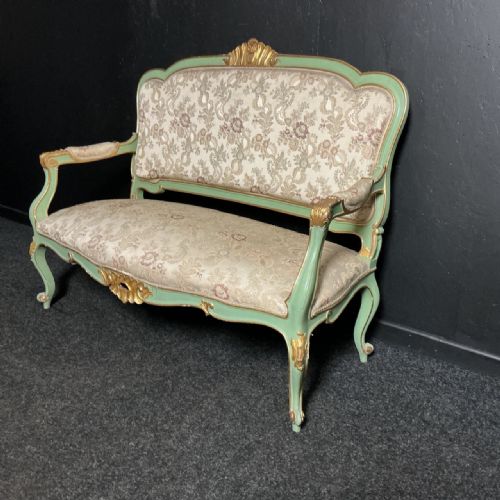
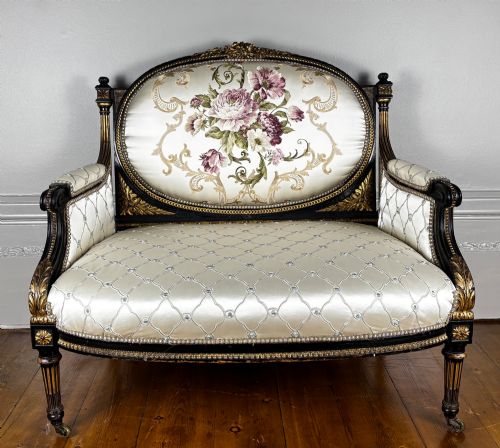


French Two Seat Sofa
A french two seat sofa offers intimate seating with historic continental flair, spanning gilded frames to painted woodwork.
French Two Seat Sofa
When searching for a french two seat sofa, buyers encounter compact settees, canapes, and boudoir seats built for two people. The pieces here span the nineteenth century through to the mid twentieth century, drawing heavily on classical French monarchical styles.
Louis XV and Louis XVI designs dominate the selection, featuring characteristic curved cabriole legs or straight fluted supports. Many items appear as smaller salon pieces, window seats, or compact couches suitable for boudoirs and drawing rooms.
How they were made
Carpenters shaped frames from dense hardwoods like walnut, mahogany, fruitwood, and beech, frequently applying giltwood, paint, or ebonisation to the surfaces. Carving ranged from simple foliate motifs to elaborate rococo scrolls.
Upholstery methods utilised traditional stuffing finished with textiles such as silk, velvet, tapestry, needlepoint, and toile de jouy. Alternatively, many frames incorporated woven cane panels for a lighter seat back and base.
Materials in these listings span walnut, mahogany, fruitwood, and giltwood alongside applied cane and diverse historical textiles.
What varies in quality
The distinction between standard and superior pieces lies in the crispness of the timber carving and the originality of the surface finish. Hand-carved walnut frames with intact original gilding or authentic period paint sit at the upper end of the scale.
Structural integrity of the joinery and the survival of period textiles, such as hand-stitched needlepoint or tapestry, define the better examples. Lesser pieces often show later re-gilding or replaced frame elements that obscure the original maker's hand.
The French Two Seat Sofa Glossary
- Canape
- A traditional French settee or sofa featuring an upholstered seat and back built on an exposed wooden frame. These pieces often display elaborate carved woodwork along the crest rail.
- Giltwood
- Timber coated with a thin layer of gold leaf over a prepared base. This finish appears frequently on formal nineteenth-century salon seating.
- Canework
- Woven rattan or cane panels utilised for the backrests and seats of light framed chairs and settees. It provides a breathable surface popular in period French furniture.
- Ormolu
- Cast bronze ornaments finished with mercury gilding and mounted onto furniture frames. They highlight the corners and aprons of high-status neoclassical pieces.
- Bergere
- An enclosed upholstered armchair or small sofa featuring solid wooden sides filled with upholstery or cane work. The design provides a cosy, sheltered seat.
French Two Seat Sofa: Frequently Asked Questions
Where did people use these small sofas?
These compact seats found places in private chambers, intimate salons, and dressing rooms rather than grand reception halls.
Their scale made them ideal for window alcoves and smaller sitting spaces where a full-sized settee would overwhelm the floor plan.
How do I identify a Louis XV style frame?
Louis XV pieces rely on asymmetrical curves, cabriole legs, and organic floral carvings without straight architectural lines.
The woodwork typically flows smoothly from the crest rail down to the feet, reflecting the rococo taste for natural movement.
Are these sofas suitable for daily sitting?
Period frames provide sturdy seating, but nineteenth-century internal webbing and padding often require professional conservation for regular modern use.
Buyers planning daily lounge seating should check the condition of the internal springs and support foundations before purchase.
What is the difference between a settee and a canape?
A settee is a general English term for a wide seat for two or more people, while a canape specifically denotes a French-design sofa with an exposed wooden frame.
Canape frames generally exhibit more pronounced regional French carving styles and curved profiles.