


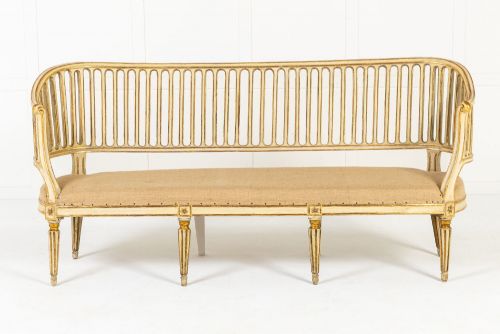


Cream Painted Wooden Settee
A cream painted wooden settee brings lightness and neoclassical elegance to a room, offering generous seating rooted in centuries of European design traditions.
Cream Painted Wooden Settee
A cream painted wooden settee is a upholstered or timber bench built for multiple sitters, drawing on forms from the eighteenth and nineteenth centuries. These pieces span continental movements, including Gustavian, Swedish Rococo, and French provincial styles.
The versions most commonly met here originate from French, Swedish, and Italian workshops, reflecting classical design vocabularies. Makers built them using pine and hardwood frames finished in pale painted surfaces, often paired with exposed woodwork.
Forms range from double and triple back configurations to bergere styles and settle benches. They bridge formal reception rooms and casual spaces, serving as functional seating with distinct historical character.
Materials and construction
Frames are constructed primarily from solid wood, including pine and decorative timbers such as satinwood, shaped into curved and straight structural members. Artisans applied layers of paint directly to the timber, often distressing or layering the surface to achieve a weathered aesthetic.
Upholstery techniques integrate traditional support systems beneath coverings of fabric, linen, and hessian. Caning frequently appears on panelled backs and seats, providing a lighter texture that complements the painted wooden frames.
Some eighteenth-century Swedish settlers doubled as family sleeping quarters when the farmhouse hearth went cold at night.
Assessing craftsmanship and finish
Quality reveals itself in the crispness of the wood carving and the integrity of the structural joinery. Fine examples display well-proportioned frames where decorative motifs integrate harmoniously into the structural lines rather than appearing applied as an afterthought.
The application and preservation of the painted surface dictate visual appeal, distinguishing carefully built period pieces from later interpretations. Original paint layers that show natural ageing and wear hold greater fidelity to historical precedent than heavy modern refinishing.
The Cream Painted Wooden Settee Glossary
- Gustavian
- The Swedish interpretation of French neoclassical design, characterised by restrained carving, fluted legs, and pale painted finishes. This style emerged during the late eighteenth century under King Gustav III.
- Bergere
- An enclosed upholstered armchair or settee featuring wooden frames and upholstered sides. The back is typically a single padded unit integrated with the arms.
- Settle
- A wooden bench with high backboards, solid arms, and often a storage box beneath the seat. Early examples provided protection from drafts in large halls.
- Satinwood
- A durable hardwood native to Ceylon and India, known for its golden lustre and fine grain. Cabinetmakers utilised it extensively during the Sheraton Revival period for high-status furniture.
- Neoclassical
- A Western cultural movement drawing inspiration from the classical art and architecture of ancient Greece and Rome. It prioritises symmetry, straight lines, and classical motifs such as urns and swags.
Cream Painted Wooden Settee: Frequently Asked Questions
What periods do these settees come from?
The pieces span the eighteenth, nineteenth, and early twentieth centuries. Surviving examples include items from the 1700s alongside later Victorian and Edwardian revivals.
Craftsmen across these eras reproduced continental aesthetics, meaning nineteenth-century workshops frequently manufactured pieces in earlier Louis XV or Swedish Rococo styles.
How were these settees used historically?
Owners placed these seating items in formal salons, parlours, and drawing rooms for entertaining guests. Their decorative frames were designed to be viewed from multiple angles within a room.
Simpler variants like settle benches also served in domestic halls and farmhouses, offering communal seating close to hearths while blocking cold drafts.
How do I care for painted wooden furniture?
Protect the painted surfaces by keeping the furniture away from direct sunlight and sudden temperature fluctuations. Dust gently with a dry or slightly damp cloth without harsh chemical cleaners.
Maintain stable indoor humidity to prevent the underlying timber from expanding or contracting, which preserves both the wood joints and the painted finish.
How do I distinguish regional styles?
Swedish and Gustavian pieces typically feature restrained neoclassical lines, minimal carving, and pale cream or grey paintwork. French designs such as Louis XV styles often display more elaborate cabriole legs and asymmetrical floral carvings.
Italian variants incorporate bolder architectural elements and distinct regional interpretations of classical ornamentation.