
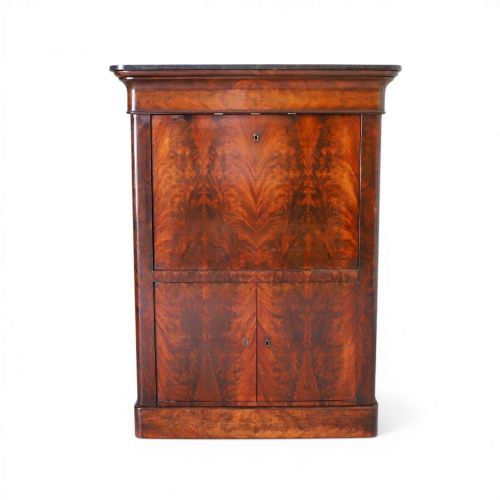
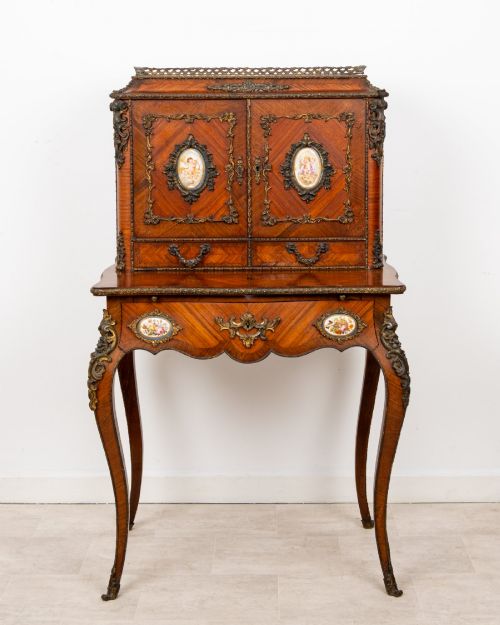
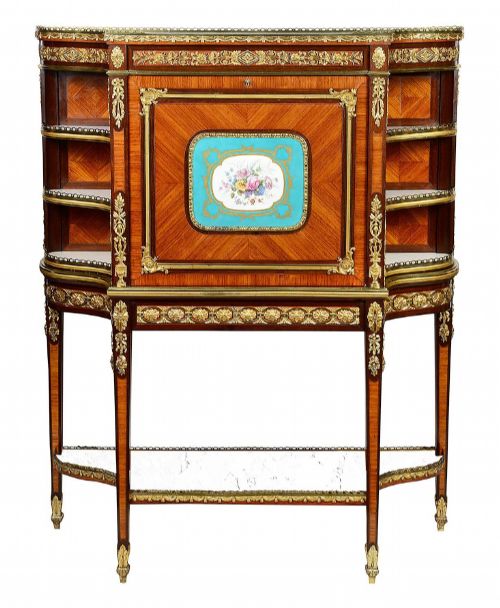
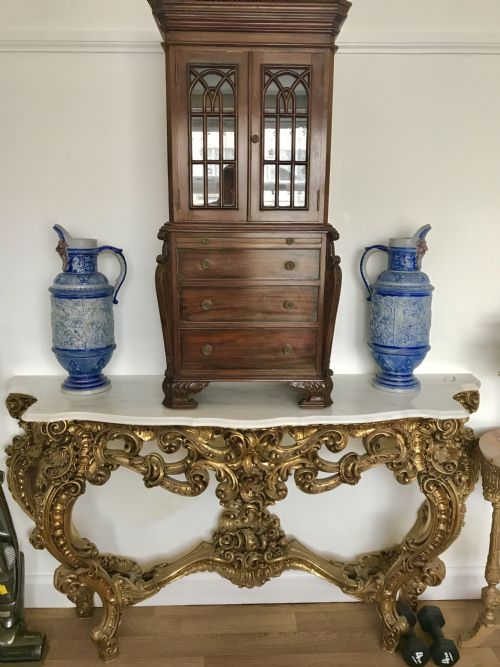

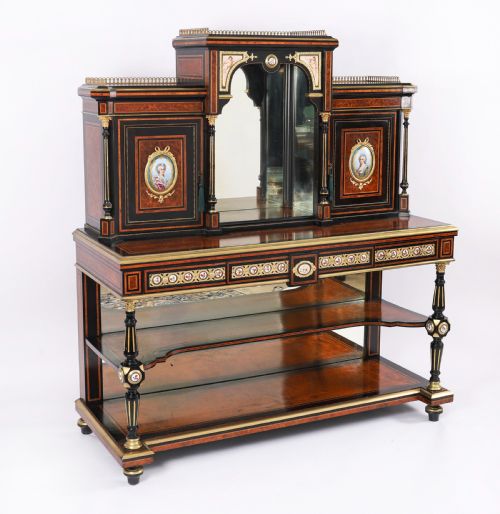


French Style Writing Cabinet
A french style writing cabinet brings continental elegance to a study, offering concealed compartments and refined surfaces for correspondence.
Evaluating Quality
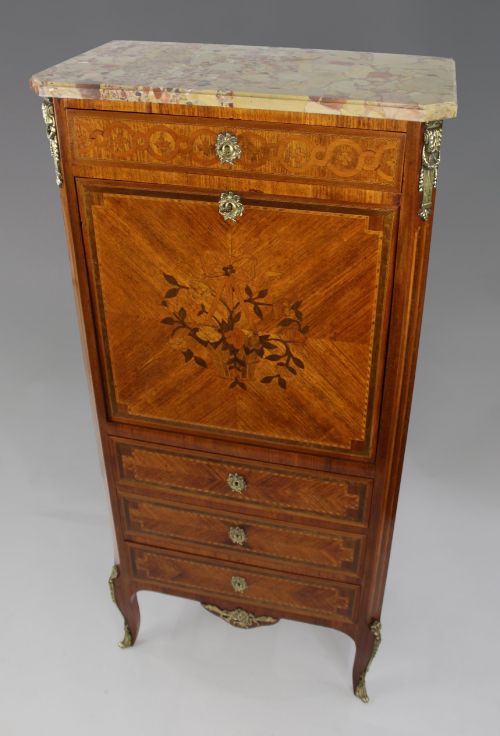
Quality rests upon the crispness of the gilt bronze mounts and the precision of the veneer work, where superior examples exhibit seamless matching across curved and flat surfaces. Hand-chased ormolu displays sharp relief rather than soft casting, and marquetry retains tight, hairline joints without excessive filler.
The interior architecture reveals the maker's hand through secondary timbers, the smooth action of secret drawers, and the integration of original marble tops or porcelain plaques. Finer pieces demonstrate consistent patination across the timber and well-fitted internal stationery compartments that align perfectly when closed.
Mercier Frères·Blake London·Edwards and Roberts·Jean Werner·Millet
The French Style Writing Cabinet Glossary
- Bonheur du jour
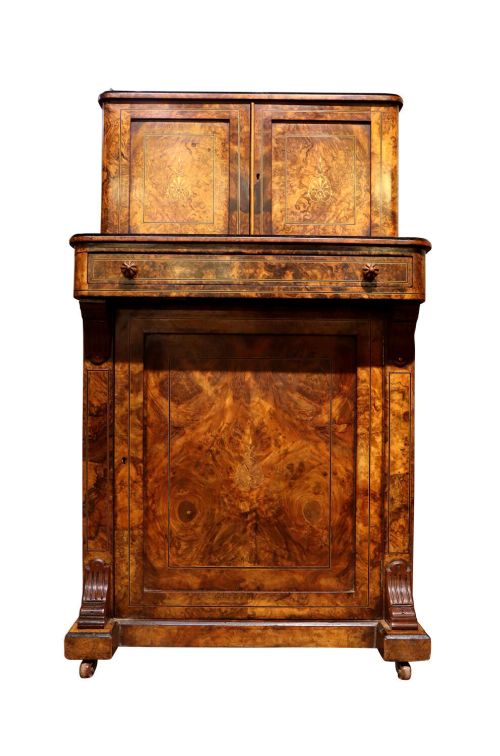
- A small, light ladies writing desk featuring a tiered superstructure with drawers, shelves, or a cabinet above the main writing surface. It became particularly fashionable during the nineteenth century revival periods.
- Secrétaire à abattant
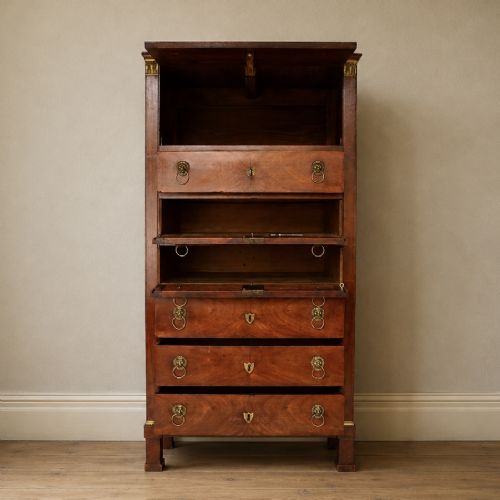
- An upright tall cabinet featuring a hinged fall-front writing flap that conceals an interior arrangement of small drawers and pigeonholes. When closed, it presents the appearance of a standard tall chest or cabinet.
- Ormolu
- Gilt bronze mounts applied to furniture for decorative enrichment, cast and chased by hand to produce a rich metallic finish. It frames panels and highlights the structural lines of revival pieces.
- Marquetry
- Decorative veneer work formed by fitting together small pieces of different coloured wood, ivory, or metal to create pictorial or geometric designs. It is meticulously glued to the carcase timber.
- Vernis Martin
- A type of simulated Japanese lacquer developed in France, utilised to create translucent painted panels on cabinet doors and writing desks. It provides a glossy, decorative surface finish.
Listings feature eighteenth and nineteenth century periods, incorporating walnut, kingwood, ormolu, and porcelain materials across desks and cabinets.
French Style Writing Cabinet: Frequently Asked Questions
What is a bonheur du jour?
A bonheur du jour is a small, portable ladies writing desk featuring a tiered superstructure with drawers and shelves above the writing surface.
First appearing in France, these desks were designed for intimate correspondence and boudoir use before becoming popular across nineteenth century Europe.
How do I use a secrétaire à abattant?
A secrétaire à abattant operates by unlocking and lowering the vertical front panel to create a horizontal writing ledge.
This drop-down mechanism reveals a fitted interior of small drawers and compartments while keeping private papers concealed behind the closed door.
Where should I place a writing cabinet?
These cabinets suit studies, drawing rooms, or bedrooms where their compact proportions and decorative surfaces can be appreciated.
Keep them away from direct sunlight and strong heat sources to protect delicate veneers, marquetry, and polished wood finishes.
How do I identify French revival styles?
French revival styles are identified by specific decorative motifs and structural forms that echo earlier royal periods like Louis XV and Louis XVI.
Look for cabriole legs and asymmetrical curves in Rococo pieces, or straight tapered legs, neoclassical columns, and symmetry in Louis XVI examples.