
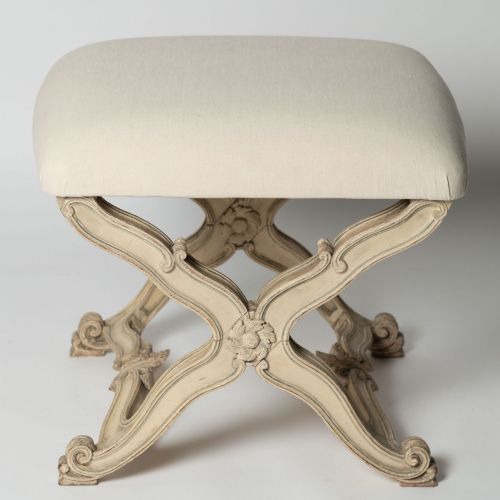
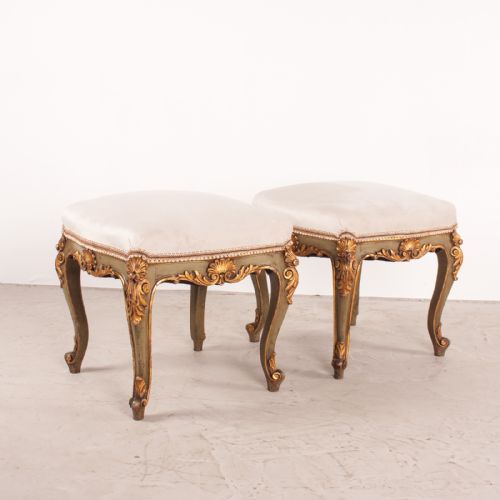


French Style Painted Stool
These French style painted stool examples bring continental seating to a room through carved woodwork and painted finishes.
French Style Painted Stool
A french style painted stool sits within a tradition of continental seating spanning the nineteenth century through the nineteen thirties. These forms include long benches, circular boudoir seats, and adjustable piano stools constructed from wood and upholstered in fabric or linen.
The aesthetic draws heavily from Louis XV, Louis XVI, and Regence revivals alongside French provincial and continental rococo designs. Makers utilise painted, gilt, and carved surfaces to create decorative seating for bedrooms, windows, and living spaces.
Buyers encounter single pieces alongside matched pairs featuring brass details and screw top mechanisms. The scale ranges from compact footstools to very large window seats suitable for dual use as coffee tables.
Materials and construction methods
Wood forms the primary structure of each french style painted stool, with beech and carved timber providing the framework for upholstered tops. Craftsmen apply paint and gilding directly to the wooden frames to achieve decorative continental finishes.
Upholstery uses fabric and linen stretched over padded seats, sometimes complemented by brass fittings and adjustable screw mechanisms. Hand carving defines the structural details across nineteenth century and early twentieth century examples.
Several stools double as tables when a magazine lands on top.
Distinguishing quality in decoration and form
Quality rests upon the depth of hand carving and the finesse of the painted surface across the wooden frame. Superior examples display crisp architectural details in the Louis style tradition rather than simplified mouldings.
The integrity of the original paint and the proportion of the seating geometry separate standard utilitarian items from decorative salon pieces. Better specimens maintain cohesive upholstery choices that complement the carved woodwork.
The French Style Painted Stool Glossary
- Louis XV Style
- A design movement characterised by asymmetrical curves, natural motifs, and flowing lines originating from eighteenth century French taste. This aesthetic reappears frequently in nineteenth century revival seating.
- Regence Style
- An architectural and decorative transition phase preceding rococo, featuring robust carving and symmetrical symmetry. Pieces in this style display heavier structural lines.
- Gilt Painted
- A surface treatment combining paint with metallic gold leaf application to accentuate carved wooden details. This finish heightens the decorative presence of continental seating.
- Boudoir Stool
- A small, often circular seat designed for private dressing rooms and bedrooms. These compact items frequently feature upholstered tops and painted frames.
French Style Painted Stool: Frequently Asked Questions
Where do I put a french style painted stool?
These pieces fit naturally at the foot of a bed, beside a dressing table, or beneath a window as a low seat.
Larger long variants also function as impromptu coffee tables or magazine stands in sitting rooms.
How do I clean the painted wood?
Dust the carved wooden frame gently with a dry, soft cloth to protect the painted and gilded surfaces.
Avoid liquid cleaners and harsh chemicals that might degrade nineteenth century or early twentieth century finishes.
Are these stools comfortable for sitting?
Most pieces feature padded upholstery covered in fabric or linen designed for resting or dressing.
Boudoir and piano stools provide firm seating support suited for short periods at a vanity or instrument.
How do I identify a Louis XVI style stool?
Look for straight tapered legs, neoclassical symmetry, and carved fluting rather than the curved lines of earlier rococo designs.
These pieces often incorporate circular or oval seat shapes with painted wooden frames.