
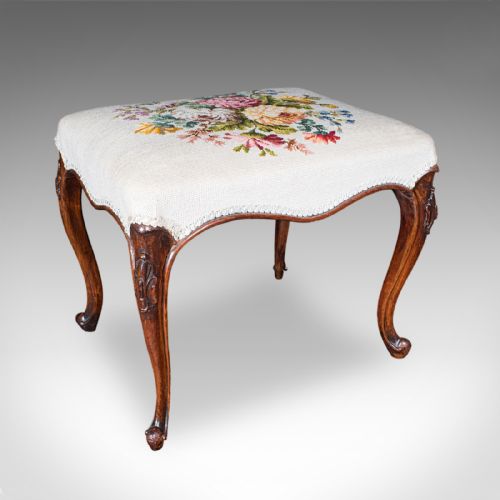
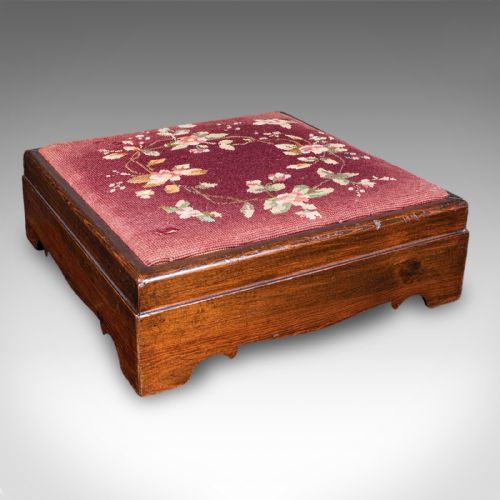


Floral Needlepoint Footrest
A floral needlepoint footrest brings warmth and texture to a room, offering a practical seat upholstered in stitched wool.
Floral Needlepoint Footrest
A floral needlepoint footrest is a low seat designed to support the feet while seated in an armchair or fireside chair. The pieces seen on this page range across multiple periods, including the eighteenth century, Victorian era, and Edwardian period.
Most examples take the form of small stools or low ottomans with upholstered textile tops. Buyers frequently encounter nineteenth-century interpretations alongside revival styles that imitate earlier cabinet-making traditions.
Materials and construction
Makers built the frames of these pieces using various hardwoods such as walnut, mahogany, pitch pine, oak, and ebonized timber. These wooden supports provide the structural foundation for the upholstered seats.
The decorative top surfaces utilise wool tapestry and needlepoint textile work. Brass fittings occasionally appear on specific designs, while painted finishes decorate certain frames.
The periods represented in these listings span from eighteenth-century examples to pieces made in the early twentieth century.
Variations in quality
Quality rests in the crispness of the timber carving and the tightness of the joinery within the frame. Finer examples display carefully selected hardwoods and precise execution in revival styles.
The needlepoint upholstery also dictates the standard of the piece, where even stitching and well-composed floral patterns elevate the visual merit of the textile top.
Whytock and Reid
The Floral Needlepoint Footrest Glossary
- Needlepoint
- A type of counted thread embroidery stitched onto an open-weave canvas. It forms the durable floral imagery seen on the top of these footrests.
- Tapestry
- A form of textile art woven on a loom or worked by hand. It provides a heavy decorative surface for traditional seating.
- Pitch Pine
- A dense resinous softwood utilised in furniture construction during the nineteenth and early twentieth centuries. It offers sturdy support for domestic furnishings.
- Ebonized
- Wood treated with a dark finish to imitate expensive ebony. This process was particularly popular during the Victorian era for formal pieces.
Floral Needlepoint Footrest: Frequently Asked Questions
How are floral needlepoint footrests used?
These pieces function primarily as supports for the feet when resting in a chair. They also serve as low spare seats or decorative accessories in a traditional interior.
Their compact size allows them to sit neatly beside fireside chairs or under tables when not in use.
How do I care for wool needlepoint upholstery?
Wool textiles require gentle maintenance to preserve the coloured threads. Regular light vacuuming through a mesh attachment removes surface dust.
Keep these footrests out of direct sunlight to prevent the dyed wool from fading over time.
How can I tell a Victorian stool from an Edwardian one?
Victorian examples often feature heavier carved timber frames, dark ebonized finishes, or rich rosewood construction. The upholstery frequently displays dense floral needlework.
Edwardian pieces tend toward lighter woods like pitch pine and simpler structural lines reflecting changing domestic tastes.
What is a Queen Anne style footrest?
This style references the design vocabulary of the early eighteenth century, characterised by curved wooden lines. Revival versions appeared in later periods such as the early twentieth century.
They bring classic historical form to domestic seating without necessarily dating from the original reign.