



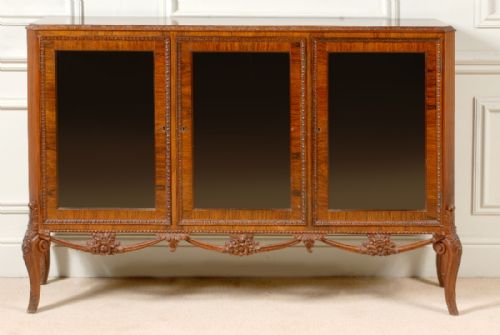


French Rosewood Credenza
A french rosewood credenza brings striking grain patterns and gilt mounts into a room, offering both display space and concealed storage.
French Rosewood Credenza
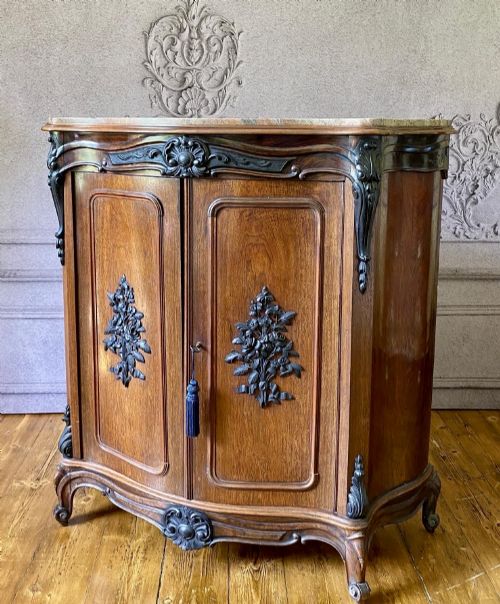
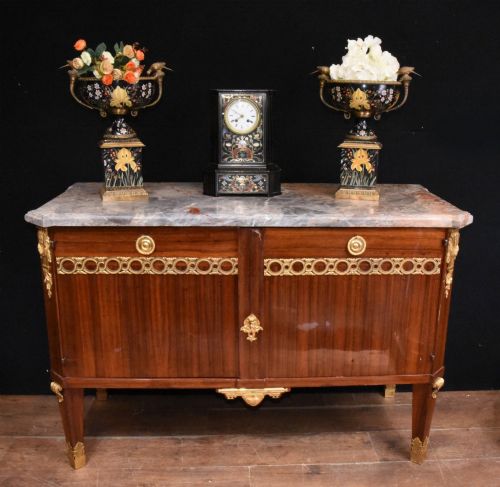
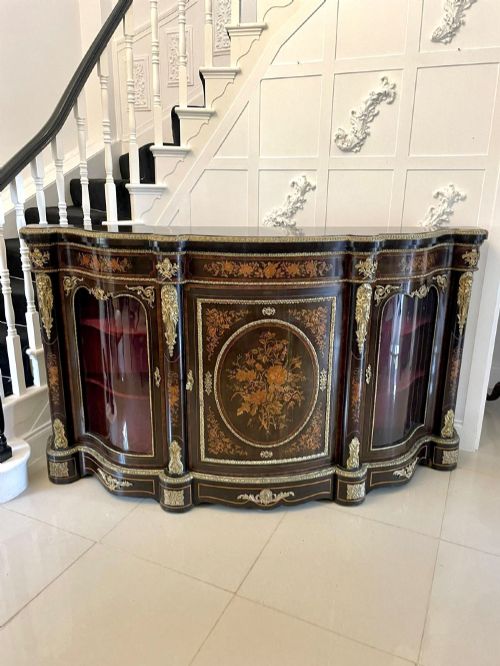
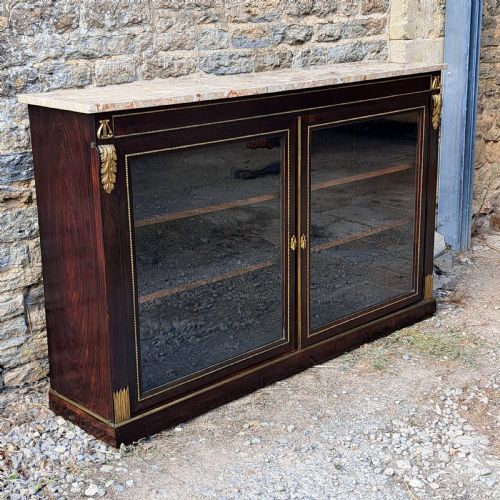
The versions most commonly found here display nineteenth-century origins, often following Victorian, Louis XVI, or French Rococo revival styles. They frequently incorporate marble tops, glazed doors, or intricate marquetry alongside the primary timber.
Object types stretch from traditional credenzas and sideboards to smaller pier cabinets, bookcases, and table-top display pieces. Each variation provides a specific proportion and layout suited to different spatial requirements.
Materials and construction
Makers utilised rosewood as the primary carcass and veneer timber, often supplemented by kingwood, mahogany, and ebony for contrasting detail. These woods were selected for deep colour variation and striking grain patterns.
Decorative embellishments rely heavily on cast or chased ormolu mounts, brass inlays, and boullework details secured to the wooden structure. Marble slabs frequently form the upper surface, providing a durable and decorative counterpoint to the timber below.
Selected examples integrate porcelain plaques, such as Sevres inserts, or incorporate glass panels within glazed doors for display purposes. Marquetry and floral inlay work add pictorial depth to door panels and friezes.
French Rosewood Credenza Retail Price Guide 2026
Typical asking prices for french rosewood credenza among the pieces listed under this phrase on Sellingantiques today, from the lower quarter to the upper quarter. They describe what is for sale here now, not the wider market.
Even miniature tabletop credenzas appear, offering all the grand ormolu detailing of a full-sized salon cabinet in miniature.
Distinctions in quality
Quality separates pieces through the precision of the marquetry and the crispness of the cast ormolu mounts applied to the frame. Superior examples demonstrate tight joints, symmetrical grain alignment, and harmonious proportions.
The choice of secondary materials, such as heavy marble tops and genuine porcelain plaques rather than painted substitutes, elevates the status of the cabinet. Finer execution in the inlay work and ebony or brass detailing indicates higher workshop standards.
Mercier Frères
The French Rosewood Credenza Glossary
- Credenza
- A low cabinet or sideboard designed for display and storage, often featuring a central door flanked by glazed compartments. It traditionally stands against a principal wall in a reception room.
- Ormolu
- Gilt bronze mounted onto furniture as decorative feet, escutcheons, and corner mounts. This technique provides a contrasting metallic sheen against dark rosewood.
- Marquetry
- Inlaid wood veneers arranged in geometric or floral patterns across the surface of the cabinet. Master craftsmen cut these pieces to fit precisely together before gluing them to the carcass.
- Boulle
- A form of marquetry utilising tortoiseshell and brass or pewter, named after the famous cabinetmaker. It creates an ornate, reflective surface pattern.
- Meuble d'appui
- A French term for a standing support cabinet of medium height, typically fitted with doors and shelves. These function as serving surfaces or display pieces.
French Rosewood Credenza: Frequently Asked Questions
What is a french rosewood credenza used for?
These cabinets serve as principal storage and display surfaces in formal reception rooms and dining areas.
Interior shelving accommodates porcelain, glassware, or linens, while the flat top surface holds lamps, clocks, or decorative objects.
How do I care for rosewood furniture?
Rosewood benefits from stable indoor humidity levels and protection from direct sunlight to prevent the timber from fading.
Regular dusting with a dry, soft cloth maintains the finish without requiring heavy polishes or chemical treatments.
Are marble tops original to these cabinets?
Many nineteenth-century side cabinets and credenzas were manufactured with fitted marble slabs to provide a durable and luxurious upper surface.
These tops sit directly upon the wooden framing, often shaped to follow the serpentine or breakfront contours of the carcass.
How can I tell different revival styles apart?
Louis XVI revival pieces generally display neoclassical symmetry, straight tapered legs, and restrained ormolu mounts.
In contrast, Louis XV and Rococo revival styles favour asymmetrical curves, serpentine shaping, and flowing floral marquetry.