




French Revival Writing Table
A french revival writing table brings eighteenth-century court elegance into nineteenth-century domestic spaces.
French Revival Writing Table
A french revival writing table encompasses nineteenth-century desks, centre tables, and bureau plats drawing on earlier Louis styles. The pieces found here span Victorian interpretations alongside continental examples from the mid to late nineteenth century.
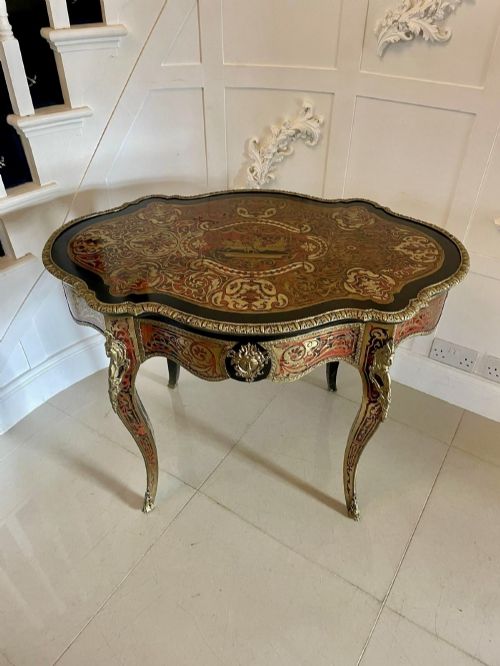
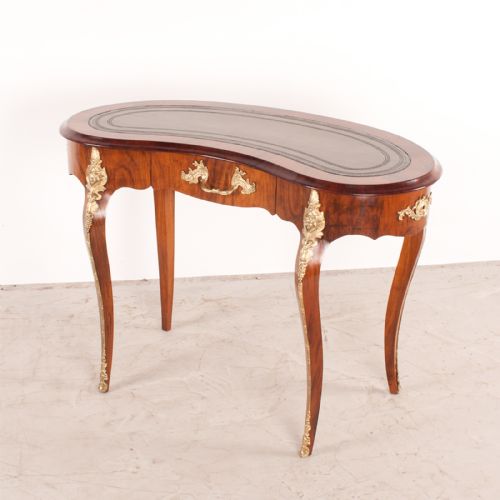
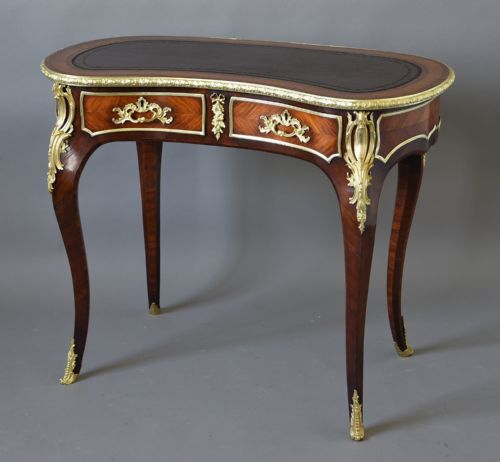
The common forms include kidney-shaped writing tables, serpentine desks, and freestanding centre tables designed to sit away from walls. Makers adapted historic silhouettes for Victorian and continental interiors, combining workspace with decorative presence.
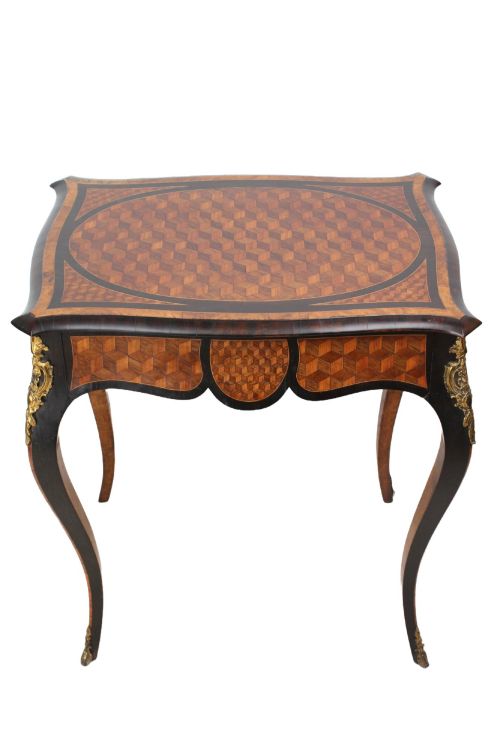
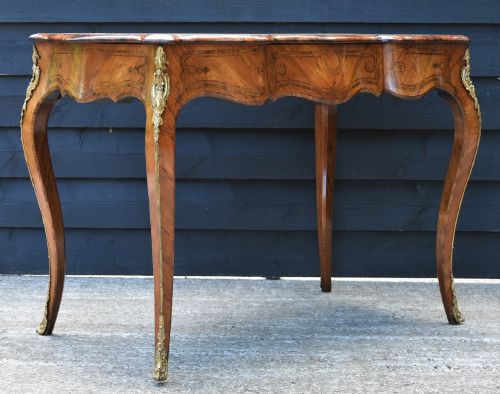
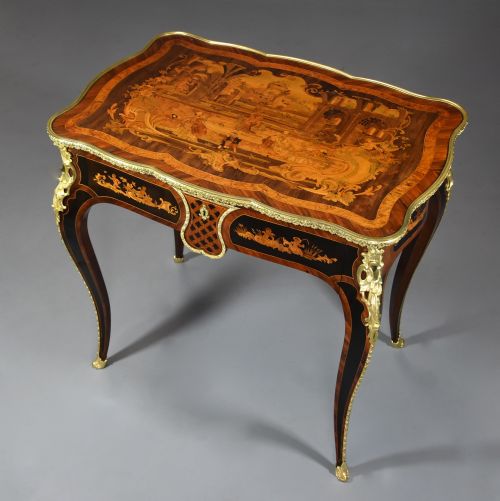
Examples on this page frequently utilise rich timbers like kingwood, walnut, and rosewood, often enhanced with marquetry and parquetry. These desks served functional writing roles for ladies and gentlemen while displaying intricate craftsmanship.
Materials and construction
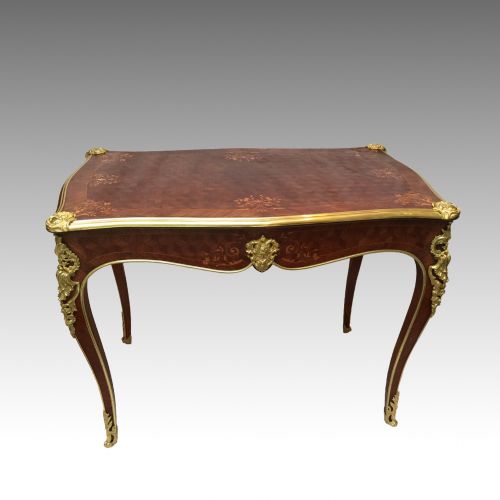
Cabinet makers constructed carcass frames from timbers like walnut, mahogany, and satinwood, applying decorative veneers of kingwood, rosewood, and burr walnut over the surfaces. Parquetry and floral marquetry designs utilised contrasting woods to create geometric or pictorial patterns across the tops and drawer fronts.
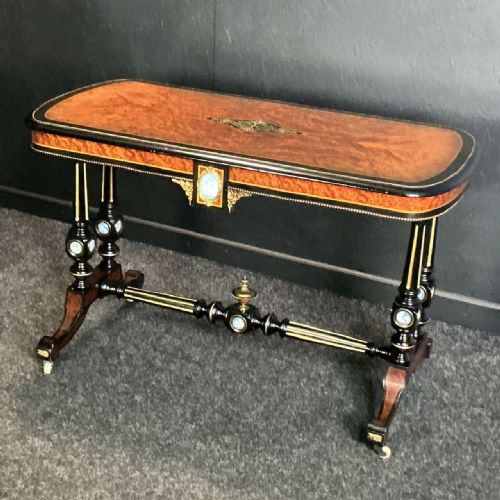
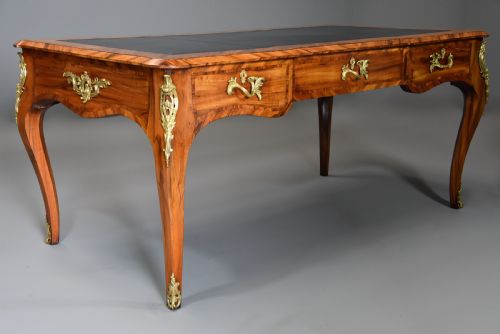
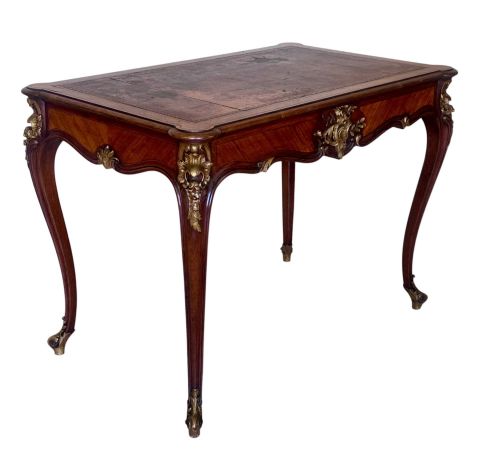
Mounts in cast ormolu and gilt bronze outlined drawers and corners, while brass inlay accented ebonised woods. Leather writing surfaces, sometimes tooled with gold, provided a functional writing plane inside framed borders.
The listings show nineteenth-century writing tables utilising kingwood, walnut, and satinwood with ormolu mounts.
The spectrum of quality
Quality rests in the precision of the timber matching and the crispness of the bronze or ormolu mounts. Finer examples show hand-chased metalwork and complex parquetry that follows compound curves without gaps.
The handling of secondary timbers inside drawers and the fluidity of serpentine shaping distinguish standard production from master workshops. Signed pieces by established makers carry evidence of meticulous planning in every structural joint.
JAS Shoolbred·CH Jeanselme and Co·Donald Ross·Holland and Son·Edwards and Roberts·Alphonse Tahan
The French Revival Writing Table Glossary
- Bureau plat
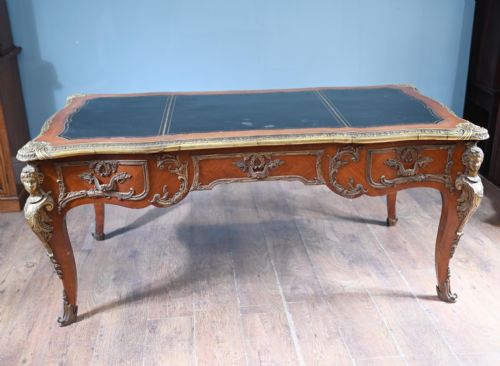
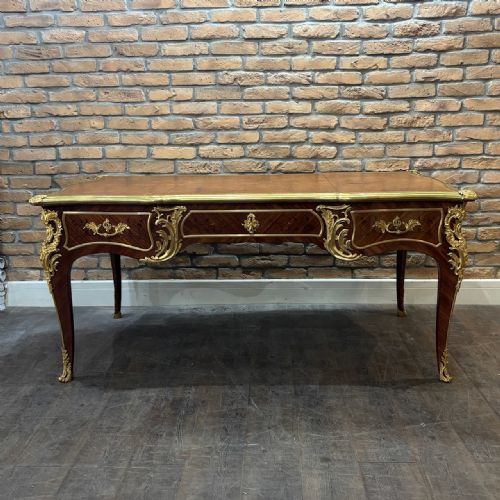
- A freestanding flat-topped writing desk fitted with drawers along the frieze. These tables were designed to stand in the centre of a room rather than against a wall.
- Ormolu
- Gilt bronze mounts applied to furniture edges, corners, and legs. This cast metalwork added decorative contrast to dark woods.
- Marquetry
- Inlaid patterns formed from pieces of various coloured woods applied to a carcass. Craftsmen created floral or pictorial scenes across the writing surface.
- Parquetry
- Geometric wood inlay forming repeating patterns such as cubes or lozenges. This technique decorated table tops and drawer fronts.
- Kidney shape
- A curved desk profile resembling a kidney bean. This form allowed the user to sit closer to the central writing space.
French Revival Writing Table: Frequently Asked Questions
Where did these tables sit?
These pieces functioned as freestanding furniture placed in the middle of reception rooms or parlours. Their finished backs allowed them to occupy prominent central positions rather than staying pushed against walls.
In domestic settings, they served as writing desks or occasional tables where inhabitants managed correspondence and displayed decorative objects.
How do I spot revival styles?
Revival pieces combine eighteenth-century forms with nineteenth-century manufacturing methods and timber choices. Look for machine-cut elements alongside hand-chiselled ormolu mounts typical of the Victorian era.
Maker labels and specific veneer combinations often point to nineteenth-century workshops imitating earlier Louis XV or Louis XVI aesthetics.
What is a bureau plat?
A bureau plat is a rectangular writing table featuring a finished top inset with leather and drawers built into the frieze. These desks were intended to sit away from the wall to display decoration on all four sides.
Cabinet makers frequently embellished these forms with ormolu mounts and parquetry patterns across the corpus.
How should I care for leather?
Leather writing surfaces require gentle cleaning with a dry or slightly damp cloth to prevent drying and cracking. Avoid harsh chemical cleaners that strip the original gold tooling along the borders.
Maintaining stable room humidity protects both the leather insert and the underlying wood veneers from warping.