


French Revival Chest Drawers
These French revival chest drawers bring Continental elegance into a room, offering both decorative presence and practical storage through classic Revival forms.
French Revival Chest Drawers
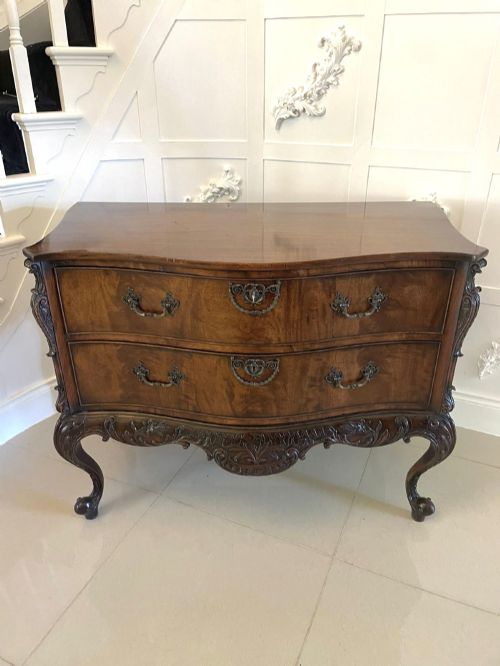
When you search for French revival chest drawers, you encounter a selection of commodes, bedside chests, and dressing tables originating from the nineteenth and early twentieth centuries. These pieces adopt the ornate aesthetic of earlier French royal courts, primarily drawing on Louis XV and Louis XVI design vocabularies.
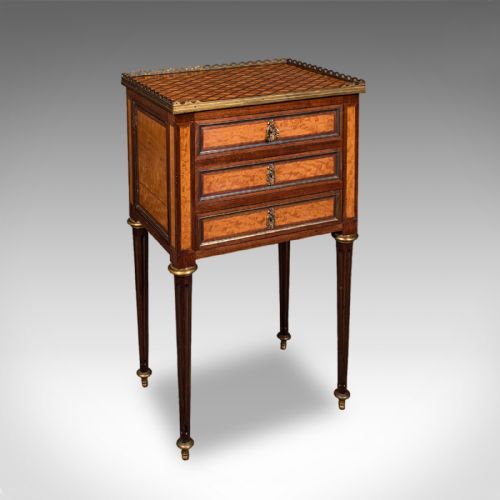
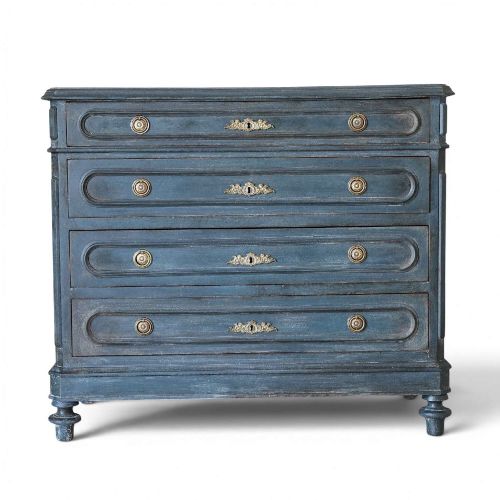
The objects listed on this page span several decades, featuring Victorian interpretations alongside pieces made in France around eighteen-eighty. Forms range from narrow bedside cabinets to serpentine commodes with multiple drawers, often accompanied by matching marble surfaces.
Buyers seeking this style find a mix of robust mahogany and walnut constructions alongside more elaborate marquetry pieces veneered in exotic timbers. Each item adapts continental proportions for domestic storage, maintaining the curved lines and gilt mounts characteristic of the revival movement.
What varies in quality
The distinction between standard and superior examples lies in the precision of the marquetry work and the weight of the bronze or brass mounts. Finer pieces display crisp hand-chasing on the metal hardware and tightly fitted timber veneers that follow complex curves without splitting.
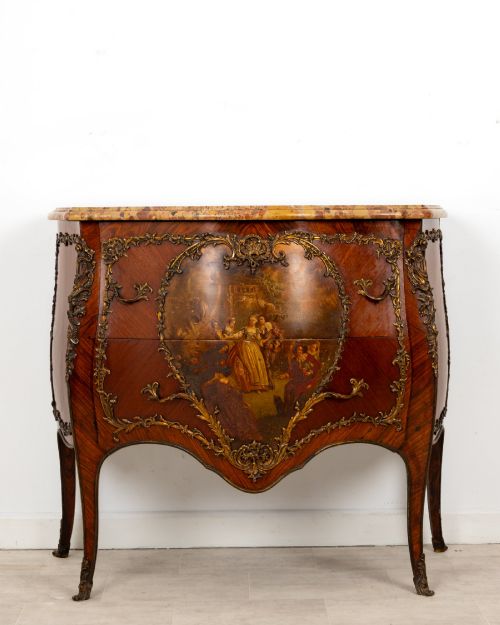
Materials also dictate the tier of the piece, with genuine marble tops and intricate vernis martin panels marking out the more ambitious workshop productions. The fluidity of the serpentine shaping and the integration of the drawer structure into the overall facade determine the visual success of the commode.
Listings feature periods from the nineteenth century up to nineteen-twenty, alongside Victorian interpretations.
The French Revival Chest Drawers Glossary
- Commode
- A low chest of drawers, often highly ornamented, originating in France during the eighteenth century and revived in later periods. These pieces frequently feature marble tops and decorative marquetry.
- Marquetry
- The art of applying pieces of veneer to a structure to form decorative patterns and pictures. Makers utilise various exotic timbers to achieve tonal contrast.
- Ormolu
- Gilt bronze ornamentation applied to furniture mounts, feet, and handles. The technique involves coating cast bronze in a layer of gold amalgam.
- Serpentine
- A furniture shape characterised by a wavy outline with a convex centre flanked by concave curves. This contour requires skilled carpentry to execute on drawer fronts and marble tops.
- Vernis Martin
- A type of simulated Japanese lacquer developed in France, used to decorate panels on fine commodes. The finish involves multiple layers of varnish applied over painted designs.
French Revival Chest Drawers: Frequently Asked Questions
What is a French revival chest?
A French revival chest is a nineteenth or early twentieth-century piece of furniture that mimics the opulent styles of Louis XV and Louis XVI. These items often feature curved fronts, marquetry, and marble tops.
Craftsmen produced them to satisfy a Victorian and Edwardian desire for continental elegance in domestic interiors. They function primarily as decorative storage units in bedrooms and living spaces.
How do I clean marble top commodes?
Marble surfaces require gentle cleaning with a damp cloth and mild, non-acidic soap to preserve the polished finish. Avoid harsh chemicals and citrus cleaners that can etch the stone.
Dry the surface thoroughly after wiping to prevent water spots. Polishing occasionally with a specialised stone wax helps maintain the sheen.
Are these chests practical for daily use?
These chests offer functional drawer storage suitable for clothing, linens, or general household items. The internal wooden construction operates much like standard modern cabinetry.
Care should be taken with older drawer runners and delicate veneer surfaces during frequent use. Placing them away from direct heat sources protects the timber and glue joints.
How do I identify Louis XV and Louis XVI styles?
Louis XV style pieces, often linked to Rococo revival, feature asymmetrical curves, serpentine lines, and ornate floral mounts. The overall appearance is flowing and organic.
Louis XVI style shifts towards neoclassical restraint, displaying straight lines, symmetry, fluted columns, and geometric marquetry patterns. Both styles utilised rich veneers and gilt bronze hardware.