


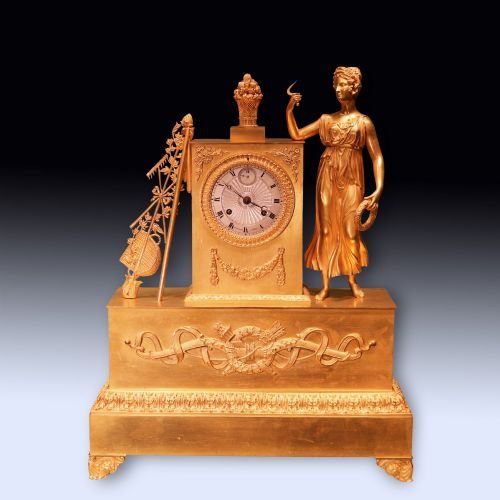


French Restoration Period Clock
A French restoration period clock brings nineteenth-century elegance and architectural precision to a mantelpiece.
French Restoration Period Clock
When you search for a French restoration period clock, you encounter nineteenth-century timepieces shaped by the transitional decades of the early eighteen-hundreds. These objects include portico clocks, figural mantel pieces, and architectural designs that reflect classical tastes.
The versions most commonly met on this page date from the early nineteenth century, spanning periods recorded as Regency, Victorian, and eighteen-fifty. They often combine classical gilt bronze with contrasting patinated elements and marble bases.
Makers and regional styles recorded in the titles range from Paris workshops to specific creators such as Canaillor, Ravrio, and Baltazart. Their work demonstrates the transition from French Empire severity toward Louis Philippe and Chinoiserie or Turkish tastes.
Materials and construction methods
These clocks rely on metalworking traditions that combine cast ormolu and gilt bronze with patinated bronze elements. Guild artisans shaped these materials into intricate figures, columns, and mounts.
Enamel feature prominently on the clock dials, providing a crisp surface for numerals alongside glass covers that protect the movement. Cases integrate materials such as white marble, rouge marble, and occasionally mahogany woodwork.
Movements are built for eight-day operation, housing brass mechanisms within heavy metal or stone housings. Textile components occasionally appear as part of the internal suspension or decorative display.
French Restoration Period Clock Retail Price Guide 2026
Typical asking prices for french restoration period clock among the pieces listed under this phrase on Sellingantiques today, from the lower quarter to the upper quarter. They describe what is for sale here now, not the wider market.
The decorative vocabulary spans French Empire, Chinoiserie, Louis Philippe, and Turkish taste variations.
Assessing quality and execution
Quality in these clocks rests upon the crispness of the bronze chasing and the depth of the gilding. Superior examples display sharply defined figural modelling and balanced proportions across architectural portico frames.
The integration of materials dictates the tier of the piece, where solid marble bases and well-matched ormolu mounts elevate the object. Finer clocks incorporate named maker signatures and detailed subsidiary decorative programmes like Chinoiserie or orientalist motifs.
Canaillor of Paris·Ravrio·Baltazart
The French Restoration Period Clock Glossary
- Ormolu
- Gilded bronze produced by applying a mercury and gold amalgam to a bronze base and heating it. This technique creates a durable, luminous golden surface characteristic of nineteenth-century French luxury goods.
- Portico clock
- A clock featuring an architectural case supported by four or more columns, resembling a classical temple facade. This form gained popularity during the early nineteenth century.
- Patinated bronze
- Bronze treated with chemical solutions to produce a dark, weathered, or coloured surface finish. It often contrasts with bright gilt or ormolu mounts on figural mantel clocks.
- Louis Philippe
- A mid-nineteenth-century French style characterised by comfortable restraint and revivalist tendencies. It succeeds the stricter geometries of the Empire period.
- Enamel
- A glassy substance fused to a metal dial substrate through high-temperature firing. It provides a smooth, wipe-clean surface for painted clock numerals.
French Restoration Period Clock: Frequently Asked Questions
What is a French portico clock?
A portico clock is an architectural timepiece structured around vertical columns that support a central dial housing. These designs draw inspiration from classical Greek and Roman temples.
They stand out on a mantelpiece due to their open, airy frames and symmetrical arrangement of gilt bronze and marble.
How do I date these clocks?
Dating relies on stylistic clues, materials, and maker signatures recorded on the dial or movement backplate. Early nineteenth-century examples often display Empire neoclassical traits or architectural portico forms.
Later Victorian and Louis Philippe iterations introduce softer decorative lines and regional exoticism such as Turkish or Chinoiserie tastes.
Where were these clocks made?
The vast majority originate from workshops in Paris, which served as the capital of European horology during the nineteenth century. Master bronze-smiths and clockmakers collaborated to produce the gilded cases and mechanical movements.
Some pieces reflect broader French provincial output or specific cabinet-making traditions involving mahogany and marble.
How do I care for gilt bronze?
Gilt bronze and ormolu require gentle dusting with a soft, dry brush to prevent the accumulation of dirt in recessed chasing. Avoid liquid cleaners, polishes, or abrasive cloths that can strip the delicate gold amalgamation.
Keeping the clock away from direct sunlight and excessive humidity preserves both the metalwork and the enamel dial.