
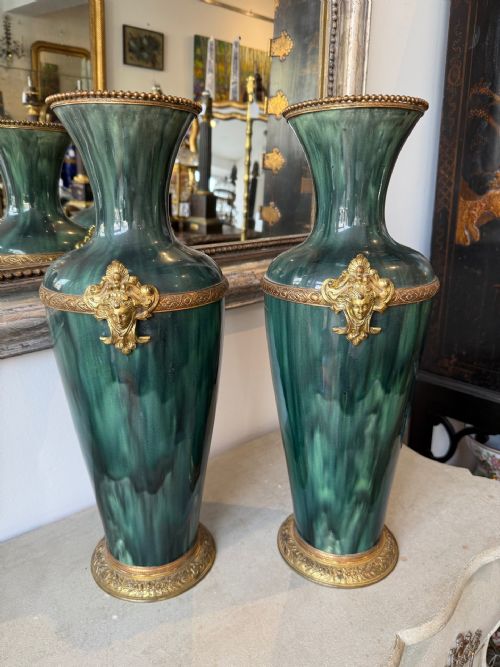
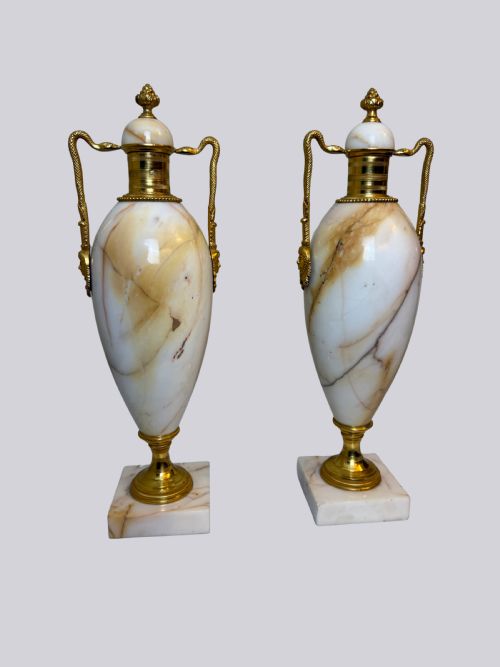

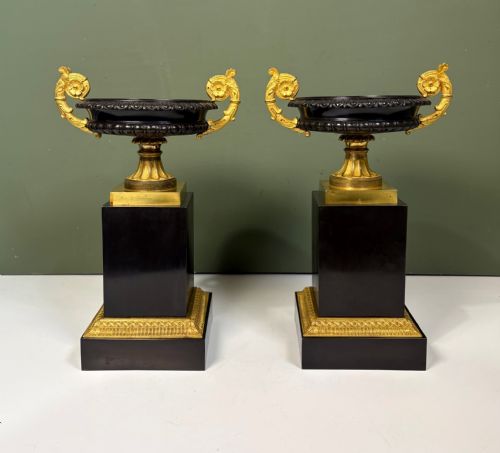
French Ormolu Mantel Urns
French ormolu mantel urns bring together nineteenth-century gilt metalwork, porcelain and marble to anchor a traditional interior.
French Ormolu Mantel Urns
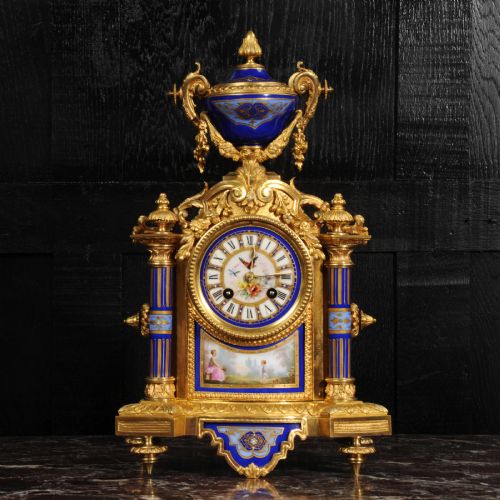
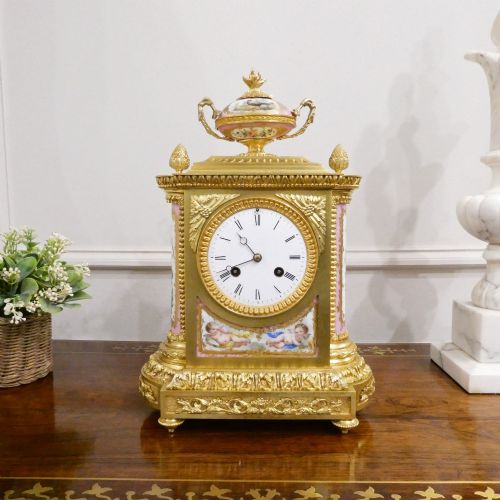
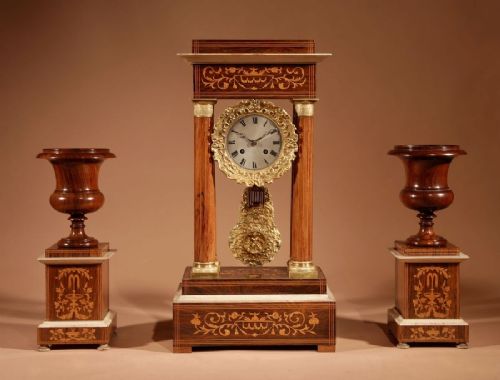
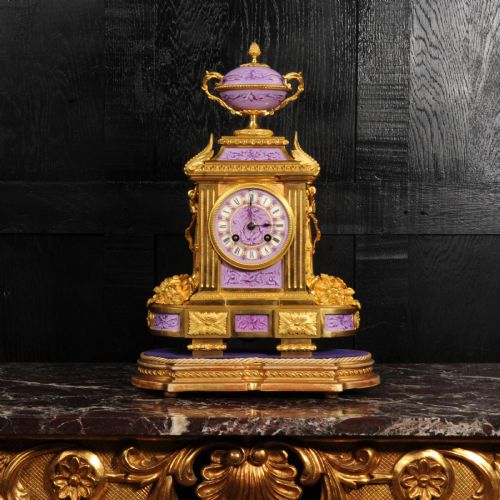
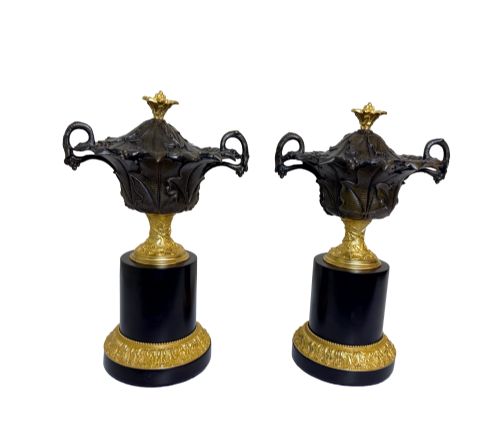
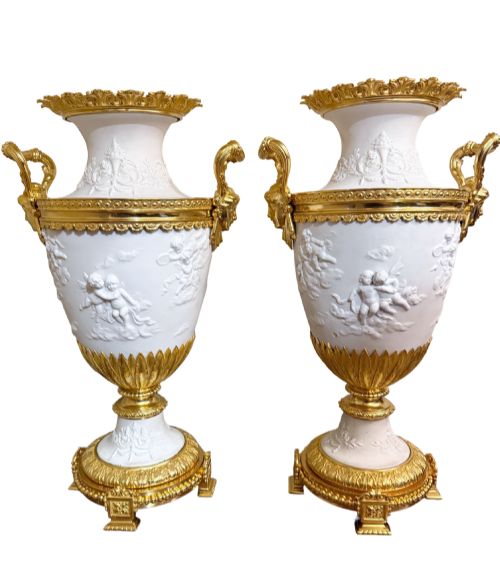
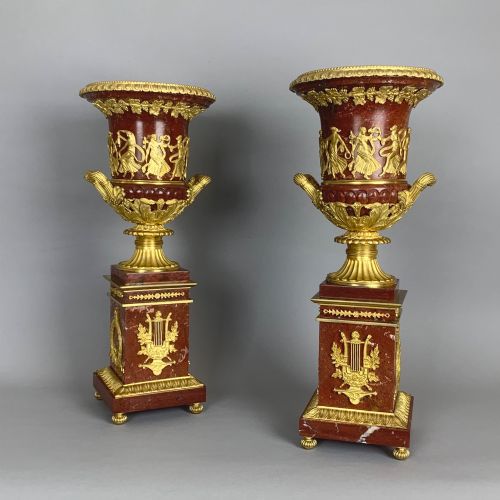
French ormolu mantel urns appear primarily across nineteenth-century forms such as clock garnitures, cassolettes, tazzas and decorative pairs resting on marble pedestals. These pieces draw on French Rococo Revival, Louis XVI Revival and French Empire styles, reflecting classical and neoclassical design vocabulary.
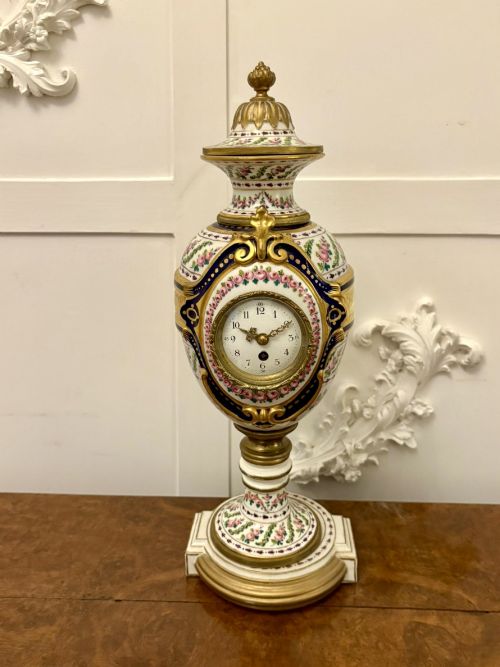
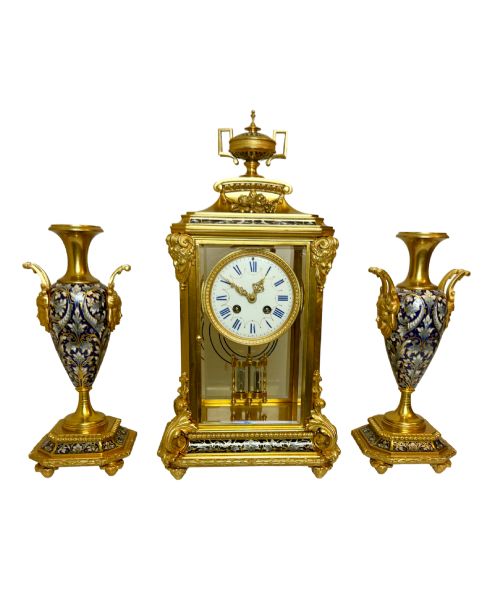
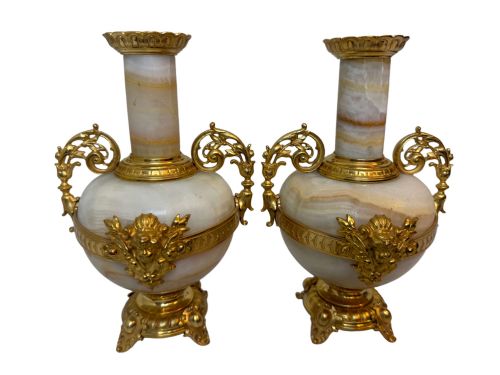
Buyers encounter items originating from the Victorian era down to the turn of the twentieth century, often paired with matching candelabras or clocks. The selection encompasses monumental urn-shaped mantle clocks alongside twin vases utilising white onyx, porcelain and bronze.
The prevalent aesthetics follow classical proportions, incorporating handles, garniture sets and pedestals that suit traditional mantelpieces and side tables.
Materials and construction
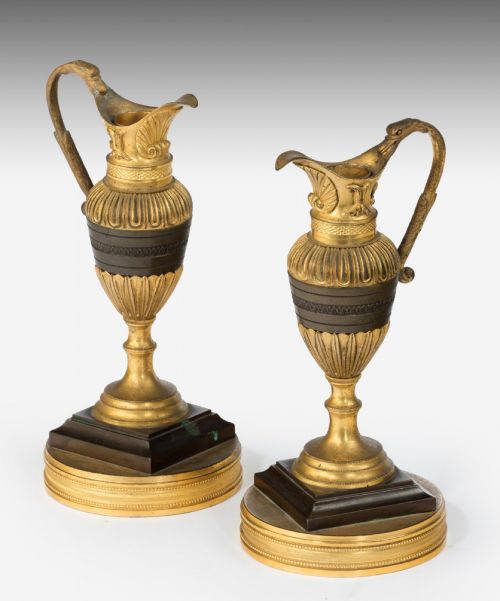
Makers combine fire-gilt bronze, known as ormolu, with cast brass, copper alloys and hand-painted porcelain panels including Sevres styles. Structural components frequently incorporate white onyx, rouge marble or green marble bases.
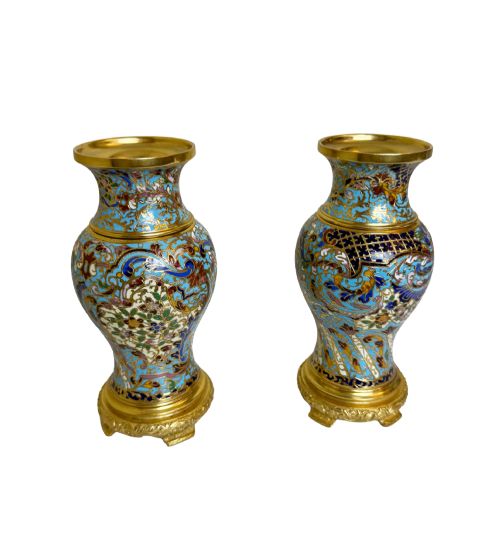
Surface decoration relies on champleve enamel work, fine chasing of metal surfaces and patinated bronze details alongside glazed porcelain bodies. The assembly integrates multiple cast elements secured with threaded fixings.
Some urns cleverly double as reversible cassolettes, ready to transform a mantelpiece at a moment's notice.
Assessing the work
Quality rests upon the crispness of the bronze chasing and the depth of the mercury gilding applied to the metal surfaces. Superior examples demonstrate rigorous symmetry in matched pairs and precise integration between the stone bases and metal mounts.
Hand-painted porcelain elements and detailed champleve enamel distinguish finer decorative works from standard production pieces. The clarity of casting in classical motifs marks the division between workshop tiers.
Japy Freres·Jean-Baptiste Delettrez·Achille Brocot·Louis Goret·Pons De Paul·A.D Mougin
The French Ormolu Mantel Urns Glossary
- Ormolu
- Finely chopped or powdered high-karat gold applied to a bronze base using a mercury amalgamation technique. This historic process yields a warm, durable finish characteristic of nineteenth-century French metalwork.
- Cassolette
- A reversible decorative vase featuring a lid that turns to function either as an urn or a burner. These objects often incorporate marble bodies with gilt bronze mounts.
- Garniture
- A coordinated set of three or more ornamental pieces, typically comprising a central clock flanked by matching urns, vases or candelabras. They create symmetry on a mantelpiece.
- Champleve
- An enamelling technique where troughs or cells are hollowed out of a metal surface and filled with vitreous enamel paste before firing. The resulting design sits flush with the surrounding metal borders.
French Ormolu Mantel Urns: Frequently Asked Questions
What is a french ormolu mantel urn?
A french ormolu mantel urn is a nineteenth-century decorative vessel cast in bronze, finished with gold gilding, and frequently paired with marble bases or clock garniture sets.
These pieces served as decorative centrepieces on nineteenth-century mantelpieces, often accompanied by matching candelabras or side vases.
How do I clean gilt bronze?
Gilt bronze requires careful dusting with a soft brush to protect the delicate mercury gilding from abrasion and moisture damage.
Harsh chemical polishes strip the historic gilt surface, so conservation relies strictly on dry, gentle maintenance.
Are garniture sets complete?
Garniture sets comprise a central clock alongside matching side urns or candelabras designed to sit together harmoniously on a mantelpiece.
Buyers should examine whether all three matching components survive intact as a unified group from the nineteenth century.
How do I date these pieces?
Dating relies on stylistic markers from the French Empire, Louis XVI Revival, and Victorian periods alongside maker marks stamped on clock movements.
Materials such as white onyx, champleve enamel, and Sevres-style porcelain help narrow the manufacturing window within the nineteenth century.