


French Ormolu Fire Dogs
French ormolu fire dogs bring heavyweight nineteenth-century hearth style into a room, combining patinated bronze and brilliant gilding for instant period drama.
French Ormolu Fire Dogs
When you search for french ormolu fire dogs, you encounter heavy hearth furniture designed to hold logs above the hearth floor while framing the fireplace. These pieces, also known as chenets or fire dogs, frequently turn up in pairs dating across the nineteenth century.
The dominant aesthetic draws heavily on French Rococo, Louis XV, and Louis XIV styles, alongside Regency and French Empire interpretations. They appear alongside related fireplace accessories like fire grates and fenders.
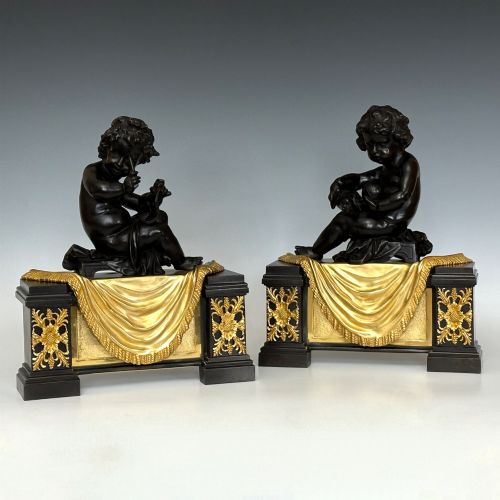
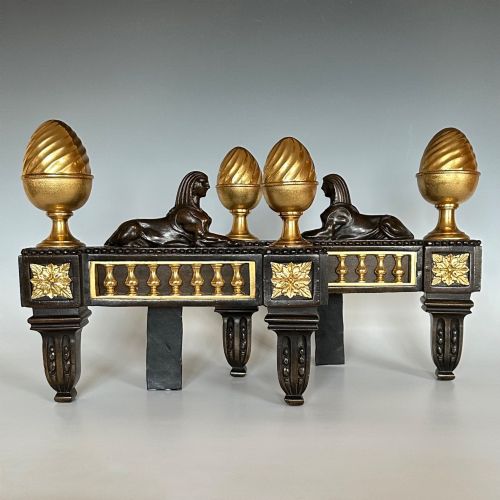
Most examples combine patinated bronze figures or mounts with bright ormolu and gilt brass, occasionally incorporating cast iron structural elements to withstand hearth heat. The forms range from simple scrollwork to elaborate figural compositions featuring cherubs.
How they were made
Maker's workshops cast these pieces in bronze, brass, and iron using traditional foundry methods. Ormolu sections received a fine layer of mercury gilding or fire gilding to achieve their characteristic bright golden surface.
Secondary elements often utilised patinated bronze to create tonal contrast against the gleaming ormolu mounts. Iron and cast iron formed the robust internal bars and dog legs necessary for practical fireplace use.
Several pairs include cheeky cherubs keeping watch over the hearth ashes.
What varies in quality
The crispness of the chasing separates standard production from exceptional examples. Finer pairs exhibit deep, hand-chased detail in the bronze and ormolu, whereas simpler pieces show softer casting edges.
Substance and structural integrity also distinguish the range. Heavier bronze castings with integrated parcel gilt components and adjustable width mechanisms indicate superior original manufacture.
The French Ormolu Fire Dogs Glossary
- Ormolu
- Gilded bronze, produced by applying a gold and mercury amalgam to a bronze base and heating it. This technique creates a durable, luminous golden finish characteristic of French decorative arts.
- Chenet
- The French term for a fire dog or andiron. These ornamental metal supports hold firewood above the hearth base to improve airflow.
- Patinated bronze
- Bronze that has undergone chemical treatment or natural ageing to darken its surface. This dark finish creates visual contrast against bright ormolu mounts.
- Rococo Revival
- A nineteenth-century design movement mimicking the asymmetrical scrolls, natural motifs, and ornate curves of the eighteenth-century French Rococo period.
- Fender
- A low metal guard placed around the hearth opening. It often matches the style of the accompanying fire dogs.
French Ormolu Fire Dogs: Frequently Asked Questions
Are french ormolu fire dogs meant for open fires?
Many nineteenth-century pairs were built with robust iron backs and sturdy bronze feet designed to hold burning logs. However, some delicate figural examples served primarily as decorative hearth ornaments.
Check the rear iron supports to determine whether a pair was intended for actual wood burning or purely for aesthetic display.
How do I distinguish Louis XV style from Louis XIV style?
Louis XIV style pieces lean toward grand symmetry, classical motifs, and heavy architectural formality. They display structured dignity suitable for formal reception rooms.
Louis XV style embraces asymmetrical curves, naturalistic leaf scrolls, and playful Rococo elements, offering a more fluid visual rhythm.
What is the difference between ormolu and gilt brass?
Ormolu consists of mercury-gilded bronze, yielding a deep, rich lustre through a chemical amalgamation process. It feels substantial and shows sharp hand-chased details.
Gilt brass is generally lighter, harder in tone, and achieved through modern electroplating methods rather than historical fire-gilding techniques.
How do I clean ormolu fire dogs?
Dust gently with a soft, dry cloth to remove soot and surface particles. Avoid chemical polishes, as abrasive rubbing strips the historical gilding from the bronze base.
Professional conservation is recommended if deep grime obscures the original contrast between the patinated bronze and the gilt surfaces.