




French Opalescent Glass Scent
These french opalescent glass scent bottles catch the light with milky blue fire, turning dressing tables into stages for Art Deco and Art Nouveau design.
French Opalescent Glass Scent
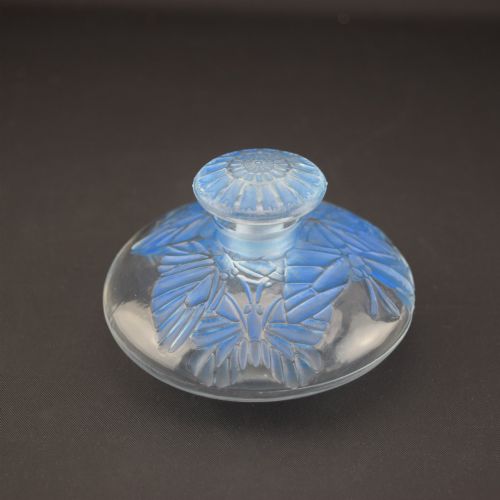
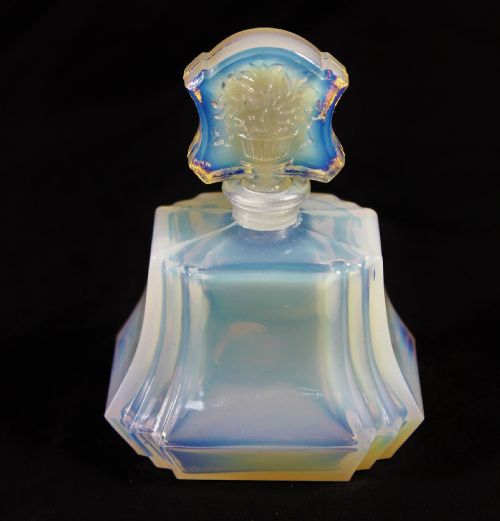
The aesthetic bridges late Art Nouveau curves with the geometric lines of Art Deco. These vessels combine translucent glass bodies with milky, iridescent highlights that shift from amber to pale blue according to the angle of the room.
Makers utilised pressed and frosted techniques to give relief decoration a tactile depth. Perfume bottles from this era frequently feature moulded stoppers shaped as butterflies, repeating the natural motifs favoured by French designers.
Production and Materials
The optical effect relies on bone ash or arsenical compounds added to the glass batch, which scatter light and create the characteristic opalescent glow. Molten material was pressed into metal moulds to achieve sharp, high-relief patterns without the need for extensive hand carving.
Frosted glass surfaces were achieved through acid etching or sandblasting, contrasting sharply against clear or blue stained areas. Ormolu and brass mounts occasionally completed these luxury objects, framing the glass body.
Listings on this site span three distinct decades: nineteen ten, nineteen twenty, and nineteen thirty.
Factors of Quality
The success of a piece depends on the density and distribution of the opalescence within the glass. Superior examples display a strong fire that shifts cleanly from warm tones in transmitted light to cool blue in reflected light.
Mould sharpness dictates the clarity of fine details such as insect wings or floral motifs. Pieces retaining their original matching stoppers command greater interest from collectors than those found altered or replaced.
Rene Lalique·Sabino·Etling·Pierre D'Avesn·Verlys
The French Opalescent Glass Scent Glossary
- Opalescent Glass
- Glass that diffuses light to display a milky or bluish turbidity. This visual property results from the chemical composition reacting to thermal manipulation during production.
- Pressed Glass
- Glass formed by mechanical pressure into a metal mould. This method allowed intricate decorative patterns to be produced with consistency.
- Frosted Glass
- Glass rendered translucent by acid etching or mechanical abrasion. The technique diffuses light and subdues surface glare.
- Ormolu
- Gilded bronze used for decorative mounts and fittings. It adds metallic contrast to glass objects of the period.
- Art Deco
- Design style dominant in the nineteen twenties and thirties characterised by geometric discipline. It succeeded the organic curves of Art Nouveau.
French Opalescent Glass Scent: Frequently Asked Questions
What is french opalescent glass scent?
These items are small perfume flasks produced in France during the early decades of the twentieth century. They utilise specialised glass chemistry to create a distinctive milky blue shimmer.
Craftsmen shaped the material using press moulds to create relief ornamentation featuring insects or geometric motifs. They served as luxury dressing table accessories for holding high-end perfumes.
How do I date these bottles?
Dating relies on stylistic markers and manufacturing signatures found on the base or body. Pieces from the nineteen tens often lean towards organic Art Nouveau curves, while those from the nineteen thirties favour geometric Art Deco lines.
Signatures stamped or engraved into the glass provide direct attribution to specific French glassworks and artists. Comparing the stopper design to known factory catalogues confirms the period of manufacture.
How should I display them?
Place these bottles where natural daylight can strike the glass from behind or the side. This directional lighting activates the opalescent chemical properties, causing the characteristic blue fire to appear.
Keep them away from direct heat sources and abrasive cleaning agents to protect the delicate frosted surfaces. Secure shelving prevents accidental tipping of these small, top-heavy vessels.
Are stoppers usually original?
Finding a bottle with its matching original stopper remains a key consideration for collectors. Because stoppers were easily misplaced or broken during use, many surviving pieces have replacement parts.
Examine the fit and the continuity of the glass colour and wear patterns between the bottle and stopper. A matched pair shares identical age indicators and opalescent qualities.