
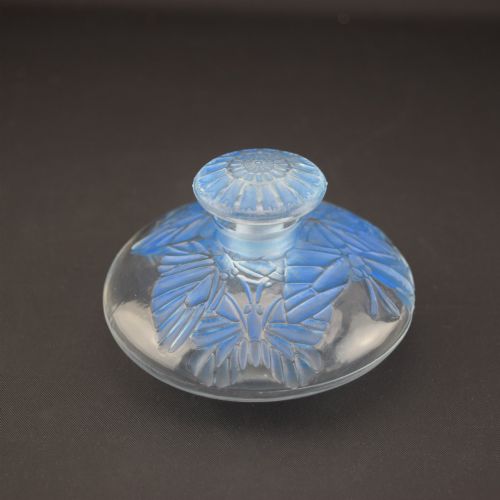


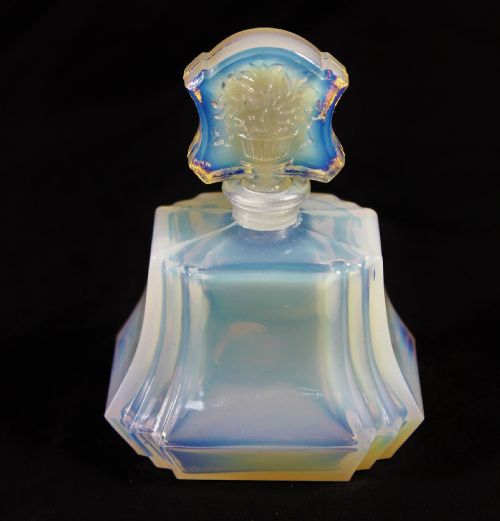


Vintage Opalescent Scent Bottle
A vintage opalescent scent bottle catches the light with milky blue hues, offering tactile glass that defines dressing table elegance.
Vintage Opalescent Scent Bottle
A vintage opalescent scent bottle captures light through milky semi-translucent glass that shifts between blue and amber tones. These pieces primarily emerge from the Art Nouveau and Art Deco periods, spanning the early decades of the twentieth century.
The versions most commonly met on this page showcase French moulding artistry from makers working around nineteen ten to nineteen thirty. Perfume bottles and perfume bottle forms dominate the selection, featuring moulded stoppers and patterned bodies.
Moulders utilised glass and frosted glass to create tactile surfaces with high relief details. The resulting objects combine practical vanity use with sculptural qualities characteristic of twentieth-century European design.
Materials and technique
Production relied heavily on pressed glass and opalescent glass formed in dedicated moulds. Molten material was shaped to achieve distinct relief patterns, such as butterflies or geometric motifs, across the body and stopper.
Frosted glass treatments were often applied to create contrast against the translucent highlights of the opalescent effect. Certain examples also incorporate blue stained glass elements to deepen the visual impact of the moulded design.
Listings feature opalescent glass and frosted glass pieces spanning three decades from nineteen ten to nineteen thirty.
Judging quality in opalescent glass
Quality rests in the crispness of the moulded relief and the depth of the opalescent fire within the glass. Finer examples display sharper detail in decorative elements like butterfly motifs and cleaner separation between frosted and clear sections.
The subtlety of the blue milk effect determines the visual distinction of the piece. Stronger chemical reactions in the glass create a richer play of colour when turned in the light.
Rene Lalique·Sabino
The Vintage Opalescent Scent Bottle Glossary
- Opalescent glass
- Glass that exhibits a milky, bluish translucence when lit from the front and an amber or warm tone when lit from behind. This optical effect results from the chemical composition and controlled cooling of the material.
- Pressed glass
- Glass shaped by being pressed into a metal mould with a plunger. This technique allowed for intricate surface decoration to be produced with consistency.
- Frosted glass
- Glass rendered matte through acid etching or sandblasting. The technique diffuses light and highlights the raised polished details of the design.
- Art Deco
- A design style of the nineteen twenties and nineteen thirties characterised by stylised motifs and geometric symmetry. It succeeded the more organic curves of the preceding era.
- Art Nouveau
- An international style of art and architecture prominent around nineteen hundred, inspired by natural forms and curved lines. It influenced early twentieth-century decorative glassmakers.
Vintage Opalescent Scent Bottle: Frequently Asked Questions
What is a vintage opalescent scent bottle?
These items are small decorative vessels designed to hold perfume, produced during the early twentieth century. They are celebrated for their milk-like glass that catches light with distinct blue and orange tones.
Collectors prize them for their sculptural forms, which often feature moulded floral or animal motifs that represent the height of period glassmaking.
How do I date a vintage opalescent scent bottle?
Dating relies on stylistic clues and maker signatures from periods like Art Nouveau and Art Deco. Pieces from nineteen ten often show naturalistic curves, while nineteen thirties examples favour geometric relief.
Examining the moulding technique and any signature etched into the base helps narrow the decade of production.
How were these perfume bottles used?
Original owners placed them on dressing tables to store and dispense liquid fragrance. The matching glass stopper sealed the contents to prevent evaporation.
Beyond vanity use, they functioned as miniature sculptural art objects that reflected the luxury aesthetic of the era.
How should I display opalescent glass?
Positioning these pieces near a natural light source allows the glass to exhibit its characteristic colour shift. Sunlight passing through the material activates the milky blue opalescence.
Keep them on stable surfaces away from high-traffic areas to protect delicate stoppers and raised glass relief details.