

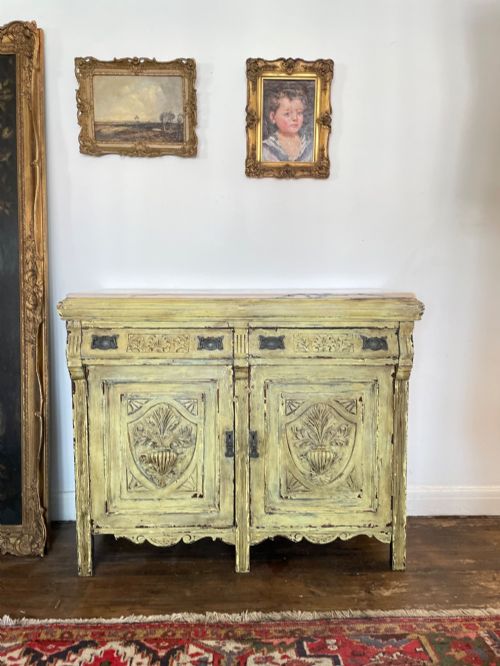
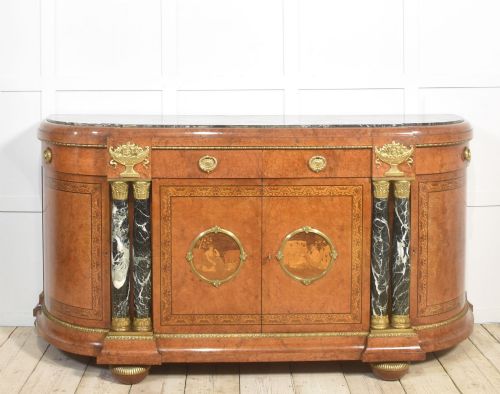


French Marble Top Buffet
A french marble top buffet brings heavy stone and figured timber together for serious storage.

French Marble Top Buffet
A french marble top buffet serves as a substantial storage cabinet for dining rooms and living spaces, often taking the form of a low sideboard, credenza, or server. These pieces combine fitted stone surfaces with timber carcases designed to hold tableware, linen, and glassware.
Most examples found on this page hail from the nineteenth century and the early decades of the twentieth century, reflecting various traditional regional tastes and revived court styles. Common configurations include two-door cupboards, multi-door sideboards, and smaller side cabinets featuring fitted marble tops.
Stylistic variations range from restrained Louis Philippe forms to ornate Louis XV and French Empire revivals, alongside provincial walnut and oak iterations. Buyers encounter everything from carved servers to large enfilades built for formal entertaining.
Materials and construction
Makers built these carcases primarily from dense hardwoods like walnut, mahogany, and oak, frequently employing kingwood, birds-eye maple, and flame mahogany for decorative veneers and marquetry inlay. The timber framework supports thick slabs of marble cut to follow the exact contours of the top surface.
Brass and ormolu mounts, hinges, and key escutcheons accent the timber structure, often framing doors or highlighting structural corners in classical revival designs. Glass panels occasionally appear in upper display sections or associated cabinet doors.
French Marble Top Buffet Retail Price Guide 2026
Typical asking prices for french marble top buffet among the pieces listed under this phrase on Sellingantiques today, from the lower quarter to the upper quarter. They describe what is for sale here now, not the wider market.
One metamorphic buffet hides its functions behind secret panels, proving nineteenth-century cabinetmakers loved a hidden mechanism.
Judging quality and craft
The standard of a french marble top buffet rests upon the selection of timber veneers, the precision of marquetry or parquetry patterns, and the weight and figure of the marble slab. Superior pieces feature finely cast ormolu mounts and hand-carved details rather than cast-metal shortcuts or applied mouldings.
Joinery execution inside the carcase and drawer construction dictate structural longevity, separating high workshop production from mass-market output. The thickness and polish of the marble top, along with how flush it sits against the timber frame, mark the difference between standard and exceptional examples.
KRIEGER of Paris
The French Marble Top Buffet Glossary
- Ormolu
- Gilded bronze mounts applied to furniture for decorative effect. These cast details add metallic contrast to wooden carcases.
- Marquetry
- Fitted wood veneers arranged in pictorial or geometric patterns across flat surfaces. It demonstrates high-level cabinetmaking skill.
- Credenza
- A low storage cabinet or sideboard designed for domestic interiors. This form frequently incorporates marble tops and lockable doors.
- Enfilade
- An extended sideboard or buffet designed for long dining rooms. These large pieces provide expansive top surfaces and multiple internal compartments.
French Marble Top Buffet: Frequently Asked Questions
How do I clean the marble top?
Use warm water and a soft cloth to wipe down the stone surface regularly. Avoid acidic cleaners that etch polished marble.
Dry the stone thoroughly after washing to prevent water marks and preserve the natural finish.
What rooms suit a buffet?
Dining rooms remain the traditional placement for storing heavy tableware and serving dishes. Living areas and large hallways also accommodate these low cabinets well.
The flat marble surface functions as a useful display area or serving station during gatherings.
How do I spot a revival style?
Revival pieces borrow decorative motifs from earlier centuries, such as Louis XVI symmetry or Louis XV curves. Construction methods and secondary timbers usually give away the actual manufacturing date.
Nineteenth-century workshops frequently looked back to court aesthetics while using contemporary joinery techniques.
Are the marble tops attached?
Most marble slabs rest directly on top of the wooden carcase under their own weight. This allows the heavy stone to be lifted off for moving the piece.
Some larger or fitted servers secure the marble with hidden brackets or mortar bedding.