


French Marble Inkstand
A french marble inkstand sits heavy and cool on the desk, bringing Neoclassical and Empire weight to your writing space.
French Marble Inkstand
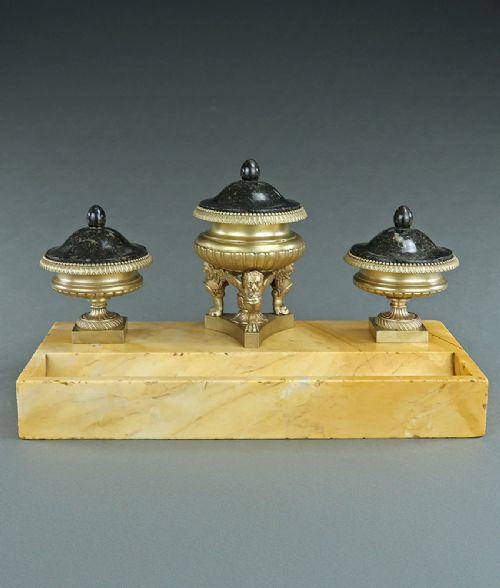
When you search for a french marble inkstand, you are looking at substantial desk accessories designed to hold ink and pens for correspondence. These pieces bring together solid stone bases and cast metal mounts, serving as both functional tools and decorative objects for the desk.
The versions you are most likely to meet on this page hail from the nineteenth century, ranging from early empire styles to later art nouveau interpretations. They typically appear as platforms or caskets in marble, fitted with one or two inkwells and often accompanied by patinated bronze or ormolu details.
Materials and construction
The foundation of each piece relies on cut and polished stone, utilising varieties such as Sienna marble, green marble, vert marble, and onyx. This heavy base provides the necessary stability for daily writing use.
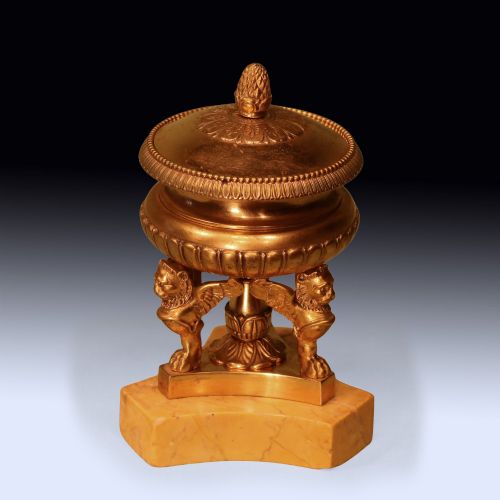
Metalwork forms the secondary element, combining cast bronze, gilt bronze, ormolu, and brass. Founders mounted these gilded or patinated elements directly onto the stone to frame the glass inserts and provide pen rests.
Listings feature nineteenth-century desk pieces utilising Sienna marble, green marble, brass, and ormolu mounts across empire and art nouveau styles.
Assessing quality and finish
Quality rests upon the crispness of the bronze casting and the depth of the fire-gilding. Finer pieces display sharp chiselling in the ormolu and careful polishing of the marble edges, while simpler examples rely on basic brass mounts and plain stone.
The integration between the metal components and the stone base dictates the overall success of the object. Superior inkstands feature mounts that fit the contours of the marble precisely without visible gaps or awkward fastenings.
Lefebvre of Belgium·Albert Marionnet·Jules Dalou·A. Marionnet
The French Marble Inkstand Glossary
- Encrier
- A desk stand or inkstand holding inkwells and sometimes sanders or pen trays. This term frequently appears on continental pieces.
- Ormolu
- Gilded bronze produced by applying a mercury and gold amalgam to cast bronze and firing it. It yields a distinctive, rich golden lustre.
- Grand Tour
- The nineteenth-century practice of young Europeans travelling the continent to collect classical antiquities and souvenirs. Many desk pieces reflect this classical aesthetic.
- Patinated bronze
- Bronze that has been chemically treated to alter its surface colour, usually resulting in a dark brown or green finish. It contrasts sharply with polished marble and bright gilding.
- Standish
- An alternative English term for a standing inkstand that incorporates compartments for writing implements. It matches the function of the French encrier.
French Marble Inkstand: Frequently Asked Questions
What is a french marble inkstand?
A french marble inkstand is a nineteenth-century desk accessory that combines a heavy stone base with metal mounts, designed to hold inkwells.
These items served as centrepieces for writing desks in grand houses and studies, reflecting the tastes of periods from empire to art nouveau.
How were they used?
They held liquid ink in glass or ceramic inserts housed within metal collars, preventing spills while offering a dip point for quill or steel pens.
Many included covered compartments for nibs, stamps, or fine sand used to blot wet ink from paper.
How do I date a piece?
Dating relies on stylistic clues, such as the classical restraint of early nineteenth-century empire designs compared to the flowing lines of later art nouveau.
The specific choice of marble types and the signature of casters like Lefebvre or Marionnet also help anchor the object in a decade.
How do I clean the marble?
Cleaning requires only a soft, dry cloth to remove dust from the stone and metal surfaces without disturbing the historic patination.
Water and chemical solvents should be avoided to protect the vulnerable gilt bronze and the porous nature of older marble bases.