
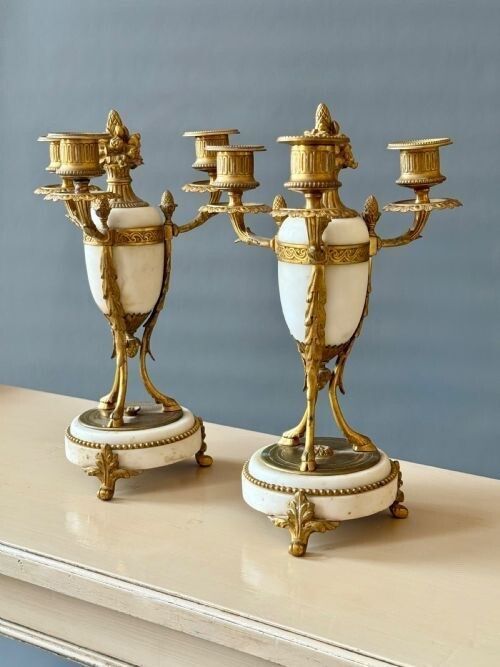

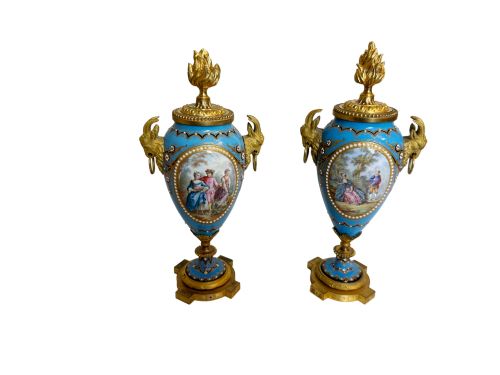


French Mantelpiece Urns
French mantelpiece urns bring classical form and rich metalwork to a room, offering decorative presence derived from nineteenth-century Continental design.
French Mantelpiece Urns
When you search for french mantelpiece urns, you encounter decorative vessels, garniture sets, and mantel clocks spanning the nineteenth century. These pieces draw on classical antiquity, drawing inspiration from Grand Tour travels and revivalist tastes.
You frequently meet pairs of campana or amphora vases mounted on plinth bases, often accompanied by matching clock sets. The forms range from strict neoclassical austerity to ornate rococo and empire detailing.
The origins trace to French workshops and Parisian foundries, producing works intended to anchor a fireplace or sideboard. Surviving examples reflect periods from the Charles X era through late Victorian revivalism.
Materials and construction methods
Foundries utilised cast bronze, gilt bronze, and ormolu, applying mercury gilding or chemical patination to metal surfaces. These metals often pair with carved white, siena, or rouge marble plinths.
Ceramic bodies incorporate Sevres style porcelain, faience, and glazed earthenware, frequently accented with hand-painted panels or enamel work. Toleware versions provide painted metal alternatives with classical silhouettes.
Materials span gilt bronze, ormolu, Sevres style porcelain, faience, toleware, and various types of marble including siena and rouge.
Distinctions in execution
The refinement of the casting separates standard production from exceptional pieces, visible in the crispness of acanthus leaves, handles, and figural mounts. Chasing and hand-finishing after the cast determine depth and definition.
Material selection dictates overall weight and presence, with dense marbles and heavy bronze alloys holding more authority than spelter or lighter brass components. Painted ceramic elements rely on pigment retention and enamel stability.
Barbedienne Paris
The French Mantelpiece Urns Glossary
- Cassolette
- A dual-purpose decorative vase featuring a reversible lid that functions as a small dish or burner. It typically sits on a marble or metal plinth.
- Garniture
- A set of three or more matching mantel ornaments, usually comprising a central clock flanked by matching vases, urns, or candelabra.
- Ormolu
- Finely chopped high-karat gold applied to a bronze base through a mercury amalgamation process. This technique creates a durable golden surface common in French decorative arts.
- Campana
- An inverted bell-shaped vessel with flared rims and handles rising from the lower body. This classic ancient Roman form influenced nineteenth-century revival pieces.
- Grand Tour
- A cultural journey undertaken by wealthy Europeans to study classical antiquities. Souvenirs brought back from these trips inspired domestic mantel ornaments.
French Mantelpiece Urns: Frequently Asked Questions
What is a garniture set?
A garniture set consists of a central mantel clock paired with two matching side urns or vases. These pieces were designed to be displayed together on a fireplace mantel or large sideboard.
The matching elements create visual symmetry and balance within a formal interior scheme, following interior design standards established in nineteenth-century France.
How do I identify French Empire style?
French Empire style draws heavily on ancient Roman, Greek, and Egyptian motifs. Look for strict symmetry, laurel wreaths, sphinxes, and military trophies.
The materials typically involve dark patinated bronze paired with bright gilt-bronze mounts and heavy marble bases, reflecting Napoleonic tastes.
What is the difference between bronze and spelter?
Bronze is a heavy alloy of copper and tin that accepts fine detail and deep patination. Spelter is a softer, zinc-based metal used as a cheaper substitute.
Spelter pieces are lighter in weight and often show brittle casting lines or flaking paint where the surface finish has degraded over time.
Where should I place an urn?
Urns look best centered on a mantelpiece, console table, or heavy sideboard where their vertical proportions can command space. Paired urns frame larger objects effectively.
Keep them away from direct sunlight and moisture to protect vulnerable gilt surfaces, enamel panels, and marble plinths from environmental damage.