

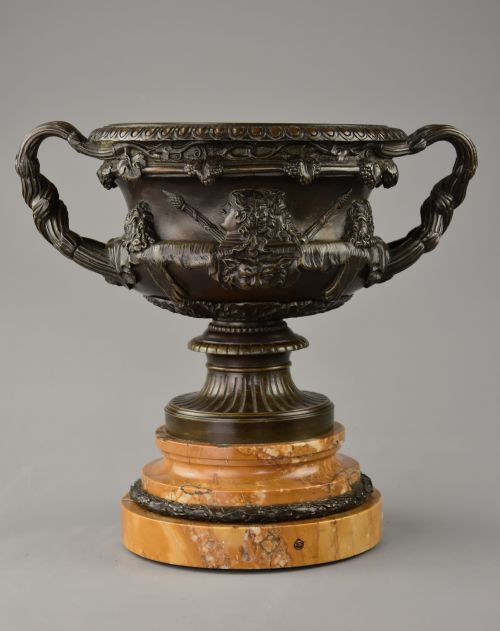
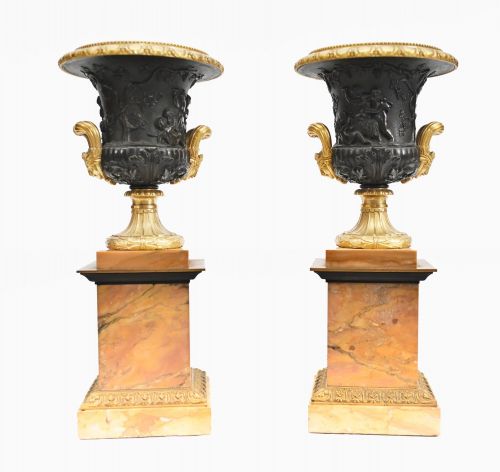


Dark Bronze Campana Urn
These dark bronze campana urns bring classical proportion and rich patination straight from nineteenth-century grand tours into your drawing room.
Dark Bronze Campana Urn
A dark bronze campana urn takes its bell-like shape from ancient Roman pottery and metalwork, scaled down for nineteenth-century studies and mantelpieces. When you search for a dark bronze campana urn, you encounter heavy decorative vessels shaped with flared rims and footed pedestals.
Most examples appearing here belong to the nineteenth century, including Regency, Charles X, and Victorian periods. Makers produced these ornamental pieces in pairs and single forms, frequently mounting them on contrasting plinths of siena marble or slate.
Grand tour travels inspired many of these works, drawing directly on classical antiquities like the Warwick Vase. Alongside solid bronze castings, you also find patinated bronze paired with gilt bronze or ormolu mounts, and occasional spelter alternatives.
Materials and construction methods
Foundries shaped these vessels through metal casting, utilising bronze as the primary medium alongside patinated finishes to achieve deep, dark tones. Artisans often combined cast bronze with bright ormolu and gilt bronze details to highlight handles, rims, and classical friezes.
Many urns rest on heavy stone supports, incorporating siena marble, plain marble, and slate into the stepped plinth bases. Makers finished the metal surfaces with careful patination, sometimes rendering figures of cherubs and Bacchus in high relief around the bell-shaped body.
Cherubs and Bacchus frequently peer out from the sides of these neoclassical vessels, keeping nineteenth-century revelry alive on the mantelpiece.
Distinctions in quality
The choice of base materials also separates examples, with rich siena marble plinths elevating a piece above simpler slate or wooden pedestals. Superior pairs match precisely in their casting weight and the precision of their ormolu mounts.
The Dark Bronze Campana Urn Glossary
- Campana
- A vase or urn shape resembling an inverted bell, widely used in classical pottery and metalwork. This profile defines the classic silhouette of nineteenth-century decorative urns.
- Grand Tour
- A cultural journey undertaken by nineteenth-century Europeans to study classical antiquities. Souvenirs from these travels included bronze reductions of famous ancient vases.
- Ormolu
- Gilt bronze decoration applied to furniture and ornamental metalwork. The technique involves fusing finely ground gold mercury amalgam to a bronze base.
- Cassolette
- A decorative vessel that functions as a perfume burner or transforms into a vase by reversing the lid. Regency makers frequently cast these in bronze with campana profiles.
- Patination
- The surface coloration and ageing acquired by bronze over time or through chemical treatment. A dark bronze patina gives these urns their characteristic antique depth.
Dark Bronze Campana Urn: Frequently Asked Questions
How were these urns used originally?
Nineteenth-century collectors displayed these vessels on mantelpieces, tables, and cabinets as symbols of classical learning and refined taste.
Some large examples also served as wine coolers or decorative planters within formal rooms.
How do I style a campana urn at home?
Place a pair on a sideboard or mantelpiece to anchor a room with symmetrical classical weight.
Single urns sit well on bookshelves or desks, where their dark bronze surfaces contrast against lighter walls.
What is the difference between bronze and spelter?
Bronze is a heavy alloy of copper and tin that takes fine detail and deep patination.
Spelter is a softer, zinc-based metal used to create lighter and less costly decorative objects.
How do I date a nineteenth-century bronze urn?
Examine the style of the mounting, the casting texture of the interior, and the material of the base.
Regency and Charles X pieces often feature distinct marble plinths and crisp neoclassical friezes.