
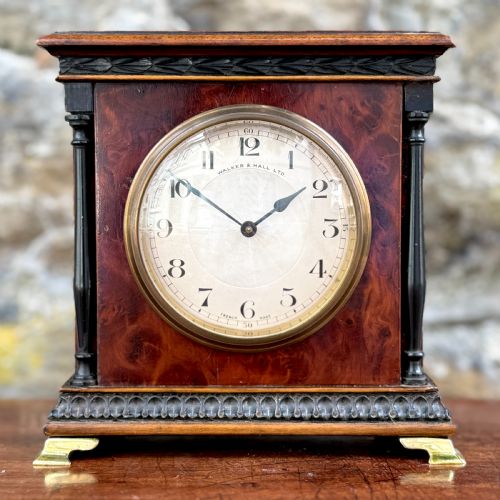
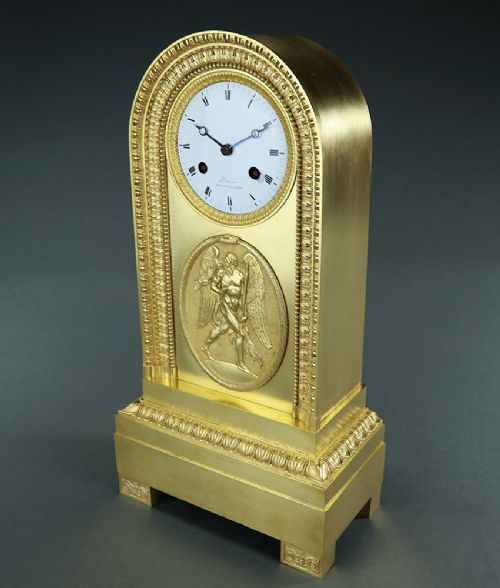


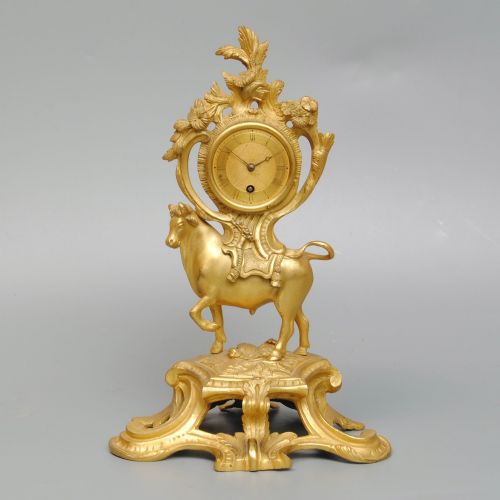


French Mantelpiece Timepiece
A french mantelpiece timepiece sits on a shelf to measure the hours while setting a room in brass and marble.

French Mantelpiece Timepiece
When you search for a french mantelpiece timepiece, you encounter desk and shelf clocks spanning the nineteenth and early twentieth centuries. These objects combine timekeeping mechanics with sculptural cases made for domestic interiors.
The versions most common on this page date from the Victorian era and the 1870s to 1920s. They range from solid brass carriage designs to heavy marble or ormolu garniture pieces placed in reception rooms.
Makers and designers from London and France shaped these works across periods from French Empire to Art Deco. They function both as practical timepieces and as decorative focal points for a mantel.
Materials and Construction
Casings rely on cast metals such as ormolu, gilt bronze, and solid brass, often combined with white or red marble, porcelain panels, and carved wood like rosewood. Artisans shaped these materials using classical casting, chasing, and marquetry techniques.
Dials feature enamel paint with Arabic or Roman numerals, frequently protected behind glass and framed by engine-turned brass masks or porcelain rings. Movement plates and gears were fitted by hand to house eight-day escapements and striking trains.
The object forms range from monumental architectural portico clocks to heavy marble designs featuring sculpted bronze elephants and stallions.
Judging Quality and Craft
The standard of a french mantelpiece timepiece depends on the crispness of the bronze casting and the depth of the hand-chasing on ormolu mounts. Finer examples display sharp architectural details and smoothly integrated figural bronzes rather than soft, mass-produced edges.
Materials dictate upper tiers of execution, particularly heavy marbles, pristine Sevres porcelain inserts, and profusely engraved brass cases. The precision of the dial work and the weight of the bronze signal the skill invested by the maker.
Walker and Hall·Henry Marc·Francois Moreau
The French Mantelpiece Timepiece Glossary
- Ormolu
- Gilded bronze produced by applying a mercury-gold amalgam to cast bronze before heating. This process creates a durable golden finish seen on many nineteenth-century clock cases.
- Garniture
- A set comprising a central clock flanked by matching decorative objects such as vases or candelabra. These sets were designed to balance the visual weight of a mantelpiece.
- Carriage clock
- A portable spring-driven timepiece with a carrying handle, originally made for travellers. Examples often feature glazed glass sides that reveal the internal escapement.
- Portico clock
- A clock case constructed in the architectural form of a classical portico with columns. This style gained popularity during the early nineteenth century.
- Escapement
- The internal mechanism that controls the release of gear train power to move clock hands at a steady rate. It produces the characteristic ticking sound of a mechanical timepiece.
French Mantelpiece Timepiece: Frequently Asked Questions
How do I wind a French mantel clock?
Insert the appropriate winding key into the designated arbour on the enamel dial face. Turn the key gently clockwise until you feel resistance, taking care not to overwind the mainspring.
Most mechanical movements require winding once every eight days to maintain accurate timekeeping. Ensure you support the case if it is heavy marble or bronze while operating the key.
What periods do these clocks cover?
The pieces span from the early nineteenth century through the Victorian era and into the Art Deco period of the 1920s and 1930s. Styles range from French Empire and Louis XVI Revival to Neoclassical and modern geometric designs.
Earlier nineteenth-century works often use heavy ormolu and marble, while later twentieth-century examples incorporate bakelite and streamlined bronze or brass forms.
How were these clocks used?
These timepieces were placed on living room and bedroom mantels to organise daily household schedules. They served as prominent status symbols and decorative ornaments for domestic interiors.
Larger garniture sets framed mirrors or fireplaces, while portable carriage versions travelled with owners between rooms or on journeys.
How do I clean an ormolu case?
Dust the gilt bronze surface gently with a soft, dry artist brush or microfibre cloth. Avoid chemical cleaning agents or abrasive polishes that can strip the delicate mercury gilding.
Protect the surrounding marble or wood elements from moisture while dusting to preserve the original patina of the metal.