

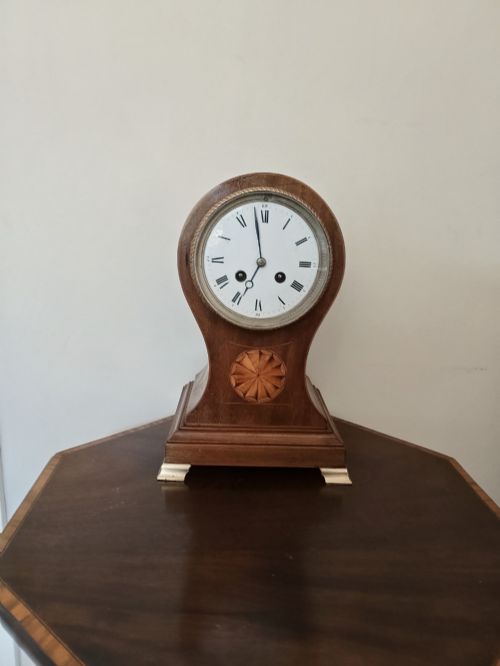
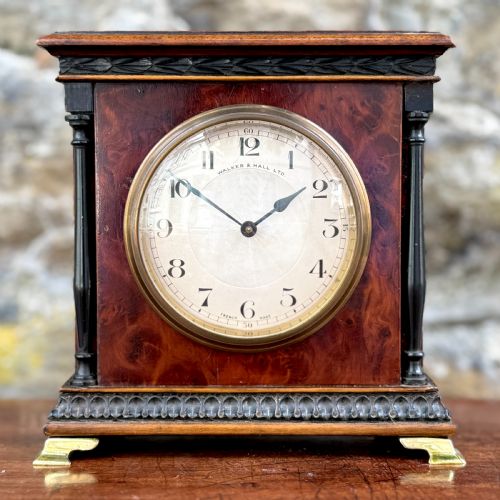
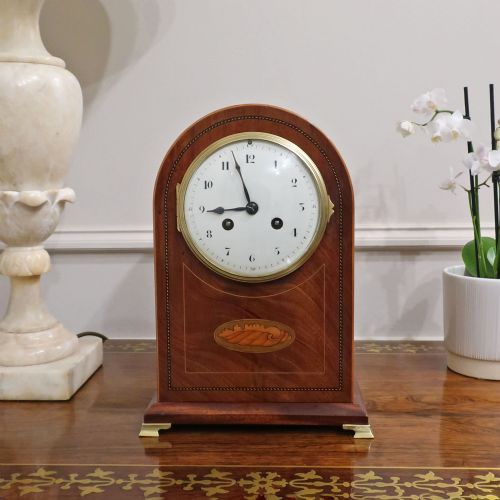


French Mahogany Bracket Clock
These french mahogany bracket clock examples bring together rich timber cases and precise movement, offering both presence and timekeeping for the home.
French Mahogany Bracket Clock
A french mahogany bracket clock combines the warmth of timber with precise continental horology, usually taking the form of a mantel clock. These timepieces appear across several periods, most commonly seeing examples from the nineteenth century, the Edwardian era, and the early twentieth century.
The objects on this page span several stylistic influences, ranging from French Empire and Louis XIV to Belle Epoque and Art Nouveau. Alongside traditional mantel clocks, buyers will encounter table clocks and wall clocks sharing the same core aesthetic.
Makers such as Walker and Hall, Valiant Paris, Malecot of Paris, and Henry Marc feature in the record, grounding these pieces in established workshops. The primary material is mahogany, frequently enriched with satinwood inlay or burr walnut.
Materials and construction
Makers shaped the cases from mahogany, applying ebonised wood, satinwood inlay, and burr walnut to create depth and textural contrast. The timber work often incorporates brass details, enamel dials, and glass panels to protect the face and reveal the movement.
Gilded elements such as ormolu mounts and finials appear frequently on nineteenth-century examples, paired with specialised escapements like the pinwheel mechanism. Enamel dials provide a crisp surface for numerals, while the timber cases require skilled cabinet-making to house the heavy brass movements securely.
French Mahogany Bracket Clock Retail Price Guide 2026
Typical asking prices for french mahogany bracket clock among the pieces listed under this phrase on Sellingantiques today, from the lower quarter to the upper quarter. They describe what is for sale here now, not the wider market.
Mahogany serves as the primary timber across these listings, frequently accompanied by brass, glass, enamel, and satinwood inlay.
Assessing quality
Quality rests in the harmony between the timber case and the mechanical movement within. Finer examples display crisply cast ormolu mounts, precise satinwood inlay, and robust pinwheel escapements that reflect the skill of workshops like Valiant Paris or Malecot.
The integrity of the mahogany and the preservation of the enamel dial also dictate the standing of a piece. Earlier nineteenth-century specimens often showcase deeper carving and more elaborate architectural styling than later Edwardian or 1910 counterparts.
Walker and Hall·Valiant Paris·Malecot of Paris·Henry Marc
The French Mahogany Bracket Clock Glossary
- Escapement
- The mechanical linkage that controls the release of gear train energy to maintain the motion of the clock. The pinwheel escapement is a notable example found in these pieces.
- Ormolu
- Gilded bronze ornamentation applied to the wooden case. This technique adds metallic lustre to nineteenth-century designs.
- Inlay
- A decorative technique where contrasting woods such as satinwood are fitted into the mahogany surface. This method creates geometric or floral patterns.
- Enamel dial
- A metal face coated with fused glass powder to produce a smooth, white background for numerals. These dials require careful firing to avoid cracking.
- Bracket clock
- A portable timepiece originally designed to sit on a wall bracket or table. These cases often feature architectural proportions and carrying handles.
French Mahogany Bracket Clock: Frequently Asked Questions
Where should I place a bracket clock?
These clocks sit comfortably on mantelpieces, sturdy tables, or dedicated wall brackets where their timber cases can be appreciated from multiple angles. Ensure the surface is level to keep the internal pendulum or balance wheel beating evenly.
Keep the clock away from direct sunlight and draughty doorways to protect the polished mahogany finish and the delicate enamel dial from rapid temperature changes.
How do I wind the movement?
Use the appropriate key gently on the winding squares, turning only until you feel firm resistance. Overwinding can damage the internal springs, so regular, moderate winding is better than forcing the mechanism.
Consult the specific requirements of the striking train if the clock chimes, ensuring you advance the hands correctly according to the instructions for pinwheel or striking mechanisms.
What styles are available?
The selection includes pieces influenced by French Empire, Louis XIV, Belle Epoque, and Art Nouveau aesthetics. Each period brings distinct decorative flourishes, from ornate ormolu mounts to clean Edwardian lines.
Mahogany serves as the constant base material, but the decorative vocabulary shifts from heavy classical detailing to lighter inlaid patterns depending on the date of manufacture.
How do I date these clocks?
Dating relies on a combination of stylistic cues, maker signatures, and construction methods. Nineteenth-century examples often feature heavier ormolu mounts and classical proportions, while Edwardian and 1910 pieces tend toward simpler Edwardian forms.
Inscribed names like Malecot or Henry Marc help narrow down the decade, alongside material markers such as satinwood inlay and ebonised wood details.