
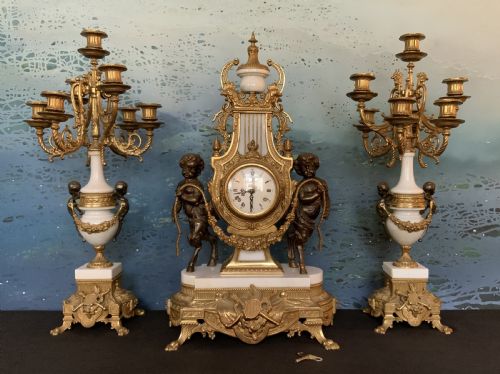


French Lyre Clock
A french lyre clock takes the graceful silhouette of the stringed instrument and turns it into a striking timepiece for the mantel.

French Lyre Clock
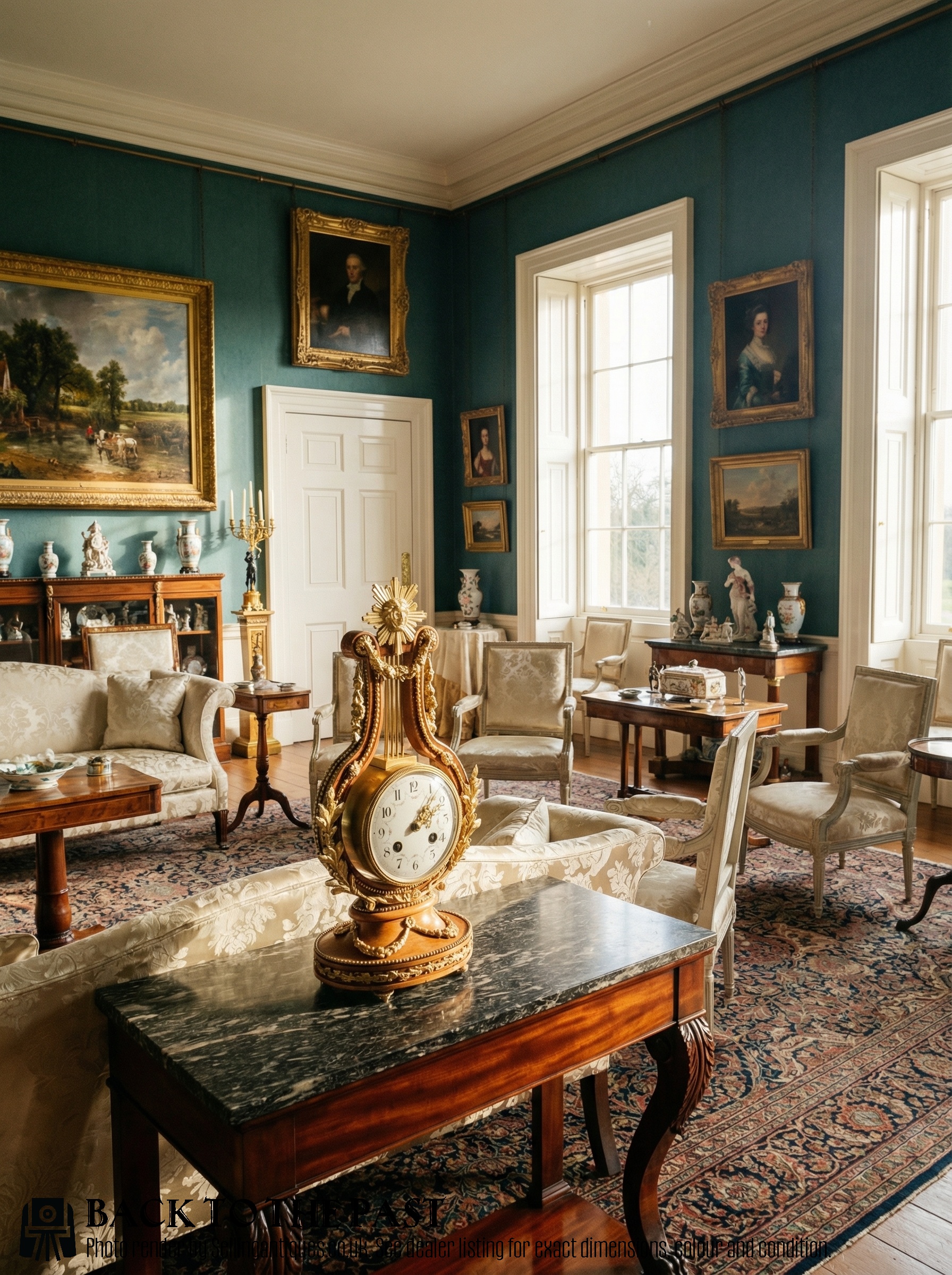
A french lyre clock mimics the sweeping curves of an ancient Greek lyre, housing a circular enamel or porcelain dial within the central frame. These mantel clocks and wall clocks appear in nineteenth-century forms, drawing heavily on Louis XVI and neoclassical design vocabularies.
The layout typically mounts the mechanism centrally with suspension systems, sometimes taking the form of a mystery clock where the movement appears to operate without conventional visible linkages. Surviving examples frequently arrive accompanied by matching garniture sets and candelabra.
The most common versions encountered here pair gilt bronze or ormolu mounts with marble bodies in shades of white, pink, or bleu de roi. Mahogany, maple, and burr walnut iterations also surface alongside porcelain bodies finished in Sevres style.
How they were made
Craftsmen shaped the distinct musical instrument frames from hardwoods like mahogany and maple, or cast them in bronze and brass before applying heavy ormolu gilding. Ormolu mounts were chased by hand to sharpen the leaf scrolls, drapery, and sunburst motifs that define the neoclassical aesthetic.
Bases and bodies relied on turned and polished marble, incorporating contrasting pink marble or white varieties to anchor the metalwork. Dials utilised white enamel with painted numerals, protected behind bevelled glass bezels set into the cast frames.
French Lyre Clock Retail Price Guide 2026
Typical asking prices for french lyre clock among the pieces listed under this phrase on Sellingantiques today, from the lower quarter to the upper quarter. They describe what is for sale here now, not the wider market.
Some models hide their mechanical workings so cleverly behind glass that guests spend hours searching for the secret gears.
What varies in quality
The crispness of the bronze casting and the depth of the subsequent mercury gilding dictate the visual success of the metal mounts. Superior pieces exhibit hand-chased surface detail on the ormolu rather than flat, machine-finished cast textures.
The selection of materials creates a clear hierarchy, with finely figured burr walnut, rich bleu de roi porcelain, and unblemished marble commanding greater presence than standard timber carcasses. Movement construction, ranging from standard eight-day brass mechanisms to signed makers like Lenzkirch or FB Adams, elevates the technical standard.
Lenzkirch·FB Adams London·Maple and Co Paris
The French Lyre Clock Glossary
- Ormolu
- Gilded bronze produced by applying a mercury and gold amalgam to a cast bronze object and heating it to vaporise the mercury. This technique yields a deep, enduring golden lustre characteristic of high-end nineteenth-century decorative arts.
- Mystery clock
- A timepiece where the dial hands appear to move without mechanical connection to the movement. The glass dial allows the illusion to function.
- Garniture
- A set of matching decorative ornaments, typically a central clock flanked by a pair of urns, vases, or candelabra. They are designed to sit together symmetrically on a mantelpiece.
- Cartel clock
- A wall-mounted clock featuring an ornamental frame made of gilt bronze, wood, or brass. The design mimics wall-hanging brackets of the eighteenth century.
- Fusee movement
- A conical pulley device connected to the clock spring by a chain or cord, designed to equalise the torque as the mainspring unwinds. This mechanism improves the timekeeping accuracy over the running period.
French Lyre Clock: Frequently Asked Questions
What is a french lyre clock?
A french lyre clock is a decorative timepiece shaped like the ancient musical instrument, combining a circular dial with symmetrical curved sides. These pieces emerged strongly during the nineteenth century in various revival styles.
Craftsmen built them using materials such as ormolu, marble, bronze, and fine woods, often displaying neoclassical decorative motifs.
How do you wind a mystery clock?
Winding depends on the specific internal mechanism housed within the glass or open frame of the lyre shape. Most utilise a standard key applied to winding squares on the dial face.
Care should be taken not to overwind the mainspring, particularly on older ormolu and marble models with delicate suspension springs.
Where should you place a mantel clock?
These clocks find their traditional home on a living room mantelpiece, sideboard, or console table where the decorative bronze and marble can catch the light. Placing them on a level surface is essential for the pendulum to beat evenly.
Keeping them away from direct sunlight and damp walls protects the enamel dials and gilt surfaces.
How do you identify a neoclassical clock?
Neoclassical clocks display architectural symmetry, classical urns, swags, acanthus leaves, and clean geometric lines inspired by Greek and Roman antiquity. They reject the asymmetric curves of earlier rococo styles in favour of formal restraint.
In this category, the lyre frame itself serves as the primary classical architectural reference.