


Vintage Pink Marble Clock
A vintage pink marble clock brings heavy stone presence and functional elegance to a mantelpiece, combining mineral colour with traditional timekeeping.
Vintage Pink Marble Clock
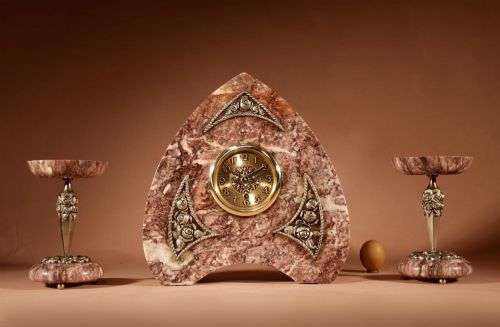
When you search for a vintage pink marble clock, you encounter substantial stone timepieces shaped into portico designs, lyre silhouettes, and geometric Art Deco forms. These pieces originate from nineteenth-century workshops and twentieth-century studios, often accompanied by matching garniture sets.
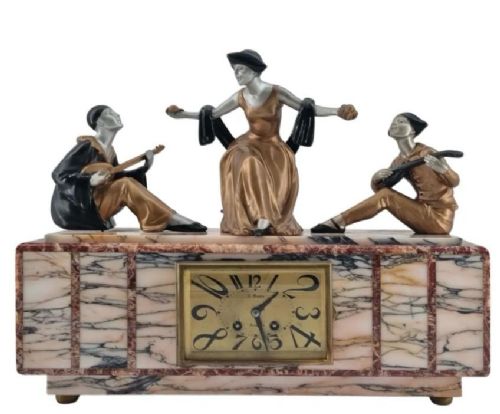
The most common examples on this page date from the Victorian era and the Art Deco period, combining veined pink stone with contrasting metallic mounts and enamel dials. They function primarily as mantel clocks, designed to anchor a room with dense mineral weight and period character.
How they were made
Masons shaped and polished natural pink marble blocks into architectural cases, porticos, and curved lyre bodies. These stone bodies were frequently mounted with cast brass, ormolu, and gilt bronze elements to accent the natural veining.
Clockmakers fitted mechanical movements behind white enamel dials protected by glass bezels. Figures in spelter or carved materials were occasionally added to Art Deco compositions, depicting subjects such as Pierrot and Columbine or elephants.
Some Art Deco models feature stone elephants standing guard beside the dial, proving that even heavy mineral timepieces appreciate a touch of wildlife.
What varies in quality
Quality rests in the depth of the marble's colouration, the crispness of the stone cutting, and the integration of metal mounts. Finer examples display harmonious mineral patterns across the entire case without disruptive repairs.
The refinement of the casting in the brass or ormolu mounts separates standard production from superior work. Complete garniture sets with matching side pieces represent a higher tier of domestic display.
Sega
The Vintage Pink Marble Clock Glossary
- Garniture
- A matching set of decorative objects for a mantelpiece, typically comprising a central clock flanked by two matching vases or urns. These sets create a balanced symmetrical arrangement on a fireplace.
- Portico clock
- A architectural clock style supported by columns resembling a classical porch. This form gained popularity during the nineteenth century.
- Lyre clock
- A timepiece shaped in the silhouette of a musical lyre instrument. The strings are often simulated by brass rods or pendulum arrangements.
- Ormolu
- Gilt bronze ornamentation applied to furniture and clock cases. The technique involves creating a mercury gilding finish on cast bronze.
- Spelter
- A zinc alloy used as a cheaper alternative to bronze for casting sculptural figures. It was frequently painted or patinated to resemble richer metals.
Vintage Pink Marble Clock: Frequently Asked Questions
What is a clock garniture?
A clock garniture is a matched decorative set designed for display on a mantelpiece. It usually includes a central clock accompanied by two side ornaments such as urns or vases.
These sets provide a unified decorative scheme for nineteenth and early twentieth-century interiors.
How do I identify Art Deco clocks?
Art Deco clocks feature geometric forms, stylised animal or human figures, and streamlined architectural silhouettes. They often incorporate contrasting marbles and metals characteristic of the interwar period.
Makers during this era moved away from ornate Victorian revival styles towards cleaner, bolder lines.
Where were these clocks made?
Many of these pieces originate from French workshops and clockmakers renowned for combining marble cases with ornate metal mounts. Victorian examples also reflect domestic British and broader European manufacturing traditions.
French pieces frequently utilise styles ranging from Louis XVI revivals to early twentieth-century modernism.
How heavy are marble clocks?
Marble clocks are exceptionally heavy due to the dense solid stone construction of their cases. They require a sturdy mantelpiece or shelf capable of supporting considerable weight.
The stone mass helps stabilise the mechanical movement housed within the central cavity.