

French Louis XVI Desk
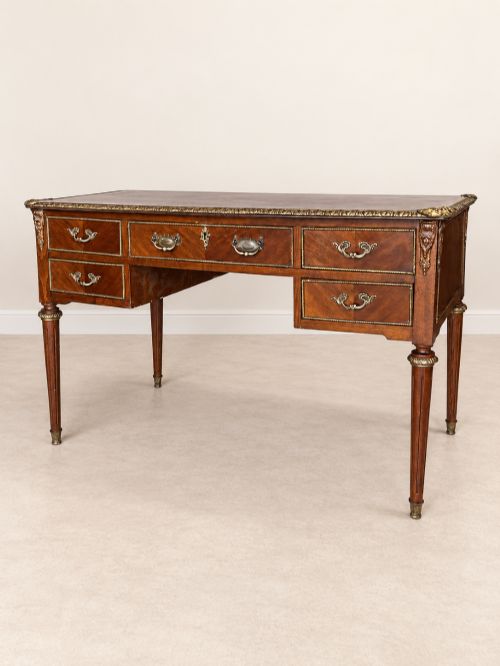
A french louis xvi desk brings neoclassical symmetry and gilt bronze mounts into a study, offering a refined workspace grounded in eighteenth-century French design principles.
French Louis XVI Desk
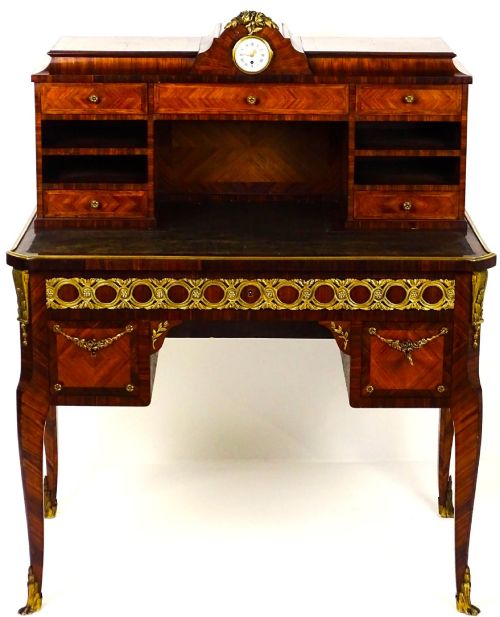
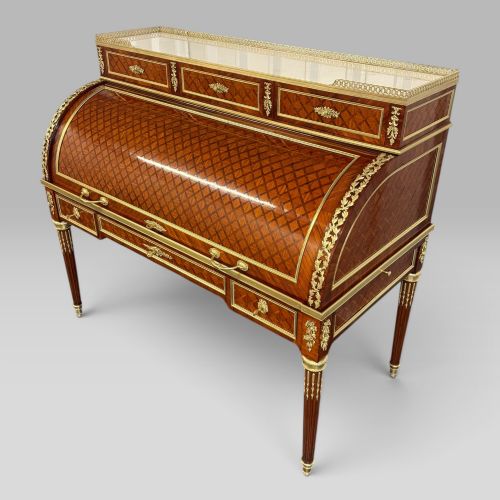
A french louis xvi desk encompasses various writing surfaces from this selection, including the bureau plat, cylinder desks, and secretaire forms originating primarily from nineteenth-century revivals of earlier French aesthetics. Makers adopted the straight lines, architectural proportions, and restrained ornamentation associated with the reign of Louis XVI, moving away from curvaceous rococo forms.
Most examples encountered on this page date from the nineteenth century, particularly the eighteen-eighties, reflecting a period of intense interest in French neoclassical cabinet-making. These pieces often feature inset leather writing surfaces accompanied by matching wood veneers and cast metal mounts.
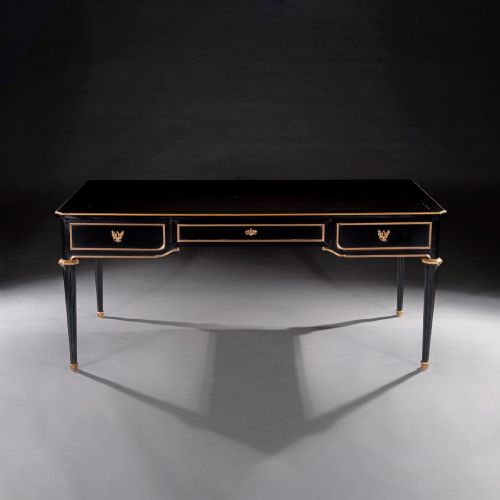
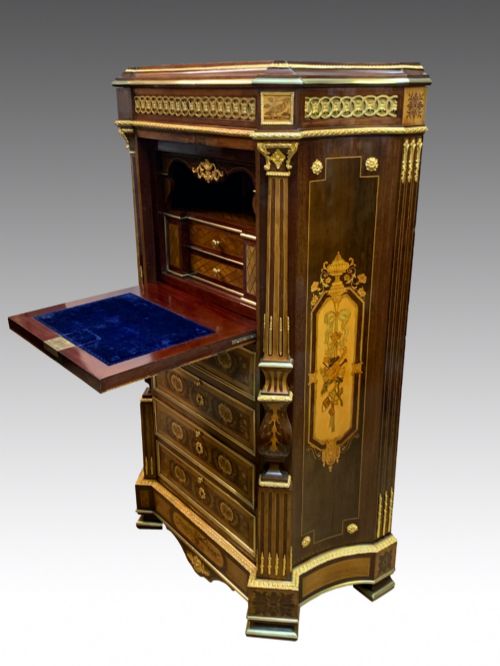
The layout typically prioritises symmetry, with frieze drawers arranged beneath rectangular tops supported by tapered, fluted legs. While some pieces adhere strictly to period profiles, others incorporate cylinder lids or fall-front compartments designed for functional nineteenth-century correspondence.
Materials and Technique
Cabinet-makers constructed these writing tables using supportive secondary timbers overlaid with decorative exotic veneers such as kingwood, mahogany, and tulipwood, frequently arranged in geometric parquetry or floral marquetry patterns. Parquetry adds visual depth through contrasting grain directions, while marquetry introduces intricate pictorial or abstract motifs.
Gilt bronze and ormolu mounts punctuate the corners, drawer edges, and legs, shaped by lost-wax casting and subsequently chased by hand to sharpen the leaf and dart motifs. Brass inlay and leather writing inserts provide additional textural contrast to the polished timber surfaces.
Marble tops appear on select variants, providing a cool, smooth counterpoint to the warm wood tones and metallic lustre of the bronze mounts. Joinery relied on traditional techniques to accommodate seasonal wood movement without compromising the rigid geometry of the frame.
Some cylinder desks feature secret compartments revealed only by pressing hidden wooden springs.
Distinctions in Execution
Quality in a french louis xvi desk is determined by the crispness of the ormolu chasing and the precision of the veneer work, where superior examples exhibit sharp, deep metal detailing and seamless grain matching across moving parts. Lesser pieces rely on mechanical casting and simpler timber cuts with minimal hand finishing.
The integration of the mounts into the wooden carcass reveals the maker's hand, as top-tier workshops ensured every bronze fitting sat flush into a recess carved specifically for it. Standard commercial production often applied mounts directly onto the finished surface without inletting.
Internal construction, from drawer dovetailing to the quality of the secondary woods used for drawer linings, distinguishes workshop masterworks from mass-produced factory output of the late nineteenth century.
Paul Sormani·Maison Krieger·François Linke·Alphonse Tahan
The French Louis XVI Desk Glossary
- Bureau Plat
- A double-sided writing table featuring a rectangular top inset with leather and one or more frieze drawers. These tables stood in the centre of a room rather than against a wall.
- Ormolu
- Gilt bronze ornamentation applied to furniture, clocks, and lighting fixtures. The process involves treating cast bronze with an amalgam of gold and mercury before firing.
- Parquetry
- Geometric mosaic woodwork formed by small veneer pieces laid down in repeating patterns such as cubes or chevrons. This technique highlights the natural grain variations of timbers like kingwood and tulipwood.
- Cylinder Desk
- A writing desk featuring a quarter-cylinder rolling shutter that conceals pigeonholes and small drawers when closed. Opening the cylinder often automatically extends the writing slide.
- Neoclassical
- A revival style drawing inspiration from the classical art and architecture of ancient Greece and Rome. It is characterised by symmetry, straight lines, and classical motifs like acanthus leaves and fluting.
French Louis XVI Desk: Frequently Asked Questions
What is a bureau plat?
A bureau plat is a freestanding writing table designed to be viewed from all sides, typically featuring a leather-lined top and drawers integrated into the apron.
Unlike traditional wall desks, these tables occupied the middle of a room, serving as central administrative hubs for correspondence and estate management.
How do I identify Louis XVI style?
The style is identified by straight, tapered legs, right angles, and classical architectural motifs, in direct contrast to the curved lines of earlier periods.
Look for fluted columns, guilloche banding, and symmetrical arrangements of ormolu mounts on mahogany or kingwood surfaces.
Where were these desks placed?
These desks were placed in private studies, grand libraries, or elegant reception rooms where letters were written and business conducted.
Because many are finished on the reverse side, they often sat away from walls to allow the owner to work in the middle of the space.
Are nineteenth-century copies authentic?
Nineteenth-century interpretations produced by notable Parisian makers are authentic period pieces in their own right, representing the height of historical revival craftsmanship.
They reflect the Victorian and Belle Époque appetite for eighteenth-century French design, executed with exceptional material quality and technical skill.