
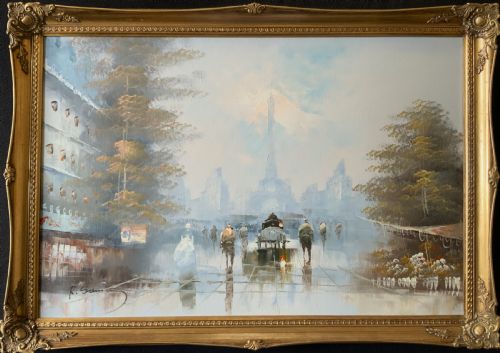


French Impressionist Street Scene
These french impressionist street scene works capture the light and movement of Parisian boulevards and provincial towns, offering buyers an immediate window into urban European life.
French Impressionist Street Scene
A french impressionist street scene transports the viewer directly to the boulevards, cafes, and historic monuments of Paris and the South of France. Buyers searching this term encounter works that record the shifting light of day, urban bustle, and architectural landmarks like the Eiffel Tower or the Pont Neuf.
The pieces represented in this selection span from the Belle Epoque through the mid-twentieth century, capturing enduring motifs such as Montmartre in winter and sun-drenched Mediterranean coastal views. Oil paintings dominate the category, though pastels on paper and watercolours also appear.
Most examples originate from the early decades of the twentieth century up to the nineteen-fifties, reflecting various stylistic interpretations from Post-Impressionism to mid-century colourist approaches.
Materials and techniques
Artists typically applied oil paint to canvas or board, utilising rapid, visible brushstrokes to convey the energetic atmosphere of crowded streets and changing weather conditions. Some creators worked on paper using pastel media, capturing delicate atmospheric effects with layered chalk pigments.
The completed artworks are generally housed in wood frames, frequently enhanced with gilt or gilded finishes that complement the warm tones of the painted urban compositions.
The listings include works spanning multiple decades, from the nineteenth century through the nineteen-sixties.
Factors of quality
Quality in a french impressionist street scene rests on the dexterity of the brushwork and the artist's ability to render light and spatial depth within a bustling composition. Stronger examples display confident handling of paint that evokes movement and atmosphere rather than relying on stiff architectural precision.
The harmony of the palette and the preservation of the painted surface significantly influence the standing of a piece. Original framing, particularly period gilt wood surrounds that complement the canvas, also contributes to the integrity of the work.
Albert Ludovici Jnr·Caroline Burnett·Victor Gabriel Gilbert·Merio Ameglio·Cecil R Doyly John·Eduard Leon Cortes·Letitia Marion Hamilton
The French Impressionist Street Scene Glossary
- Impressionism
- A nineteenth-century art movement characterised by relatively small, thin, yet visible brush strokes and an emphasis on accurate depiction of light. This approach forms the foundation for the street scenes and cityscapes found in this category.
- Belle Epoque
- A period of French history dating from the late nineteenth century to the outbreak of the First World War in nineteen fourteen. Artworks from this era often celebrate urban leisure and Parisian architecture.
- Post-Impressionism
- A predominantly French art movement that developed from about eighteen eighty-six to nineteen fourteen, extending Impressionism while rejecting its limitations. Artists of this style focused on more symbolic content and heavier structural brushwork.
- Gilt Wood
- Wood that has been treated with gold leaf or a gold-coloured metallic finish. Many period frames utilise this technique to enhance the presentation of oil paintings.
French Impressionist Street Scene: Frequently Asked Questions
What periods do these street scenes date from?
The available works span from the late nineteenth century through the mid-twentieth century, with a strong concentration of pieces originating between nineteen-ten and nineteen-sixty.
This broad timeframe encompasses the Belle Epoque, Post-Impressionist developments, and mid-century modern interpretations of French urban life.
What surfaces were used for these paintings?
Most works in this category are executed in oil paint on canvas or board. Paper is also utilised, particularly for pastel drawings and watercolours.
Supports vary according to the medium and the specific decade of creation, ranging from traditional stretched canvas to sturdy artist boards.
How should I display a framed street scene?
These paintings are typically housed in wood or gilt wood frames that complement the tonal qualities of the urban compositions. Wall placement should avoid direct sunlight to protect the pigments on canvas or paper.
Ensure the hanging environment maintains stable humidity levels to preserve both the artwork and its period frame.
Are all these paintings from Paris?
While many depict Parisian landmarks such as the Eiffel Tower, the Pont Neuf, and Montmartre, the selection extends beyond the capital. Other pieces capture scenes from the Cote d'Azur, provincial towns like Semur, and broader French landscapes.