


Framed Parisian Street Artwork
Framed Parisian street artwork captures the enduring charm of France's capital through oils and watercolours, offering an instant window into urban life.
Framed Parisian Street Artwork
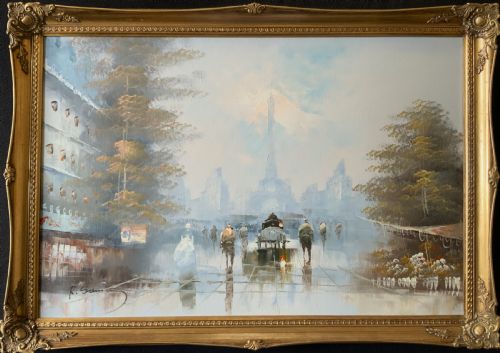
Framed Parisian street artwork encompasses oil paintings, watercolours and pastel drawings depicting the iconic thoroughfares, monuments and daily scenes of France's capital. These pieces range from quiet winter views of Montmartre to bustling depictions of the Eiffel Tower and the Pont Neuf.
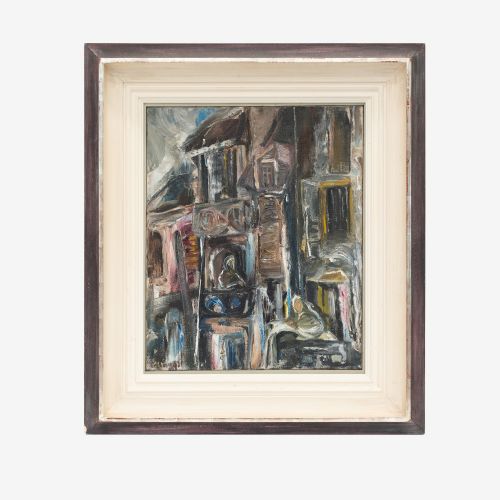
The versions most commonly met on this page originate from the twentieth century, spanning from the 1900s through to the 1960s. They capture shifting artistic approaches, from early impressionist interpretations to mid-century expressionism and modernist perspectives.
Works are typically presented in substantial surrounds, utilising wood and gilt wood frames to complement the painted canvas, board or paper beneath. These pieces function primarily as wall art, bringing historical French atmosphere directly into a domestic interior.
What varies in quality
Quality rests in the confidence of the brushwork and the artist's ability to capture the atmosphere of light and weather in the capital. Stronger examples demonstrate a sure command of perspective and colour harmony, bringing depth to urban facades and street figures.
The construction and condition of the framing contribute significantly to the overall integrity of the piece. Well-preserved wooden and gesso surrounds that complement the period of the painting elevate the object, whereas mismatched or compromised frames diminish the presentation.
The selection includes prominent art movements such as Impressionism, Post-Impressionism, and Mid-Century Expressionism.
Lilian Colbourn·Albert Ludovici Jnr·Caroline Burnett·Merio Ameglio·Eduard Leon Cortes·Albert Guillaume
The Framed Parisian Street Artwork Glossary
- Impressionism
- A nineteenth-century painting style characterised by relatively small, thin yet visible brush strokes and an emphasis on accurate depiction of light. It forms the stylistic foundation for many cityscapes produced in the decades that followed.
- Gesso
- A plaster-like mixture applied to wood frames as a base for moulding decorative details and applying gilding. It provides a smooth surface that can be intricately carved before finishing.
- Pastel drawing
- An artwork created using dry pigment sticks on paper, offering soft colour transitions and a velvety texture. It requires careful framing behind glass to protect the delicate powder surface.
- Gilt wood
- Wood coated with a thin layer of gold leaf or metallic powder to create a lustrous surface. It is frequently seen on traditional picture frames surrounding mid-century and earlier canvases.
Framed Parisian Street Artwork: Frequently Asked Questions
How do I hang a heavy framed oil painting?
Heavy oil paintings require secure fixings anchored directly into solid wall studs or masonry using appropriate wall plugs and screws. Picture wire rated well above the weight of the piece should be attached firmly to the frame structure.
Ensure the hanging height places the centre of the artwork at eye level for optimal viewing. Using two hooks rather than one helps keep the painting level over time.
Should I keep these artworks out of direct sunlight?
Direct sunlight causes fading in both oil pigments and paper works over extended periods. Position these pieces on interior walls away from bright windows to preserve the original colour balance.
If framing works on paper, consider using conservation-grade glass that filters ultraviolet light. This extra layer protects delicate pastels and watercolours from environmental degradation.
How can I tell a painting's age from the frame?
Frame construction methods often provide clear clues to an artwork's period, such as corner joinery and the composition of the gesso mouldings. Mid-century frames frequently feature simpler profiles compared to the ornate carved gilt surrounds of earlier decades.
Inspect the back of the frame and canvas for old labels, stamps, or oxidation on the fixings. These secondary details help confirm the era in which the artwork was assembled.