
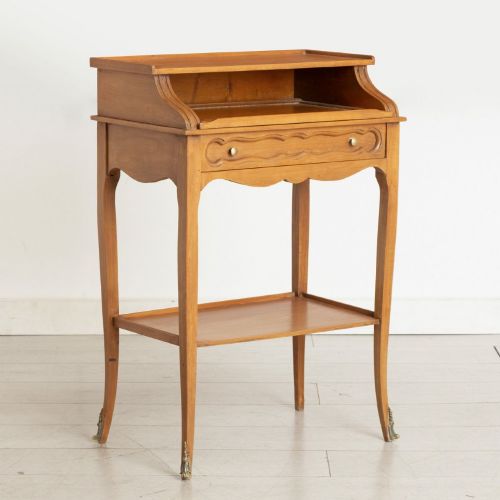
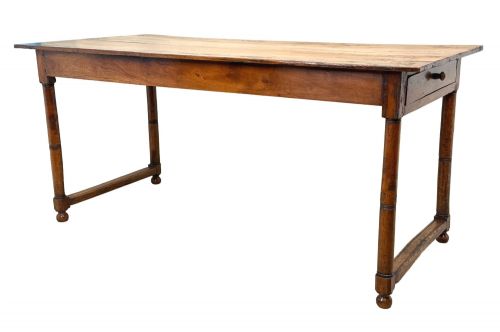


French Fruitwood Desk
These french fruitwood desk examples combine provincial character with practical workspace, offering rich timber tones and honest construction.
French Fruitwood Desk
A french fruitwood desk combines provincial utility with refined regional joinery, spanning formats from small ladies writing tables to large occasional desks. These surfaces reflect the practical needs of nineteenth-century households and workshops, often sharing forms with farmhouse tables and side tables.
The materials centre on fruitwood, cherrywood, and occasional satinwood, grounded in nineteenth-century and eighteenth-century construction dates. Pieces range from simple trestle forms and watchmakers tables to ormolu-mounted secrétaires à abattant.
Buyers meet provincial interpretations alongside Louis XVI style details and Empire influences. Proportions vary from intimate bedroom companions to substantial library pieces.
Materials and construction
Construction relies heavily on solid fruitwood and cherrywood timbers, selected for density and warm natural grain. Joinery prioritises sturdy frame assembly, visible in trestle supports and farmhouse table architecture.
Surface detailing incorporates brass mounts, ormolu, and parquetries where pieces draw on formal cabinet-making traditions. Timber surfaces develop deep patination through decades of friction and wax polishing.
One recorded workshop table spent its earlier life serving watchmakers rather than writers.
Judging quality and character
Quality rests in the integrity of the timber selection and the depth of patination across the fruitwood surface. Superior examples maintain original hardware and uncompromised structural joints without excessive timber replacement.
Refinement in carving and the precision of brass or ormolu mounts separate standard provincial furniture from high-style Parisian workshops. The balance between rustic charm and deliberate stylistic ambition dictates the standing of each piece.
Paul Garnier·Millet
The French Fruitwood Desk Glossary
- Fruitwood
- Timber taken from fruit-bearing trees such as cherry, pear, or apple. It yields a warm, dense surface that accepts patination readily.
- Provincial
- Describing furniture made in the regions outside Paris. It reflects local traditions rather than strict court fashions.
- Secrétaire à abattant
- A tall writing cabinet with a drop-front flap that conceals fitted interior pigeonholes and small drawers.
- Ormolu
- Gilded bronze mounts applied to furniture for decorative accent. It appears on finer neoclassical pieces.
- Parquetry
- Geometric wood inlay patterns arranged to form decorative surfaces on tabletops and fall-fronts.
French Fruitwood Desk: Frequently Asked Questions
What defines a french fruitwood desk?
These pieces utilise regional timbers like cherry and fruitwood, shaped into writing surfaces influenced by provincial French or Louis XVI styles. Their appeal lies in honest construction and warm domestic character.
They bridge the gap between utilitarian workshop benches and refined parlour tables, suiting modern studies or sitting rooms.
How do I care for fruitwood timber?
Fruitwood responds best to traditional beeswax applied sparingly and buffed with a soft cloth. Avoid placing timber near direct heat sources or strong sunlight to prevent splitting.
Regular gentle dusting preserves the natural patination built up over centuries of use.
Are these desks suitable for daily work?
Many nineteenth-century writing tables and ladies desks provide adequate space for laptops and correspondence. Their heights and proportions reflect historical ergonomic standards.
Checking dimensions against modern seating ensures comfortable daily use in a study.
How can I tell the period?
Dating relies on joinery techniques, tool marks, and stylistic clues such as Louis XVI neoclassical lines or Empire proportions. Fruitwood handling and hardware styles offer further chronological markers.
Comparison with documented examples helps narrow down the decade of manufacture.