


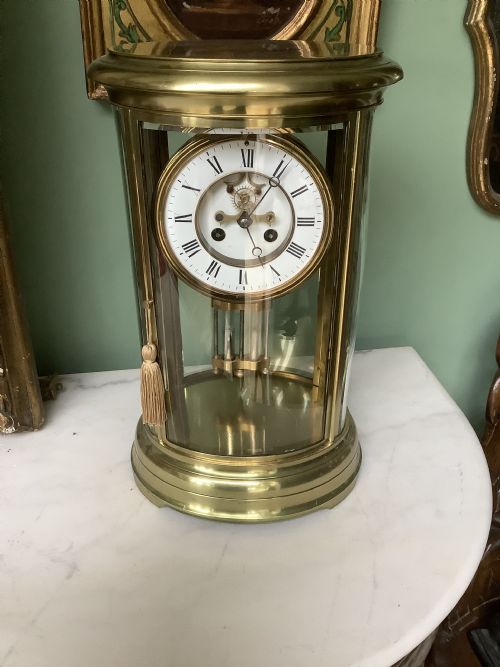


French Four Glass Timepiece
A french four glass timepiece offers a clear view of its delicate interior mechanics through bevelled panes, bringing refined elegance to a mantelpiece.
French Four Glass Timepiece
A french four glass timepiece presents a striking architectural form encased in glass panels that showcase the movement from all sides. These mantel clocks and bracket clocks frequently emerge from the nineteenth century, including the Victorian era and periods around eighteen eighty up to nineteen ten.
Collectors encounter distinct stylistic revivals across these pieces, ranging from French Neoclassical and Louis XVI style to Rococo Revival and Third Republic designs. Many examples feature brass or gilt brass frames, while others incorporate white marble and enamel details to accentuate the display.
The layout typically highlights a central dial, sometimes accompanied by complications such as a moon-phase indicator or a ships wheel motif. Certain versions operate as simple timepieces, whereas others include striking mechanisms housed securely within the glass and metal housing.
Materials and Construction
The structural framework relies heavily on brass, gilt brass, gilt bronze, and ormolu, providing a stable housing for the heavy glass panels. Makers frequently employed white marble for bases, adding substantial weight and a contrasting pale tone beneath the metallic lustre.
Dials were commonly fashioned from enamel, carrying painted numerals and often bearing the signature of the maker or retailer. Bevelled glass panes were fitted precisely into the metal chassis to create a clear, distortion-free view of the swinging pendulum and gear train.
French Four Glass Timepiece Retail Price Guide 2026
Typical asking prices for french four glass timepiece among the pieces listed under this phrase on Sellingantiques today, from the lower quarter to the upper quarter. They describe what is for sale here now, not the wider market.
Listings span the nineteenth century, including Victorian examples, eighteen eighty, eighteen ninety, and nineteen ten, utilising brass, marble, and enamel.
Distinguishing Quality in the Range
The sophistication of the movement dictates the upper tier of the range, particularly pieces engineered for extended duration between windings, such as one-year movements. Signed dials and movements by noted makers elevate an example well above standard production models.
TIFFANY·AD MOUGIN·Rodier
The French Four Glass Timepiece Glossary
- Four glass clock
- A mantel clock featuring glass panels on the front, back, and both sides to expose the movement. This design gained immense popularity during the nineteenth century in France.
- Timepiece
- A clock that indicates the time without including a striking mechanism or chiming train. These mechanisms focus purely on the motion of the gear train and escapement.
- Ormolu
- Gilded bronze produced by applying a mercury and gold amalgam to a bronze object and heating it. This technique imparts a durable, rich golden surface to clock mounts.
- Regulator
- A precision clock designed to keep exceptionally accurate time. In this context, the term often describes glass-cased mantel clocks with highly visible pendulums.
- Moon-phase dial
- A specialised dial mechanism that displays the lunar cycle alongside the standard time. It tracks the phases of the moon through a rotating painted disc.
French Four Glass Timepiece: Frequently Asked Questions
What is a four glass clock?
A four glass clock is a mantel timepiece enclosed by glass panels on all four sides and the top, allowing an unobstructed view of the internal movement and pendulum from every angle.
These pieces typically date from the nineteenth century and combine brass or gilt frames with enamel dials to create a bright, architectural presentation.
How do I wind a french timepiece?
Winding requires a matching key inserted into the winding holes on the enamel dial, turning it gently until resistance indicates the mainspring is fully tensioned.
Care must be taken not to overwind the mechanism, ensuring the movement continues to keep reliable time without straining the internal springs.
Where should I place my clock?
Position the piece on a stable, level surface such as a mantelpiece, bracket shelf, or sideboard where it will not experience vibrations or accidental bumps.
Keeping the clock away from direct sunlight and damp environments preserves the delicate gilt finishes on the brass and marble components.
How do I date these clocks?
Dating relies on stylistic clues, materials such as white marble or ormolu, and signature marks left by makers or retailers on the movement plates and dials.
Pieces originating in the nineteenth century often reflect broader decorative movements like Neoclassical, Rococo Revival, or Louis XVI styles.