



French Enamel Jewellery
French enamel jewellery comprises charming pendants, trinket boxes and brooches forged in 18ct yellow gold, porcelain and bronze.
French Enamel Jewellery
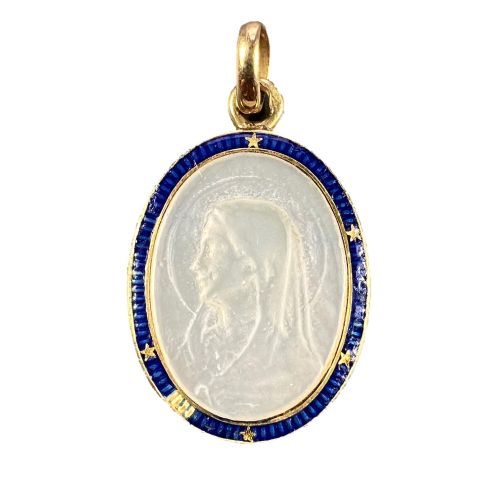
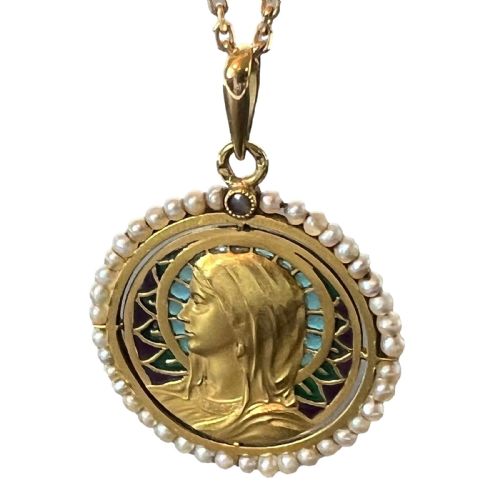
When buyers search for french enamel jewellery, they encounter an array of pendants, lockets, brooches, charms, cufflinks and small decorative boxes. These objects originate from the nineteenth and early twentieth centuries, spanning periods such as the Victorian era, Art Nouveau, and the 1920s. Pendants depicting the Virgin Mary, gambling cards, and coats of arms frequently appear alongside cobalt blue porcelain jewellery caskets.
The objects combine precious metals with vitreous, plique-à-jour and champlevé enamelling techniques. Pieces range from small charm pendants set with pearls and mother-of-pearl to larger gilded bronze and ormolu trinket boxes adorned with hand-painted porcelain miniatures. The selection bridges personal adornment and boudoir containers, all bearing the distinct hallmarks of French design.
How They Were Made
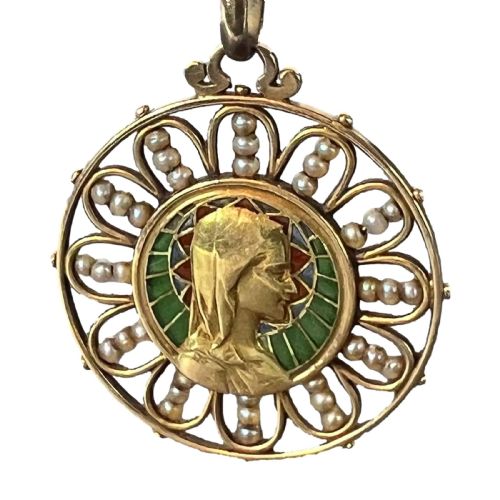
Maker's workshops utilised 18ct yellow gold, ormolu, silver plate, and bronze as structural foundations for enamel work. Pendants and medals often incorporated translucent plique-à-jour enamel, which creates a stained-glass effect by suspending enamel within open gold cells without a backing. Other pieces rely on vitreous enamel applied to porcelain, copper, or gold bases, sometimes enhanced with hand-painted details or gilt embellishments.
Surface ornamentation frequently integrated natural pearls, seed pearls, rose-cut diamonds, and mother-of-pearl alongside the coloured glass pastes. Trinket boxes combined cast bronze or ormolu mounts with inset Limoges or Sèvres porcelain plaques depicting figures and floral scenes. Structural integrity depended on precise metalwork, such as triple cartouche designs and secure bezel settings for gems.
The inventory encompasses wearable pendants and brooches alongside desktop trinket boxes and jewellery caskets.
What Varies in Quality
Quality reveals itself in the delicacy of the enamelling technique and the precision of the metalwork. Plique-à-jour pieces with even, unclouded translucency and intact cell structures sit at the higher end, requiring immense skill to prevent cracking during firing. Inferior examples show uneven thickness in the enamel or heavy, clumsy gold wireframes that lack definition.
Piel Freres·Belinda Gentle·Sellier·Dropsy
The French Enamel Jewellery Glossary
- Plique-a-jour
- An enamelling technique where enamel is applied in cells without a backing, allowing light to shine through like stained glass. This method is frequently seen in early twentieth-century pendants.
- Vitreous enamel
- A material made by fusing powdered glass to a substrate by firing, producing a durable and glossy coloured surface. It forms the protective and decorative coating on many brooches and charms.
- Ormolu
- Gilded bronze or brass applied to decorative objects and furniture mounts. This material gives nineteenth-century trinket boxes their rich golden appearance.
- Champleve
- An enamelling technique where troughs or cells are carved into the surface of a metal object and filled with enamel powder before firing. It provides robust decoration on bronze table boxes.
- Sevres
- A type of fine French porcelain produced by the state-owned factory, often incorporated into nineteenth-century jewellery caskets and decorative boxes.
French Enamel Jewellery: Frequently Asked Questions
What is plique-a-jour enamel?
Plique-a-jour is a demanding enamelling technique where the glass suspension has no metal backing. This creates a translucent window effect resembling miniature stained glass.
Artisans utilised this method extensively in early twentieth-century French pendants to capture light through coloured glass.
How are these trinket boxes constructed?
Trinket boxes combine cast bronze, ormolu, or gilded metal frameworks with inset porcelain panels. Artisans mounted hand-painted Limoges or Sevres plaques into the lids and sides.
Interior compartments frequently house velvet or silk linings to protect delicate contents.
How do I date a piece?
Dating relies on stylistic markers such as Art Nouveau floral motifs or 1920s geometric designs. Material choices and manufacturing techniques, like the prevalence of 18K yellow gold, also indicate specific decades.
Inscribed signatures and maker stamps provide precise historical origin points.