


French Empire Wall Table
These french empire wall table pieces bring neoclassical drama and mahogany elegance to an interior, built for striking display against a room's perimeter.
French Empire Wall Table
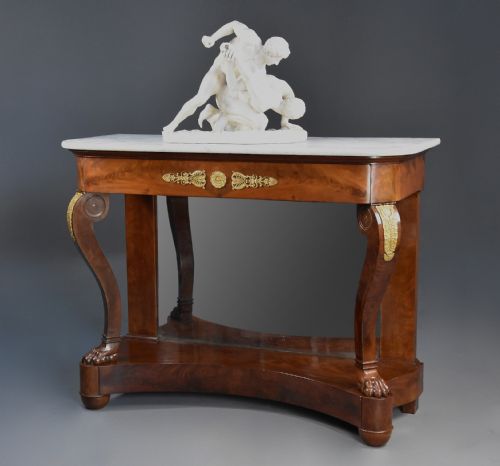
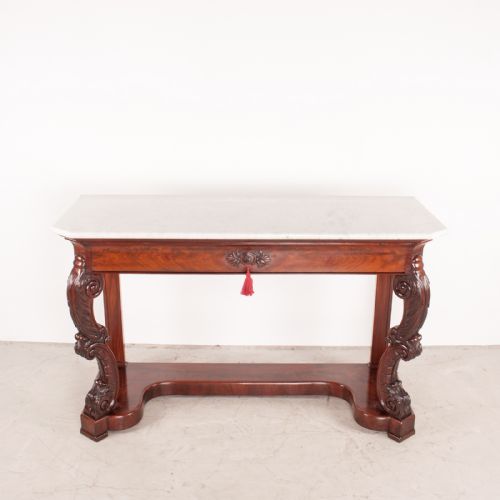
A french empire wall table is primarily represented here by console tables and pier tables designed to sit flush against a vertical surface. These forms emerge through the nineteenth century, including revival pieces from later decades alongside examples from the foundational period around eighteen hundred.
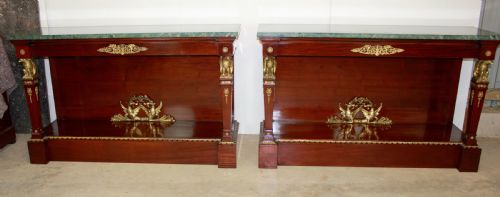
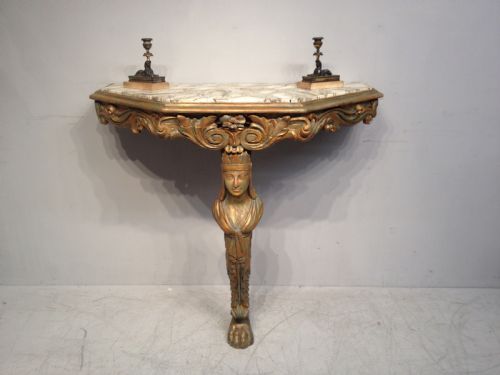
Buyers encounter substantial case pieces fashioned from flame mahogany, figured walnut, and painted wood, frequently topped with marble or fossil stone. The selection spans single statement items and matched pairs originating from French workshops, drawing on neoclassical and empire design vocabularies.
Materials and construction
Cabinetmakers utilised dense timbers such as mahogany and walnut, often selecting highly figured veneers for the main structure of the console. These wooden carcasses are paired with heavy marble slabs and fossil stone tops fitted precisely to the upper frame.
Surface enrichment relies heavily on cast or chased ormolu and gilt bronze mounts applied to the mahogany structure, alongside carved and gilded giltwood detailing. Painted wood finishes also appear among the listed variations, providing an alternative to polished timber.
Current listings span the nineteenth and early twentieth centuries, featuring mahogany, walnut, marble, and giltwood across console table forms.
Judging the work
Quality rests upon the selection of the timber grain, where highly figured flame mahogany and rich walnut distinguish finer execution from plain surfaces. The integration of the marble or fossil top with the wooden base also marks the tier of the piece.
The crispness of the gilt bronze and ormolu mounts, or the depth of the carved giltwood, separates standard production from superior decorative achievement. Proportion and the handling of neoclassical motifs govern the visual success of each console.
Jean Joseph Chapuis
The French Empire Wall Table Glossary
- Console table
- A table designed to be fixed against a wall, traditionally supported by two front legs or brackets while the rear relies on the vertical surface for stability. These pieces often serve as decorative focal points in entrance halls and reception rooms.
- Ormolu
- Gilt bronze ornamentation applied to furniture, created by amalgamating gold and mercury onto a bronze base and firing. This technique produces a durable golden finish characteristic of empire design.
- Pier table
- A specific type of side table constructed to fit the pier, which is the wall space situated between two windows. They are frequently paired with large mirrors placed directly above them.
- Flame mahogany
- A veneer cut from the fork of the mahogany tree where the branch joins the trunk, producing a distinctive leaping flame pattern. Cabinetmakers prized this figure for principal display surfaces.
French Empire Wall Table: Frequently Asked Questions
What is a french empire wall table?
A french empire wall table is a console or pier table designed to stand against a wall, typically featuring neoclassical motifs and mahogany or walnut construction.
These pieces often include marble tops and metal mounts, reflecting the decorative vocabulary of the nineteenth century.
Where do you place these tables?
These tables are traditionally positioned flat against a room's perimeter, frequently between windows or along hallway walls.
Because they are shallow and rely partly on the wall for stability, they suit narrower spaces where standard freestanding tables would obstruct movement.
How do I identify a revival piece?
Revival pieces date from later decades such as the late nineteenth or early twentieth century, mimicking the earlier empire and neoclassical styles.
They share materials like mahogany and marble but show construction methods and timber handling characteristic of their actual manufacturing period.
What materials were used?
The primary materials visible across these pieces include mahogany, walnut, and painted wood for the structural carcasses.
Surfaces are frequently completed with marble or fossil stone tops, accompanied by ormolu, gilt bronze, and giltwood embellishments.