



French Empire Garniture
A french empire garniture brings monumental classical presence to a mantelpiece, pairing a central striking clock with matching candelabra or urns.
French Empire Garniture
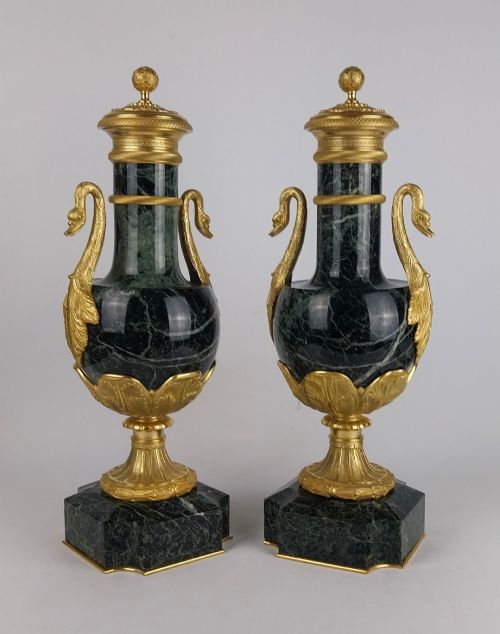
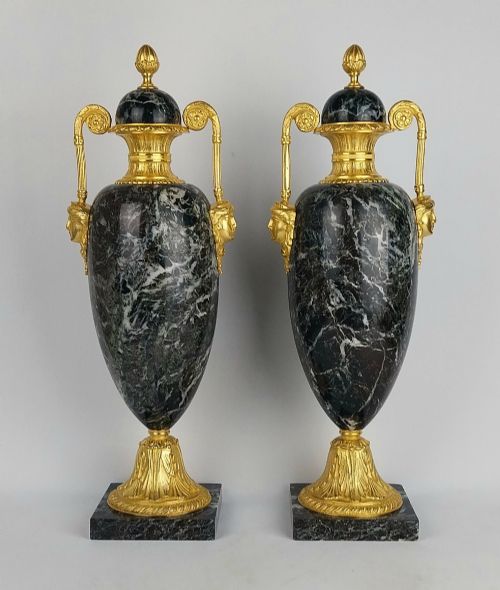
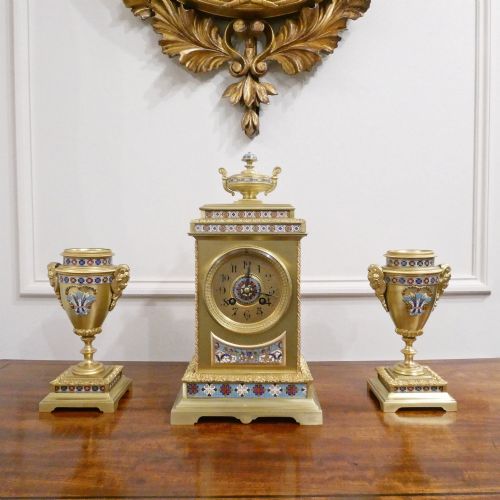
A french empire garniture unites a central mantel clock with flanking decorative objects, most frequently paired candelabra, urns or vases. These matched suites create symmetry on a chimney piece or sideboard, following design traditions rooted in the nineteenth century and later revival periods.
The objects appearing in this grouping span the nineteenth century, encompassing Victorian interpretations, Regency pieces and Napoleon III productions. Alongside complete clock sets, individual matched pairs of vases or candelabra reflect the enduring influence of classical motifs.
Forms within these sets draw heavily on neoclassical vocabularies, featuring amphora shapes, cassolettes and figural subjects. Collectors encounter both grand architectural clock garnitures and slender gilt bronze mounted glass or porcelain vessels.
Materials and construction methods
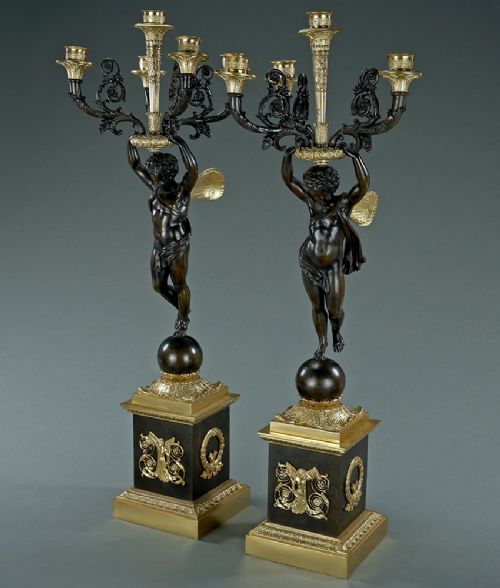
Maker workshops combined cast metals with mineral supports, fusing gilded bronze and ormolu with white marble, siena marble, slate or onyx bases. Patinated bronze frequently provides contrast against bright gilt highlights on figural and architectural components.
Decorative surfaces incorporate applied enamel dials, hand-finished mountings and glass or porcelain bodies with metal trim. Metal casting utilised detailed tooling to achieve crisp acanthus leaves, classical figures and structural mounts.
French Empire Garniture Retail Price Guide 2026
Typical asking prices for french empire garniture among the pieces listed under this phrase on Sellingantiques today, from the lower quarter to the upper quarter. They describe what is for sale here now, not the wider market.
Bronze cherubs occasionally lend a playful touch to nineteenth-century candelabra arms, steadfastly holding aloft candle sockets.
The markers of finer execution
Superior examples display exceptional crispness in the bronze chasing and gilding, where hand-finishing defines the nuance of drapery, hair and floral motifs. Lesser pieces rely on softer cast details and uniform surface treatments that lack depth.
The integration between the stone bases and metal mounts indicates workshop standard, with finer suites utilising dense marbles and precisely fitted ormolu bezels. Movement quality within the clocks, alongside the substantial weight of the matching vases, distinguishes standard production from exhibition pieces.
VINCENTI of PARIS·Deniere, Paris
The French Empire Garniture Glossary
- Garniture
- A set of matching ornamental objects designed to be displayed together on a mantelpiece or furniture top. It usually comprises a central clock flanked by two matching vases, urns or candelabra.
- Ormolu
- Gilding technique involving the application of finely ground high-carat gold to a bronze object. The term also describes the finished gilt bronze mounts characteristic of neoclassical furniture and clocks.
- Cassolette
- A decorative vase or urn featuring a reversible lid that transforms the piece from a closed vessel into a candleholder or burner. They frequently appear in matched pairs within nineteenth-century suites.
- Patinated Bronze
- Bronze treated with chemical solutions to produce a deliberate surface colouration, ranging from deep brown to dark green. This dark finish creates contrast against bright ormolu mounts.
- Neoclassical
- A style of design drawing inspiration from the art and architecture of classical antiquity. It forms the primary aesthetic foundation for nineteenth-century French decorative arts.
French Empire Garniture: Frequently Asked Questions
What is a french empire garniture set?
A matched decorative grouping consisting of a central mantel clock accompanied by two side pieces, such as candelabra, urns or vases. These suites were designed to create balanced symmetry when placed upon a fireplace mantel or large cabinet.
The components share consistent decorative motifs, materials and stylistic vocabulary, uniting gilt bronze, marble and classical figures into a single cohesive interior display.
How do you style a garniture on a mantelpiece?
The central clock takes pride of place in the exact middle of the mantel shelf, providing a strong visual anchor. The matching candelabra or vases are then positioned symmetrically on either side to complete the balanced arrangement.
Spacing depends on the length of the shelf and the scale of the objects, allowing each piece in the suite to be viewed clearly without overcrowding the space.
How do you wind a nineteenth-century clock set?
Most movements utilise a small winding key inserted into specific holes on the enamel dial to tension the springs for the time and striking train. Care must be taken not to over-wind the mechanism, ensuring the clock maintains accurate eight-day operation.
Setting the hands requires gentle movement, avoiding rapid adjustments that might disrupt the internal striking sequence or escapement.
What distinguishes an original nineteenth-century garniture?
Authentic period pieces display period casting techniques, hand-chased ormolu details and substantial natural marble or slate bases. The mechanisms inside the clocks typically bear maker marks or serial numbers consistent with French workshop production of the era.
Materials show appropriate age-related wear to the gilding and patination, distinguishing genuine nineteenth-century manufacturing from later decorative reproductions.