



French Column Clock
A French column clock brings striking architectural presence to a mantelpiece, combining classical proportion with precision mechanical timekeeping.
French Column Clock
A French column clock comprises architectural mantel clocks and carriage clocks defined by structural pillars supporting upper and lower cases. When exploring a French column clock, buyers encounter nineteenth-century pieces spanning the Victorian era, Charles X, and Empire periods.
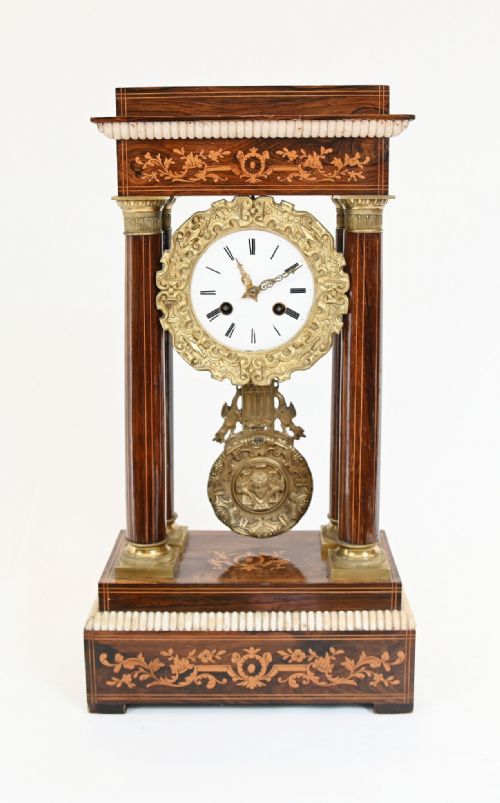
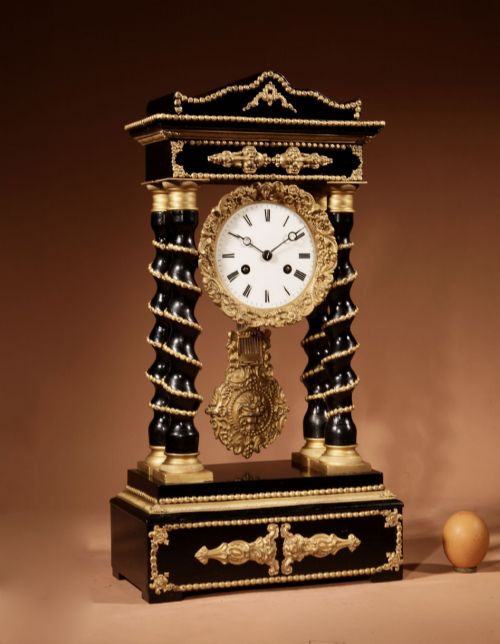
The selections on this page range from grand portico clocks with prominent columns framing a central pendulum to heavy marble architectural mantel clocks and portable carriage clocks fitted with brass or porcelain supports. These timepieces originate primarily from French workshops active during the eighteenth, nineteenth, and early twentieth centuries.
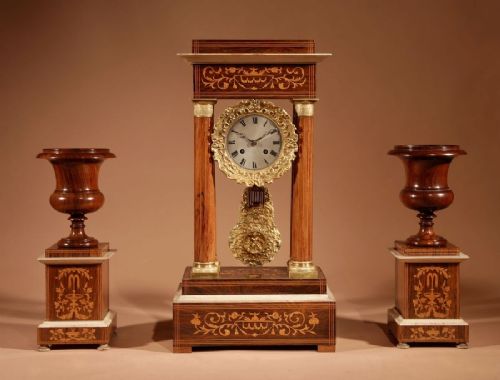
Mantel versions often appear as part of clock garnitures accompanied by matching side ornaments, while carriage varieties offer compact versions with glazed panels and decorative columns at the corners.
Materials and construction
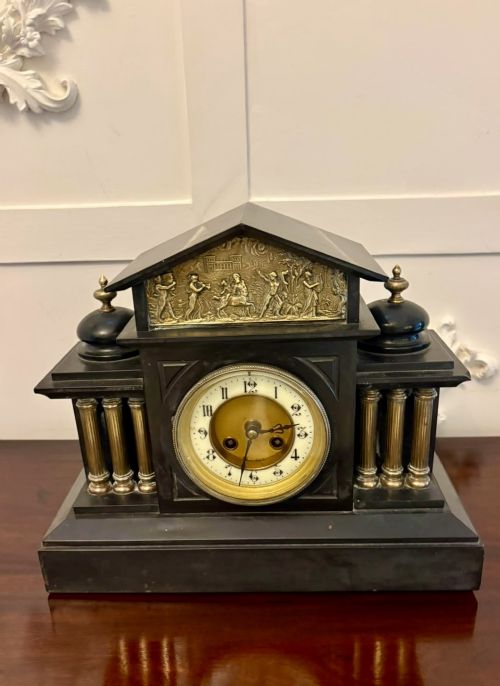
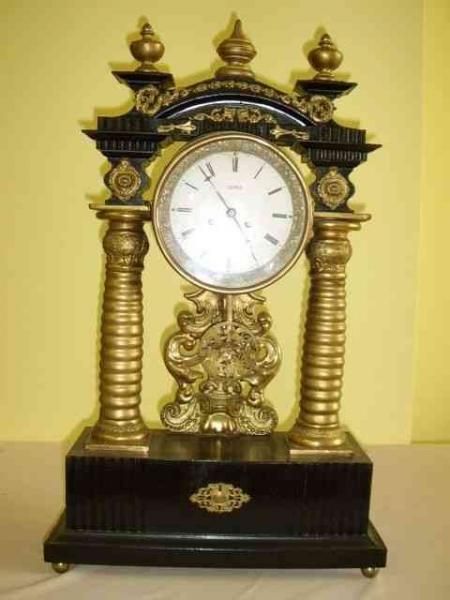
Maker construction relies on substantial natural materials such as black marble, white marble, and dense hardwoods including rosewood and ebonised timber. Ormolu, gilt bronze, and cast brass provide structural mounts, bezels, and decorative capitals for the supporting columns.
Listings feature 19th Century, Victorian, and 18th Century periods alongside materials like brass, glass, marble, ormolu, and rosewood.
Assessing quality and craftsmanship
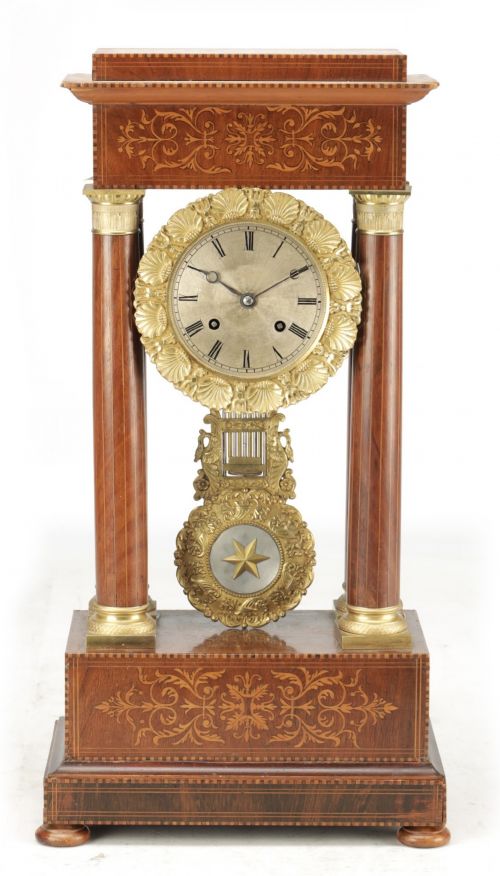
Quality separates through the crispness of the cast ormolu mounts and the precision of the timber inlay, such as lemonwood and satinwood stringing on rosewood cases. Superior examples display signed movements by recognised makers, intricate musical or grand sonnerie complications, and original glass domes.
The architectural harmony of the columns, bases, and pediments dictates overall visual success. Heavy marble models demonstrate refinement through balanced stone selection, inlaid coloured stone details, and fully integrated matching garniture pieces.
Philippes Paris·Baby and Jannings·Breguet·Mappin and Webb
The French Column Clock Glossary
- Portico clock
- A mantel clock featuring an architectural frame supported by freestanding columns, often enclosing a suspended pendulum visible through the centre.
- Ormolu
- Gilt bronze created by applying a high-carat gold amalgam to a bronze base, producing a rich golden finish used for decorative mounts and column capitals.
- Garniture
- A set comprising a central clock flanked by matching decorative objects such as urns or candelabra designed to sit together on a mantelpiece.
- Grand Sonnerie
- A complex clock movement that strikes the hours and the quarters automatically on every quarter hour without requiring a pull repeat cord.
- Engine-turned
- A mechanical surface decoration produced on metal dials and masks using a lathe to cut precise, repetitive geometric patterns.
French Column Clock: Frequently Asked Questions
How do I wind a French column clock?
Most mechanical models use a dedicated winding key inserted into arbours on the enamel dial to tension the mainsprings for the time and strike trains.
Care should be taken not to overwind the movement, turning the key gently until firm resistance is felt.
Where should I place a heavy marble mantel clock?
These pieces require a stable, level surface such as a sturdy mantelpiece, heavy sideboard, or dedicated console table capable of supporting significant stone weight.
Ensuring the surface is level helps the pendulum swing evenly and keeps the mechanical beat regular.
What is the difference between a portico clock and a carriage clock?
A portico clock is a large stationary mantel piece featuring structural columns framing a central pendulum, built primarily from wood or marble.
In contrast, a carriage clock is a portable travel timepiece encased in brass and glass with small decorative columns at the corners.
How do I tell an 18th-century model from a Victorian one?
Earlier Empire and Charles X pieces tend to feature fire-gilded ormolu mounts, classical Neoclassical motifs, and strict architectural symmetry.
Victorian and later nineteenth-century examples often utilise black marble, ebonised wood, or more eclectic revival styles.