
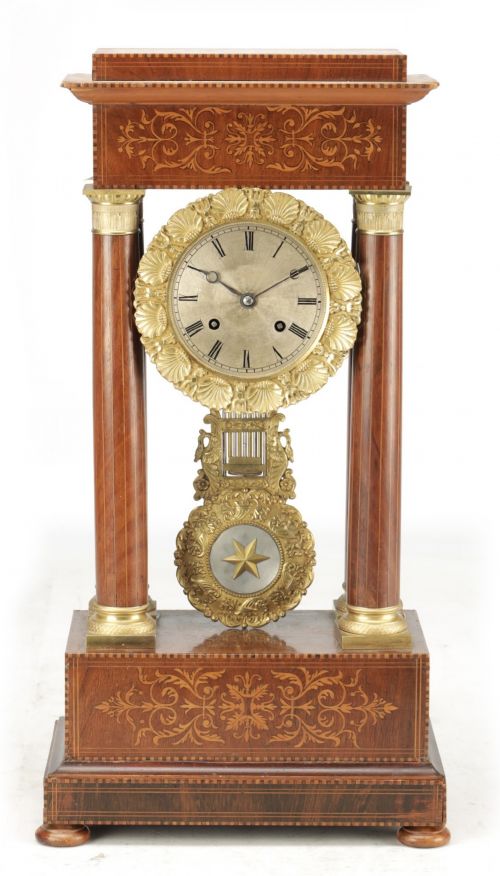


French Brass Portico Clock
These French brass portico clock examples combine striking architectural columns with precise movement, offering both dramatic visual presence and reliable timekeeping for your mantel.
French Brass Portico Clock
A french brass portico clock stands on distinct pillars supporting a classical architectural entablature, housing the pendulum movement centrally between the supports. These items appear across the Victorian era and the nineteenth century, reflecting classical architectural revivals popular during those decades.
The architectural framework typically takes the form of mantel clocks, clock garniture sets accompanied by candelabras, or table regulators. You will encounter variants constructed from rosewood, marble, or mahogany alongside brass and ormolu mounts.
Originating from French workshops, these pieces draw upon Empire, Charles X, Louis XVI, and Napoleon III stylistic influences. The suspended pendulum often swings visibly within the open central channel between the flanking columns.
What varies in quality
The refinement of the cast ormolu mounts and the precision of the architectural proportions distinguish the finer examples from standard production. Rich timber grain selection and intricate marquetry or inlay work indicate higher craftsmanship.
Complete clock garniture sets with matching candelabras demonstrate greater ambition than standalone timepieces. The integration of specialised mechanisms, such as knife edge suspension in table regulators, elevates the technical standard.
Listings feature materials such as brass, ormolu, rosewood, marble, and glass across Victorian and nineteenth century periods.
The French Brass Portico Clock Glossary
- Portico clock
- A clock featuring an architectural case with supporting columns framing a central pendulum. This design gained prominence during the nineteenth century across French decorative arts.
- Ormolu
- Gilded bronze applied as decorative mounts to clock cases and furniture. This technique creates a rich golden finish on metal components.
- Clock garniture
- A set comprising a central clock accompanied by matching decorative objects such as candelabras or urns. These sets coordinate visually to adorn a mantelpiece.
- Knife edge suspension
- A precise pendulum hanging method utilising sharp edges to minimise friction. This mechanism appears in higher grade regulators.
French Brass Portico Clock: Frequently Asked Questions
What is a french brass portico clock?
A french brass portico clock is an architectural timepiece supported by columns with a central swinging pendulum.
These pieces date primarily from the nineteenth century and incorporate styles ranging from Empire to Victorian revivals.
How do you date a portico clock?
Dating relies on identifying materials like rosewood, marble, or ormolu alongside stylistic cues from periods such as Charles X or Napoleon III.
Construction methods and dial materials also offer clear indications of the manufacturing decade.
What is a clock garniture set?
A clock garniture includes the main timepiece alongside matching decorative objects, typically a pair of candelabras.
These coordinated sets were designed to create a balanced arrangement on a mantel or sideboard.
Where were these clocks made?
These clocks originated in France during the nineteenth century, drawing on classical architectural motifs.
French makers utilised diverse materials including imported exotic woods, native marbles, and gilded bronze mounts.