
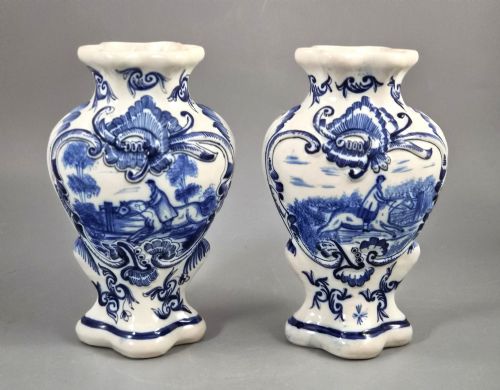
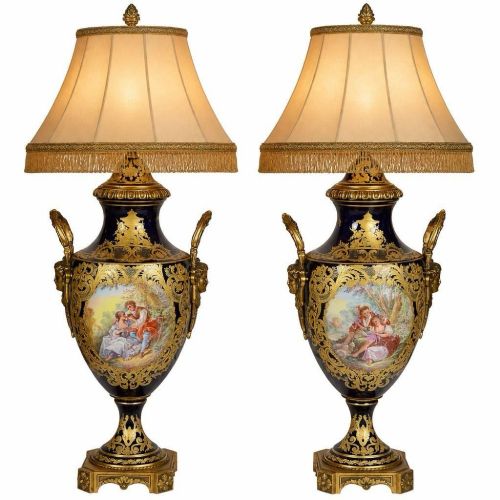


French Cobalt Blue Vases
French cobalt blue vases combine rich ceramic colour with gilt metal mounts, bringing decorative presence and nineteenth-century craftsmanship to a room.

French Cobalt Blue Vases
French cobalt blue vases span the nineteenth century and the early decades of the twentieth century, appearing as single display pieces, matched pairs, or larger garniture sets. These objects take the form of lidded urns, wide-rim vessels, and porcelain bodies adapted into table lamps.
The aesthetic leans heavily on historical revivals, with French Rococo, Empire, and Louis XVI styles frequently shaping the ceramic bodies and metal mounts. Buyers most commonly encounter Sevres style porcelain and blue glass vessels finished with decorative trim.
Many examples emerge from Paris workshops and provincial factories, replicating the grand output of royal establishments. These ornamental items served as mantel garnitures and focal points in formal nineteenth-century interiors.
Materials and technique
Makers shaped these pieces from hard-paste porcelain, majolica, faience, or coloured glass, applying deep cobalt blue oxides to achieve the signature saturated ground colour. Artisans frequently layered gold leaf, enamel, and hand-painted details over the glazed ceramic bodies.
Metalworkers added cast gilt bronze or ormolu mounts, framing the rims, handles, and bases with classical foliage and scrollwork. These metallic elements were secured to the ceramic vessels with threaded bolts or pins, combining two distinct material disciplines into a single composition.
The available listings demonstrate that nineteenth-century French cobalt blue vases frequently incorporate ormolu mounts and Sevres style porcelain forms.
Evaluating the standard of execution
Quality rests upon the crispness of the bronze casting and the depth of the fire-gilding on the ormolu mounts. Finer pieces display sharply defined chasing on the metalwork rather than soft, commercial casting textures.
The standard is further judged by the precision of the hand-painted enamel and gilding applied to the porcelain surface. Superior examples exhibit careful kiln firing that preserves the intensity of the cobalt ground without clouding the secondary details.
Fourmaintraux-Courquin·Samson of Paris·René Lalique·J and P
The French Cobalt Blue Vases Glossary
- Ormolu
- Gilded brass or bronze mounts applied to furniture, clocks, and ceramic vessels. The technique involves coating base metal with a mercury and gold amalgam before heating.
- Garniture set
- A matched group of three or more ornamental vases or urns designed to sit together on a mantelpiece. These sets typically feature a taller central vessel flanked by smaller matching pieces.
- Faience
- Tin-glazed earthenware produced in France and other European regions. It provides an opaque white ground suitable for painted decoration beneath a clear glaze.
- Majolica
- Heavy earthenware covered with an opaque coloured glaze and painted with metallic oxide colours. It gained popularity during the nineteenth century for decorative urns and vases.
- Clock garniture
- A decorative grouping comprising a mantel clock accompanied by matching side vases or candelabra. These sets formed unified ornamental displays in period drawing rooms.
French Cobalt Blue Vases: Frequently Asked Questions
How were French cobalt blue vases used?
These vessels served primarily as decorative garniture sets on mantelpieces or as standalone centrepieces in nineteenth-century drawing rooms. Many larger examples were later converted into table lamps during domestic interior updates.
They stood in formal reception rooms to signal taste and wealth through their rich blue glazes and gilded mounts. Their substantial weight and ornate proportions meant they remained static display objects rather than functional flower containers.
Are these vases made of porcelain or glass?
The listings comprise both porcelain and heavy blue glass bodies, though porcelain examples dominate the selection. Glass versions typically rely on translucent cobalt material paired with cast ormolu mounts.
Porcelain vessels provide an opaque surface that often carries hand-painted enamel scenes or gilded gilding over the blue ground. Glass variants depend on the depth of the material and the quality of the metal trim for their visual impact.
What is a Sevres style vase?
A Sevres style vase is a nineteenth-century European piece made in imitation of the royal French Sevres factory output. These items appropriate the distinctive cobalt grounds, gilded scrollwork, and classical forms associated with the historic institution.
Such pieces were produced across various Parisian workshops to satisfy a broad market for French imperial aesthetics. They capture the decorative luxury of earlier court porcelain without necessarily originating from the state manufactory.
How do you style a large garniture set?
A garniture set works best arranged symmetrically across a wide mantelpiece, sideboard, or dedicated console table. Placing the tallest urn in the centre with the matching flanking vessels creates balanced visual weight.
Because these objects command attention through their rich colour and metallic mounts, they require neutral surrounding spaces to avoid visual clutter. Pairing them with simple wooden or stone furniture allows the gilding and cobalt glaze to stand out.