

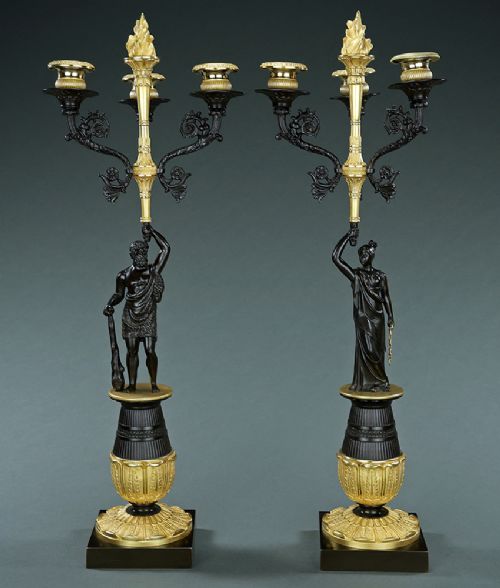


French Classical Style Candelabra
French classical style candelabra bring formal balance and rich metallic lustre to a room, drawing the eye with sculptural bronze and gleaming ormolu.
French Classical Style Candelabra
French classical style candelabra are lighting fixtures designed to hold multiple candles, originating in periods such as the nineteenth century, Victorian era, and Regency period. Buyers searching this phrase encounter pairs of heavy metal branch holders often accompanied by matching mantel clocks in complete clock garniture sets.
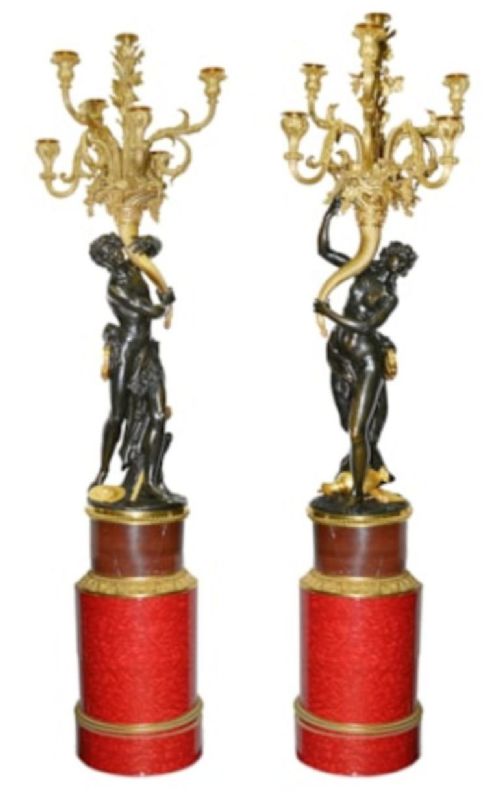
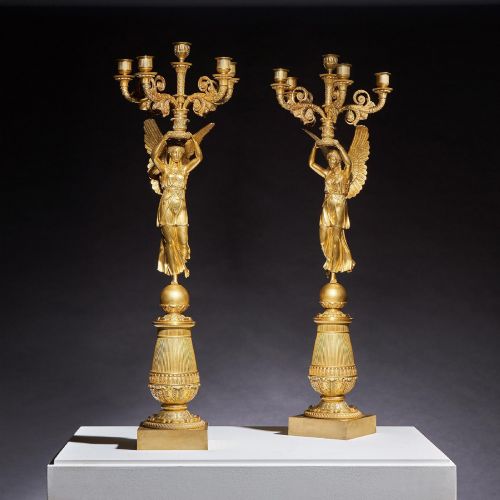
The objects displayed on this page frequently manifest as Louis XVI style or French Empire designs, incorporating classical figures like putti, maidens, and mythological heroes. Materials span cast bronze, gilded brass, and marble bases, reflecting the grand interior aesthetics of nineteenth-century France and Britain.
How they were made
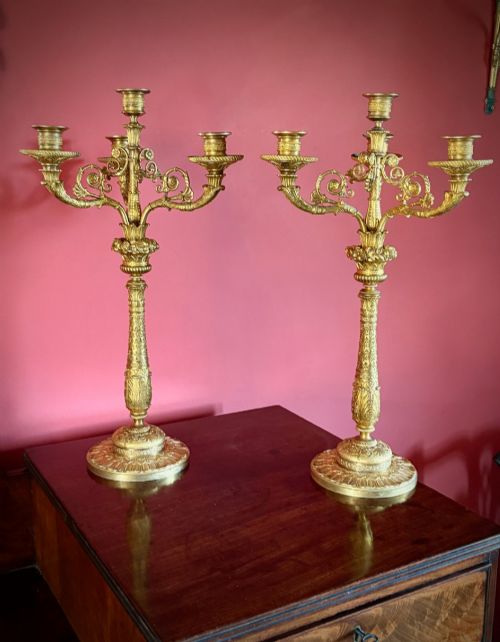
Craftsmen utilised metalcasting techniques to shape bronze, brass, and ormolu into intricate figural and botanical candle arms. Gilt bronze and fire-gilded ormolu provide the brilliant metallic surfaces characteristic of these pieces.
Hercules and Hesione occasionally stand holding your candles, reminding guests of mythological rescues while illuminating the dinner table.
What varies in quality
The choice and combination of materials also establish distinction, particularly the weight and depth of colour in the marble bases paired with fire-gilded ormolu rather than simple painted finishes.
Pierre Philippe Thomire·H Luppens Paris·Thomas Hope
The French Classical Style Candelabra Glossary
- Ormolu
- Gilt bronze produced by applying a finely ground high-carat gold-mercury amalgam to a bronze object before firing. This technique creates a durable, golden surface finish seen on many nineteenth-century pieces.
- Patinated bronze
- Bronze that has been treated chemically to produce a dark brown or greenish surface coloration. This dark finish highlights the brighter gilt elements in classical designs.
- Clock garniture
- A set comprising a central mantel clock flanked by matching decorative objects such as candelabra, urns, or vases. These matched sets created a unified decorative scheme on a fireplace mantel.
- Candelabra
- A branched candlestick holding multiple candles on separate arms. They differ from single candlesticks by distributing light across several points.
- Grand Tour
- The cultural journey undertaken by wealthy young Europeans in the eighteenth and nineteenth centuries to study classical art. Souvenirs from these travels heavily influenced nineteenth-century decorative styles.
French Classical Style Candelabra: Frequently Asked Questions
Can these candelabra be wired for electricity?
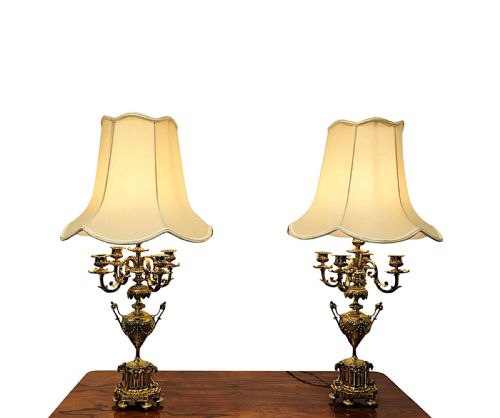
Many historical pieces have undergone conversion to table lamps over time while retaining their original metal branches. Professional electricians can often wire them safely without damaging the underlying structure.
Consider whether an electrical conversion alters the decorative intent of a period piece before proceeding with alterations.
What is a clock garniture set?
A clock garniture pairs a central mantel clock with matching side ornaments, typically a pair of candelabra or urns. These matched suites were designed to sit together on a fireplace mantel or sideboard.
The matching elements share materials, such as ormolu and marble, and decorative motifs from styles like Louis XVI and Empire.
How do I distinguish Empire from Louis XVI style?
Empire style candelabra draw on heavy Roman, Greek, and Egyptian motifs, featuring stark military trophies, classical deities, and dark patinated bronze contrasted with bright ormolu. They reflect nineteenth-century interpretations of Napoleonic grandeur.
Louis XVI style pieces lean towards lighter, more restrained neoclassical ornamentation, displaying delicate ribbons, urns, acanthus leaves, and symmetrical floral garlands associated with eighteenth-century French court tastes.