


Bronze and Marble Candelabra
When you examine bronze and marble candelabra, you find the decorative metalwork and stone bases that defined formal mantelpieces.
Bronze and Marble Candelabra
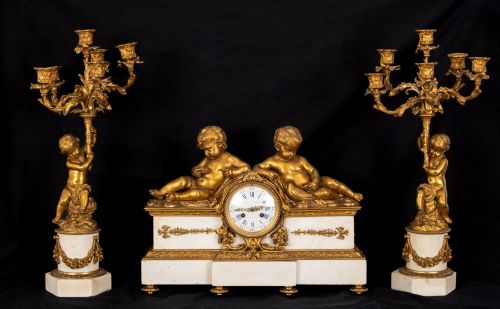
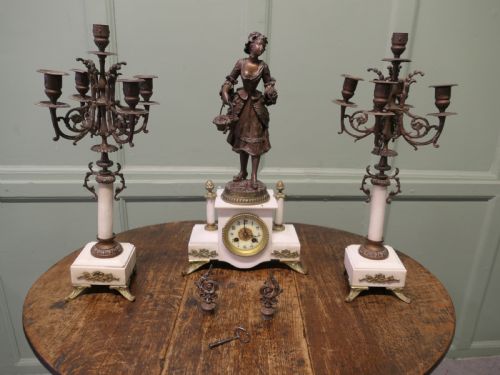
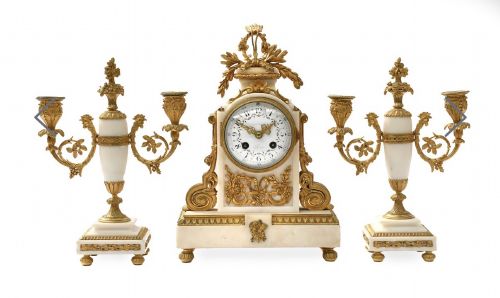
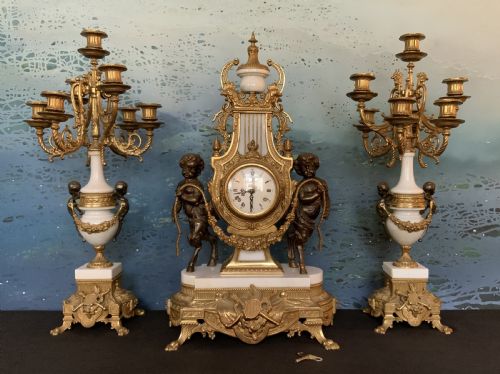
Bronze and marble candelabra combine cast metal figures or branches with carved stone plinths, often appearing alongside matching mantel clocks in larger garniture sets. The pairings span the eighteenth, nineteenth, and early twentieth centuries, with a strong concentration of nineteenth-century French manufacture.
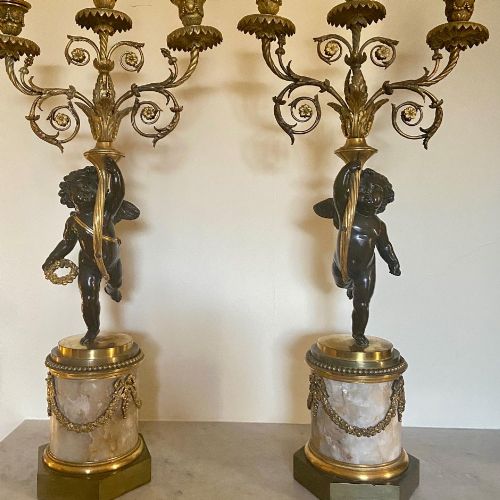
Most examples take the form of matched pairs designed to sit symmetrically on either side of a clock or fireplace centrepiece. You will frequently encounter figural motifs such as putti, cherubs, or classical maidens supporting the candle branches above circular or rectangular marble bases.
The aesthetic draws heavily on classical antiquity and French court styles, particularly Louis XVI and French Empire designs. These pieces functioned as both functional lighting and high-status decorative objects for period drawing rooms.
How they were made
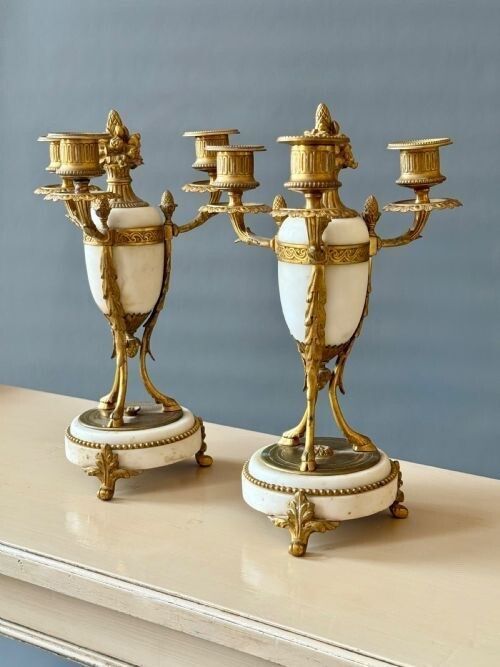
The metal components rely on bronze casting, which is then finished with patination or gilded using mercury or electroplating to produce ormolu and gilt bronze surfaces. Brass and gilt metal also appear in place of bronze on certain examples.
The bases and structural elements utilise marble, white marble, sienna marble, and porphyry, shaped by stonemasons to support the heavy metalwork. Artisans integrated these materials using threaded rods and pins to secure the figures and candle sockets to the stone plinths.
Listings show candelabra combining patinated and gilt bronze with white marble, sienna marble, and porphyry across the eighteenth and nineteenth centuries.
What varies in quality
The grade and weight of the marble plinth also indicate quality, with dense, unblemished stone and precise geometric or turned shaping commanding greater respect. Additionally, the thickness and durability of the gilding or patination reflect the original workshop expenditure.
Francois Redmond·Claude Clodion·H Luppens Paris
The Bronze and Marble Candelabra Glossary
- Ormolu
- Gilded bronze, produced by applying a gold and mercury amalgam to a bronze casting and heating it. The technique creates a durable golden surface characteristic of fine French decorative arts.
- Garniture
- A set of matching decorative objects, typically a central clock flanked by a pair of candelabra or vases. These sets were designed to coordinate mantelpiece decoration.
- Putto
- A representation of a bare-bodied male child, frequently winged, appearing often in Renaissance and later art. In these pieces, they support the candle arms.
- Patinated bronze
- Metal that has been chemically treated to alter its surface colour, usually resulting in dark brown or greenish tones. This contrasts with the bright finish of gilt bronze.
- Louis XVI style
- A neoclassical aesthetic characterised by straight lines, symmetry, and classical motifs derived from ancient Rome and Greece. It experienced major revivals during the nineteenth century.
Bronze and Marble Candelabra: Frequently Asked Questions
What is a clock garniture?
A clock garniture is a matched set consisting of a central mantel clock and two matching side pieces, such as candelabra or urns. They were produced as a unified decorative scheme for the principal rooms of grand houses.
The matching pieces repeat the materials, motifs, and metal finishes of the clock to create visual balance on a mantelpiece.
How do I date these candelabra?
Dating relies on stylistic clues, casting techniques, and the type of marble used in the base. Nineteenth-century pieces frequently revive earlier eighteenth-century French forms, making direct comparison of decorative details essential.
The presence of specific revival styles, such as Louis XVI Revival, points towards the later decades of the nineteenth century rather than the original period.
Were these originally for candles or electricity?
These pieces were originally made to hold wax candles or oil before many were later adapted for electrical wiring. Conversions to lamps often retain the original candelabra framework, allowing you to trace their initial purpose.
Examining the sockets and internal channels reveals whether the piece has undergone wiring for modern table lighting.
How do I care for bronze and marble?
Maintenance requires dry dusting with a soft cloth to protect both the delicate gilt bronze surfaces and the porous marble bases. Avoid using chemical cleaners or polishes that can strip the original gilding or stain the stone.
Moisture can damage the interior fixings and discolour the marble, so placement away from damp areas is recommended.