
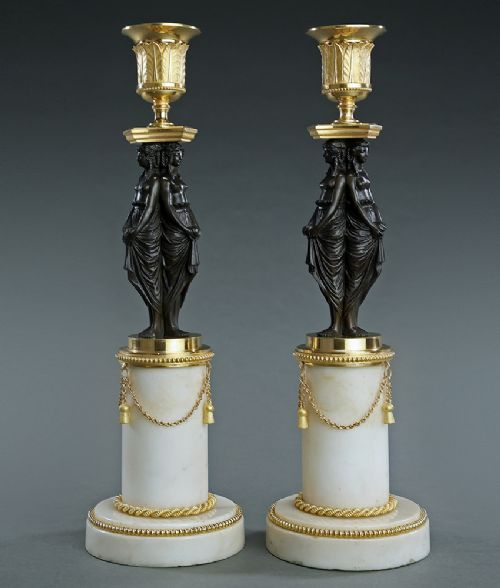


Antique Caryatid Candle Holders
These antique caryatid candle holders are sculptural figural pieces of lighting that bring classical architectural dignity straight into a room.
Antique Caryatid Candle Holders
When you search for antique caryatid candle holders, you look at figural supports modelled as draped female figures holding aloft sconces or nozzles. The pieces seen here span the Georgian, Regency, and nineteenth-century periods, drawing heavily on French Empire, Louis XVI, French Restauration, and Neoclassical styles.
Most examples take the form of candlesticks or candelabra, cast in combinations of gilt bronze, ormolu, patinated bronze, and marble, or carved from hardwood. You will also encounter works referencing specific designers or motifs, such as pieces after Dugourc, in the manner of Galle, or styled after Thomas Hope.
Grand Tour pieces and zodiac themes also appear among these nineteen-century survivals, demonstrating the broad international taste for classical antiquity during the period. The female figures act as columns, sustaining the weight of the light above them in the manner of ancient Greek architecture.
How they were made
Carved wooden examples relied on dense hardwoods shaped with gouges and chisels before receiving finishes to mimic patination or gilding. Marble bases and biscuit porcelain shafts provided contrasting textures and weight, anchoring the slender figures securely to socle mounts.
Listings for antique caryatid candle holders span the Georgian, Regency, and nineteenth-century periods, utilising gilt bronze, ormolu, bronze, marble, and carved wood.
What varies in quality
The integration of mixed materials also defines the tier of a piece, where tight joints between bronze mounts, marble socles, and porcelain shafts show precise manufacturing. Rich, even patination and high-grade fire gilding preserve their visual depth over centuries of handling.
The Antique Caryatid Candle Holders Glossary
- Caryatid
- A sculpted female figure serving as an architectural support in place of a column or pilaster. On candle holders, she bears the weight of the socket or drip pan.
- Ormolu
- Gilded bronze produced by applying a mixture of mercury and gold to a metal base and heating it until the mercury vaporised. This technique creates a durable, luminous golden surface characteristic of fine French metalwork.
- Patinated bronze
- Metal treated chemically or exposed to air to produce a dark, controlled surface oxidation. This contrast accentuates the brighter gilt elements in figural compositions.
- Grand Tour
- A cultural journey undertaken by wealthy young Europeans through France and Italy to study classical art and architecture. Souvenirs from these travels included bronze and marble antiquities and miniature sculptures.
- Socle
- A short plinth or pedestal supporting a sculpture, vase, or candlestick. It provides a stable footing and lifts the figural base off the furniture surface.
Antique Caryatid Candle Holders: Frequently Asked Questions
What is a caryatid candle holder?
A caryatid candle holder is a lighting device featuring a sculpted female human figure acting as the stem or central support. These pieces draw on ancient Greek architectural traditions where draped figures support entablatures.
In domestic settings, they served both a practical lighting function and a decorative role, displaying classical learning and refined taste during the Georgian and nineteenth-century periods.
How do I date an antique caryatid candle holder?
Dating relies on examining the casting quality, the composition of the metal alloys, and the stylistic vocabulary of the period, such as French Empire or Regency. Details in the dress, hair styling, and the secondary materials like marble or biscuit porcelain offer further clues.
Earlier pieces from around eighteen hundred often display sharper hand-chasing and heavier mercury gilding than later nineteenth-century revival works.
Where were these candle holders placed?
In period interiors, they stood upon mantelpieces, pier tables, or sideboards, often arranged as matched pairs flanking a mirror or clock. Their sculptural presence made them focal points in formal drawing rooms and dining rooms.
Because they were made of heavy metals like bronze and ormolu, they remained in fixed positions rather than being carried about the house.
What is the difference between ormolu and gilt bronze?
Ormolu specifically refers to historic gilt bronze created using a mercury-gilding technique common in eighteenth- and early nineteenth-century France. The term is often used interchangeably with gilt bronze, though mercury gilding yields a distinct, deep lustre.
Later Victorian and continental pieces sometimes utilised electroplating, which produces a different surface texture and uniformity compared to fire-gilt ormolu.