
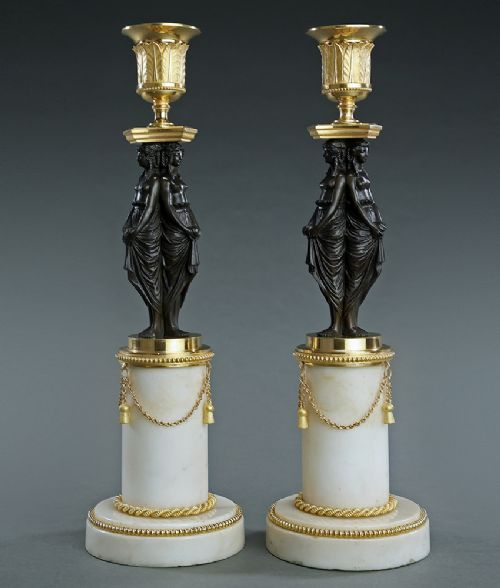


Caryatid Bronze Candlesticks
Caryatid bronze candlesticks bring classical sculpture onto the table, offering sculptural figures that support the candle nozzle.
Caryatid Bronze Candlesticks
When you search for caryatid bronze candlesticks, you encounter figural lighting where sculpted maiden forms serve as the central shaft. These pieces appear primarily across the nineteenth century, including Georgian, Regency, and French Empire periods.
The designs draw heavily on neoclassical vocabularies, referencing French Empire, Louis XVI, and Grand Tour aesthetics. Forms range from single candlesticks to paired candelabra and table lamps.
Most examples combine classical architectural motifs with functional lighting. The figures frequently stand upon marble or bronze bases, holding aloft sockets for candles.
How they were made
Selected pieces incorporate contrasting materials such as biscuit porcelain shafts or marble bases. These elements were turned, carved, and fitted together mechanically to create stable table ornaments.
Maidens double as architecture.
What varies in quality
Quality depends upon the crispness of the chasing and the contrast between the dark patinated bronze and the bright ormolu. Finer castings preserve the subtlety of facial expressions and the intricate folds of classical drapery.
The choice of secondary materials marks the distinction between standard production and superior execution. Dense marble plinths and finely articulated biscuit porcelain components elevate the overall presence of the object.
Thomas Hope
The Caryatid Bronze Candlesticks Glossary
- Caryatid
- A sculpted female figure serving as an architectural support in place of a column or pilaster. This classical motif forms the central pillar of the candlestick.
- Ormolu
- Finely ground high-carat gold applied to a bronze base using a mercury amalgamation technique. It provides a rich, warm surface finish distinct from modern plating.
- Patinated bronze
- Bronze treated with chemical solutions to produce a darkened, stable surface coloration. This dark finish contrasts sharply against gilded or ormolu highlights.
- Grand Tour
- A traditional trip of Europe undertaken by upper-class young European men of means to flourish their education. Souvenirs from these journeys often included classical bronzes and small-scale sculpture.
Caryatid Bronze Candlesticks: Frequently Asked Questions
What periods do they date from?
The pieces span the nineteenth century, drawing heavily on Georgian, Regency, and French Empire stylistic traditions.
They reflect neoclassical revivals popular throughout Europe during this era.
How were they used originally?
They served as portable lighting devices on dining tables, mantelpieces, and sideboards.
Their figural designs ensured they functioned as decorative sculpture even when unlit.
Are they found in pairs?
Many examples survive as matched pairs intended for symmetrical placement on furniture.
Single pieces also appear, often representing Grand Tour souvenirs or remnants of larger garnitures.
What materials make up the base?
Bases frequently incorporate white or coloured marble alongside cast bronze mounts.
These heavy materials provide necessary structural stability to support the upright figure.