
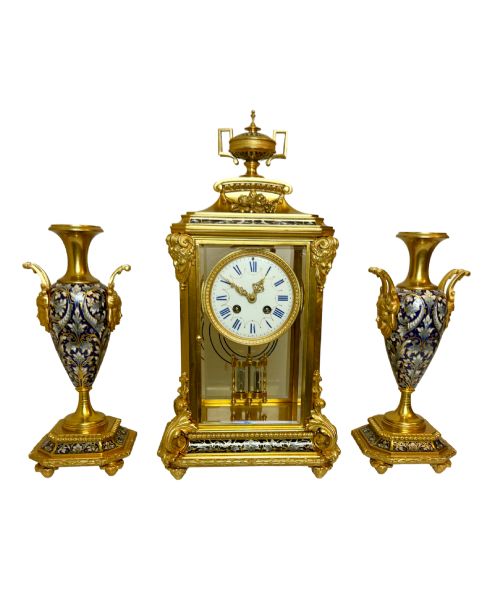


French Champleve Mantel Clock
These heavy metal cases hold bright enamel cells, offering a glimpse into nineteenth-century domestic timekeeping.
French Champleve Mantel Clock
A french champleve mantel clock combines cast metal frameworks with recessed enamel decoration, appearing frequently alongside matching garniture sets and four glass crystal regulators.
The objects stem predominantly from the late nineteenth century, spanning Victorian, Napoleon III, and Belle Epoque periods of French manufacture.
Forms range from compact carriage clocks and bedside timepieces to grand clock garniture sets anchored by bronze, onyx, or gilt brass plinths.
Materials and construction
Foundries cast brass, bronze, or ormolu into structural frames, shaping them with rococo curves, classical columns, or bevelled glass panels.
Artisans hollowed troughs into the metal surface directly, filling these depressions with coloured glass pastes before firing the piece to a hard, polished finish.
Some miniature bedside clocks are small enough to pack into a leather travelling case for nocturnal timekeeping.
Judging the work
Quality rests in the crispness of the cast metal mountings and the depth of the hand-carved enamel recesses, where sharper lines separate finer workshop output from simpler commercial production.
The integration of the movement dictates utility, as fully restored mechanisms with repeating functions and hand-painted dials represent the upper tier of surviving examples.
Le Roy and Fils·Samuel Marti·Vincenti·Leroy Paris
The French Champleve Mantel Clock Glossary
- Champleve
- An enamelling technique where troughs are dug into a metal surface and filled with vitreous paste before firing. This creates flat, patterned colour bounded by thin metal walls.
- Ormolu
- Gilded bronze produced by applying a mercury and gold amalgam to a cast bronze base. The process yields a deep, warm metallic sheen seen across many nineteenth-century French clock cases.
- Garniture set
- A matching centrepiece clock flanked by decorative side ornaments such as urns or candelabra. These matched groupings were designed to sit together on a mantelpiece.
- Crystal regulator
- A clock housed within bevelled glass panels held by a brass or bronze skeleton frame. This construction allows light to pass through the movement from multiple angles.
French Champleve Mantel Clock: Frequently Asked Questions
How do I wind the clock?
Most models require a dedicated winding key inserted into arbors on the dial face to tension the spring-driven going and striking trains.
Care must be taken not to overwind the movement, stopping as soon as resistance is felt.
Where should I place it?
These heavy metal and glass pieces need a stable, level surface such as a wooden mantelpiece or sideboard where vibrations are minimal.
Keeping them away from direct sunlight protects the delicate glass enamel colours from fading over time.
Why does the clock run fast or slow?
Pendulum regulation typically requires small adjustments via a square nut located on the pendulum bob to alter its effective length.
Temperature changes in the room can also affect the metal components and influence the beat rate.
How do I identify the period?
Stylistic cues such as heavy bronze casting point towards Napoleon III or Second Empire dates, while lighter floral motifs often signal Belle Epoque production.
Movement backplates frequently bear maker stamps and serial numbers that help narrow down the decade of manufacture.