


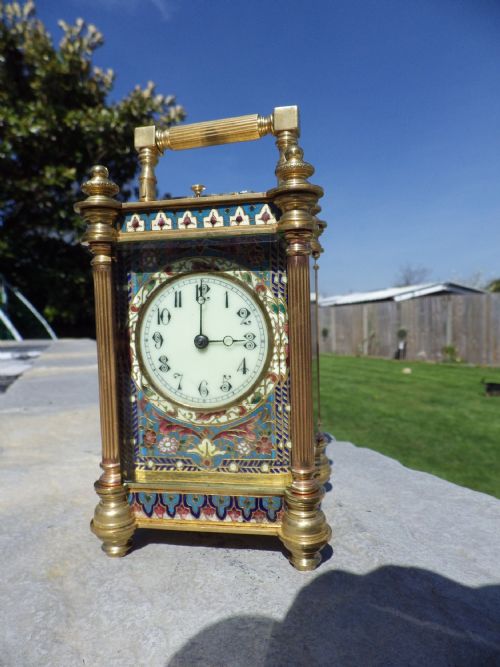


Gold Champleve Clock
These gold champleve clock pieces bring vibrant enamelled metalwork and heavy gilt brass to desks and mantelpieces, offering the polished mechanical elegance collectors seek.
Gold Champleve Clock
When you search for a gold champleve clock, you enter a field dominated by French mantel clocks, carriage clocks, and miniature bedside timepieces dating from the Victorian period through to nineteen hundred. These pieces combine metal frames in gilt bronze, ormolu, and brass with recessed coloured enamel compartments.
The version you are most likely to meet on this page is a French mantel clock or carriage clock from the late nineteenth century, often featuring visible glass panels and intricate hand-painted dials.
Beyond the standard mantel and carriage formats, the selection occasionally encompasses novelty desk pieces, strut easel clocks, and complete clock sets originating from French and English workshops.
How they were made
Makers constructed these clocks using heavy cast bronze, brass, or ormolu as the structural base, then chased the metal surface to create sunken troughs for the enamel work. Artisans filled these carved channels with vitreous enamel paste before firing the metal casing at high temperatures to fuse the coloured glass powder.
Following the firing process, the gilt surfaces received detailed burnishing while the enamel panels were ground flush and polished smooth to sit level with the surrounding metal mountings. Mechanical movements were then fitted into the housing, featuring striking trains or repeating mechanisms alongside hand-painted ceramic or enamel chapters.
Listings feature items from the Victorian, Edwardian, and Art Deco periods, utilising gilt brass, ormolu, and glass.
What varies in quality
The distinction between standard production pieces and finer examples rests on the depth of the metal chasing and the complexity of the polychrome enamel patterns. Superior cases exhibit crisp, deeply cut channels in the gilt bronze rather than shallow surface colouring, alongside heavier casting weights.
Mechanical refinement further separates the range, with higher-tier pieces housing complex repeating movements or signed escapements by notable makers. The integration of matching side garnitures or specialised desk stands also elevates the overall standard of an individual timepiece.
Le Roy and Fils·Barwise London
The Gold Champleve Clock Glossary
- Champleve enamel
- A technique where troughs or cells are hollowed out of a metal surface and filled with vitreous enamel before firing. This method creates bold coloured designs bordered by thin metal lines.
- Ormolu
- A gilded bronze finish applied to decorative metalwork using a mercury amalgam or modern electroplating method. It imparts a bright golden lustre to clock cases and mounts.
- Carriage clock
- A portable spring-driven timepiece originally designed for travel during the nineteenth century. These clocks typically feature brass cases with glass panels and a swinging carrying handle.
- Repeating movement
- A mechanical clock mechanism that chimes the hours and quarters upon demand when a lever or button is pressed. This complication requires intricate internal gearing.
- Diamonte
- Small cut crystals or rhinestones set into metal mounts to provide decorative sparkle. They frequently accent the bezels and dials of late Victorian pieces.
Gold Champleve Clock: Frequently Asked Questions
Where should I place a bronze mantel clock?
Position your mantel clock on a stable, level surface away from direct sunlight, draughts, and damp environments. Heavy bronze and gilt brass pieces require robust support due to their substantial weight.
Keep them clear of exterior doors and vibrating walls to ensure the pendulum or balance wheel maintains a steady, even beat.
How do I identify a Victorian clock?
Victorian clocks often bear registration marks, specific maker signatures, or stylistic cues rooted in nineteenth-century revival movements. Examine the casting quality and the construction of the movement backplate for period indicators.
French imports from this era frequently feature numeric date stamps or maker initials stamped directly onto the brass movement plates.
What is the difference between a timepiece and a striking clock?
A basic timepiece contains only the gear train required to keep and show the time. It lacks any mechanical components for sounding the hours or quarters.
Striking clocks include an additional gear train and hammer mechanism that hits a bell or gong at designated intervals.