


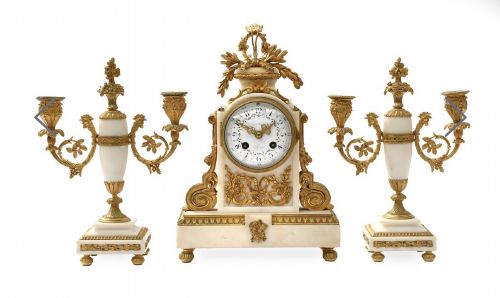


French Bronze Clock Garniture
A french bronze clock garniture brings together a central mantel clock and matching side pieces to anchor a room with period proportion.

French Bronze Clock Garniture
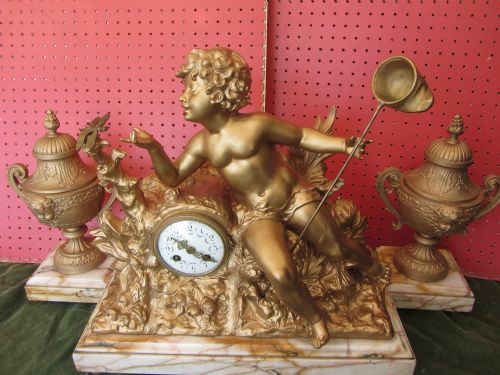
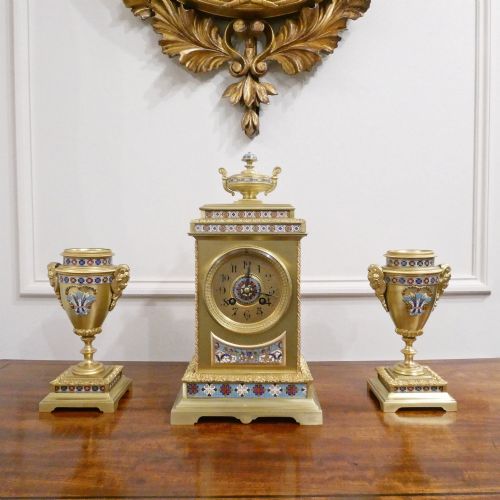
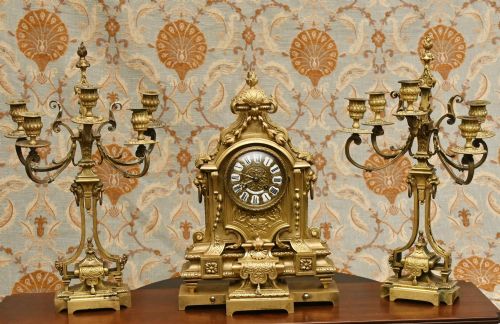
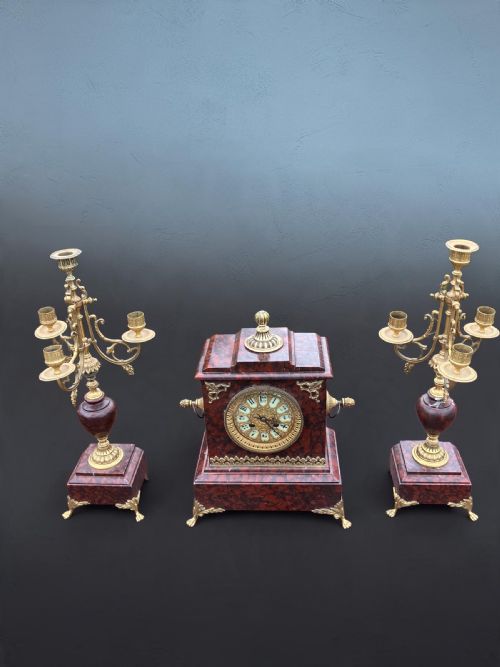
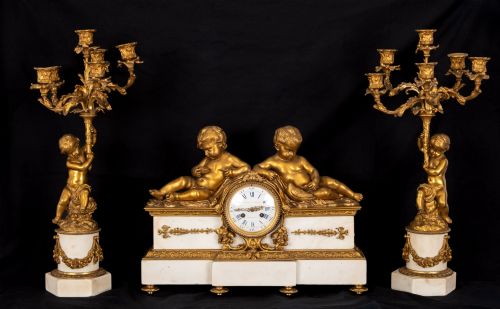
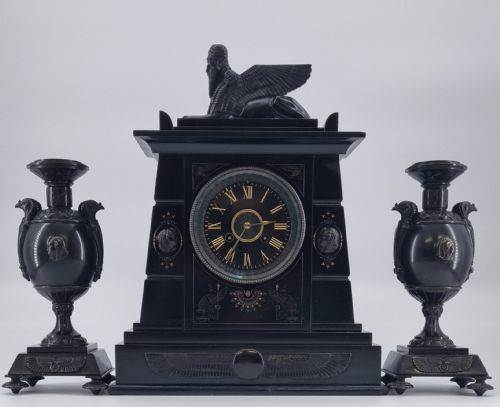
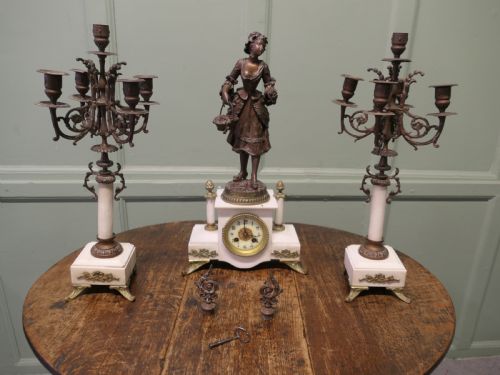
A french bronze clock garniture consists of a main mantel clock accompanied by matching side ornaments such as candelabras, urns or figures designed to sit in symmetry on a chimneypiece. These three-piece sets appear most frequently in nineteenth-century interpretations spanning the Victorian era, Louis XVI Revival and French Empire styles.
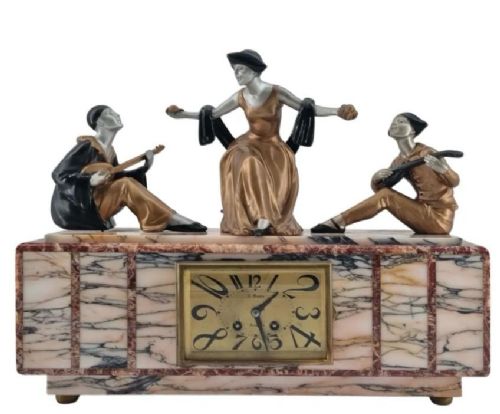
The materials combine heavy metals with mineral bases, pairing cast bronze or ormolu with white, red, siena or black marble, onyx, slate and porcelain. Central movements often drive matching sidepieces that share the decorative vocabulary of the primary dial, utilising cherubs, classical motifs or floral mounts.
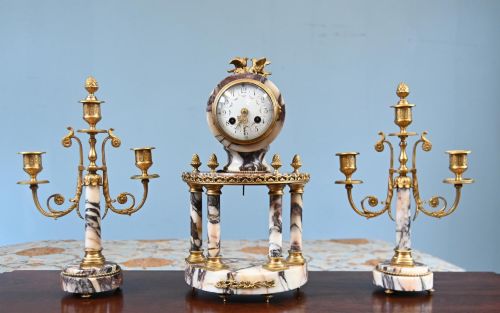
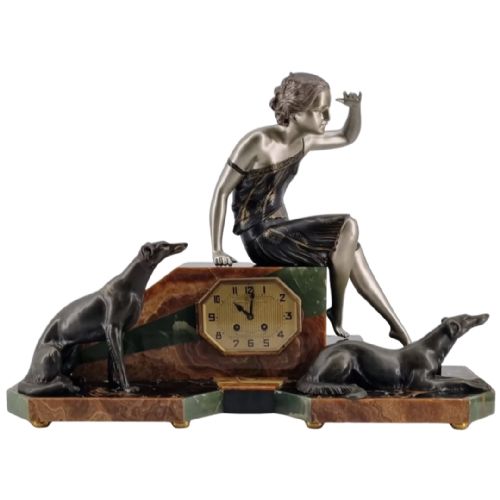
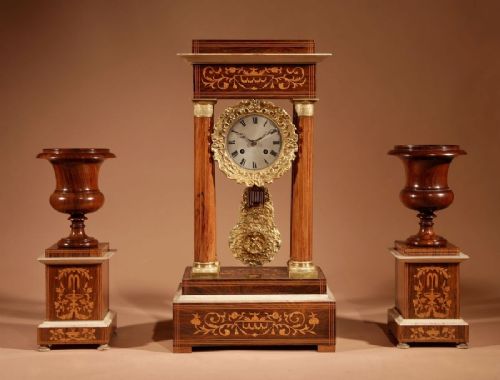
Forms range from portico clocks and lyre designs to figural subjects including Pierrot and Columbine, greyhounds and dancing girls. Buyers encounter pieces housed beneath glass domes as well as grander iterations accompanied by multi-light candelabras.
Materials and construction
Foundries cast bronze and brass components before applying mercury gilding to produce ormolu finishes, or patinating the metal to darker tones. These metal mounts are pinned or screwed to marble, onyx or slate plinths shaped by stonemasons.
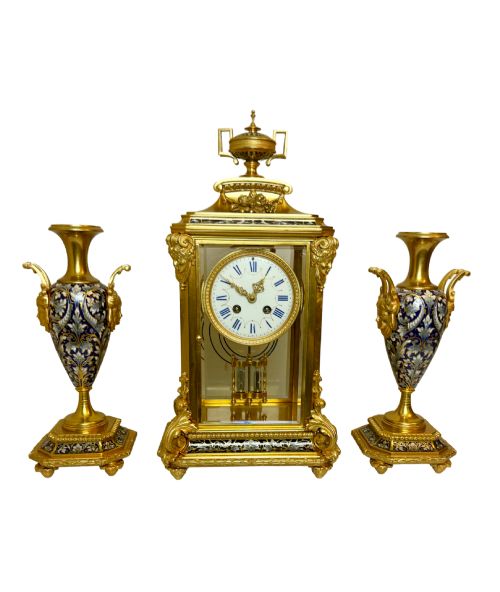
Dial faces incorporate vitreous enamel with painted Roman or Arabic numerals, frequently protected behind convex glass bezels. Some incorporate champleve or cloisonne enamel panels alongside porcelain elements in bleu de roi.
French Bronze Clock Garniture Retail Price Guide 2026
Typical asking prices for french bronze clock garniture among the pieces listed under this phrase on Sellingantiques today, from the lower quarter to the upper quarter. They describe what is for sale here now, not the wider market.
Listings feature nineteen-century French and Art Deco pieces combining gilt bronze, marble, onyx, enamel and porcelain.
Distinctions in quality
The crispness of the bronze casting dictates the definition in scrollwork, foliage and figural anatomy, separating sharp hand-chased ornamentation from soft mass-produced copies. Heavier marble and onyx bases with integrated mounts show greater structural ambition than simpler slate foundations.
The presence of signature marks from known makers or retailers on the movement backplate or dial indicates workshop origin. Complete three-piece sets retaining their original matched sidepieces and undamaged enamel dials carry more architectural integrity than mismatched assemblies.
Henry Dasson·A.D Mougin
The French Bronze Clock Garniture Glossary
- Ormolu
- Gilt bronze produced by applying a mercury and gold amalgam to a cast bronze object and firing it to drive off the mercury. This technique creates a durable golden finish seen across nineteenth-century French metalwork.
- Garniture
- A matching set of ornamental objects designed to be displayed together on a mantelpiece or sideboard, typically comprising a central clock flanked by two matching vases or candelabras.
- Champleve
- An enamelling technique where troughs or cells are hollowed out of the metal surface and filled with vitreous enamel paste before firing. The surrounding metal lines remain visible to form the pattern.
- Portico clock
- A mantel clock featuring an architectural case supported by four columns reminiscent of a classical portico. These structures often house a suspended pendulum swinging within the open central space.
- Bleu de roi
- A deep rich royal blue ceramic glaze developed at the Sèvres porcelain factory. It frequently provides a contrasting backdrop for gilded mounts on decorative clock faces and urns.
French Bronze Clock Garniture: Frequently Asked Questions
How do I maintain the movement?
Mechanical movements require professional cleaning and lubrication every few years to keep the gear train functioning properly. Avoid applying household oils directly to the brass components.
Ensure the clock rests on a level surface to keep the pendulum beating evenly. Gentle handling during winding preserves the tension in the springs.
What periods do these clocks represent?
The listings span the nineteenth century into the early twentieth, covering Victorian production, the Second Empire and Art Deco movements. Revival styles look back to Louis XVI and Charles X aesthetics.
Stylistic markers like floral garlands, classical urns or geometric motifs help pinpoint the era of manufacture. Many pieces date specifically from the eighteen-fifties through to nineteen-twenty.
How were garnitures displayed?
Sets were arranged symmetrically on a mantelpiece above a fireplace, with the central clock flanked by the two matching candelabras or vases. This layout created balanced proportions across the chimneypiece.
Some delicate or high-status sets sat upon matching brackets or beneath glass domes to protect the gilt surfaces from dust and smoke.
Are the side pieces always functional?
Side pieces often serve as decorative bookends to the clock, though many function as candelabras configured for multiple candles. Others take the form of covered urns or figural sculptures matching the theme of the central dial.
Their primary role is visual balance, echoing the materials and bronze mounts of the clock housing.