


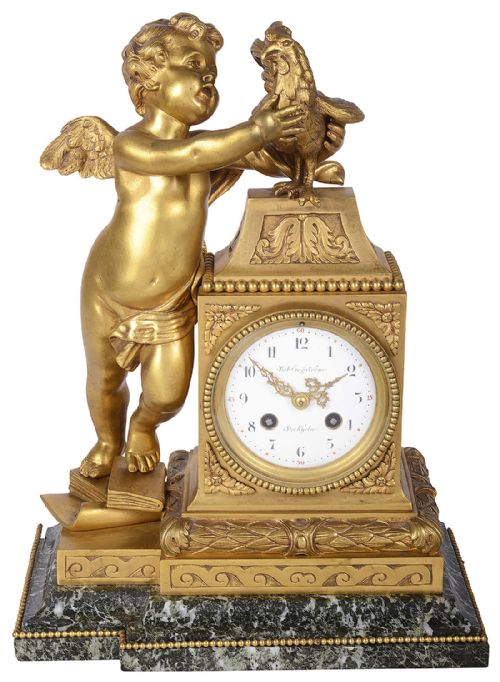

Vintage Green Marble Clock
A vintage green marble clock brings striking geological colour and heavy mineral mass to a mantelpiece.

Vintage Green Marble Clock
A vintage green marble clock comprises heavy desk and mantel timepieces constructed primarily from polished mineral stone alongside brass, chrome, and slate. These items range from compact alarm timepieces to large garniture sets complete with flanking ornaments or sculptural figures.
The pieces appearing in this selection span the Victorian era and the nineteen-thirties, covering Victorian architectural designs, French classical revivals, and geometric Art Deco forms. Buyers encountering this phrase will find mantel clocks as well as combined desk lamps and clock sets.
Makers and retail houses represented in the selection include Elliott, DEP, Michel Decoux, Ferdinand Priess, Garrards, and Pinchon Fils de Paris. The material palette frequently incorporates green onyx alongside green marble, paired with enamel dials and glass bezels.
Materials and construction methods
The primary structure relies on dense blocks of green marble or green onyx, shaped into classical architectural porticos or streamlined Art Deco geometric profiles. Stonemasons cut and polished the mineral slabs to reveal natural veining and deep tonal variations.
Metal components such as brass, chrome, and gilt mountings are integrated into the stone housings to frame enamel clock faces and protect them behind glass bezels. Sculptural elements cast in metal, including animal figures by artists like Michel Decoux and Ferdinand Priess, are frequently mounted directly onto the marble bases.
Vintage Green Marble Clock Retail Price Guide 2026
Typical asking prices for vintage green marble clock among the pieces listed under this phrase on Sellingantiques today, from the lower quarter to the upper quarter. They describe what is for sale here now, not the wider market.
Factors determining quality
The distinction between standard examples and superior pieces rests on the complexity of the stone housing and the presence of artistic metalwork. Elaborate Victorian architectural cases and sculptures by recognised artists elevate the standing of a timepiece above simple geometric blocks.
Integration of matched garniture sets, comprising flanking ornaments or matching lamps alongside the central clock, indicates a higher grade of production. The precision of the movement, the legibility of the enamel dial, and the quality of the subsidiary signatures also mark the upper tier of the range.
Elliott·Michel Decoux·Ferdinand Priess·Garrards·Pinchon Fils Paris
The Vintage Green Marble Clock Glossary
- Garniture set
- A matching centrepiece clock accompanied by flanking decorative objects or matching lamps designed to sit together on a mantel. These sets create a balanced architectural display across a fireplace.
- Green onyx
- A translucent banded form of microcrystalline quartz frequently utilised interchangeably with green marble in these timepieces. It possesses a smooth surface polish and distinct natural banding.
- Enamel dial
- A metal clock face coated with fused glass powder to create a smooth, glossy white or cream surface for painted numerals. This technique prevents the face from discolouring over decades.
- Art Deco
- A design style emerging in the early twentieth century characterised by streamlined geometric shapes and stylised motifs. Clocks from this period favour symmetrical stone blocks and chrome detailing.
Vintage Green Marble Clock: Frequently Asked Questions
What is a clock garniture set?
A clock garniture set includes a central timepiece accompanied by matching side ornaments or matching lamps designed to be displayed together on a mantelpiece. These matched groupings were popular in Victorian and Art Deco interiors to create a cohesive decorative arrangement.
The matching pieces share identical stone materials, such as green marble or green onyx, along with matching brass or bronze mounts. They provide a balanced visual anchor for a room's focal point.
How do I care for marble clocks?
Caring for a stone timepiece involves dusting the polished surfaces regularly with a soft, dry cloth to prevent grit accumulation. Avoid using chemical cleaners or abrasive pads that can dull the high gloss finish of the marble or onyx.
Keep the clock away from direct sunlight and damp environments to protect both the stone integrity and the internal mechanical movement. Professional servicing every few years ensures the mechanical gears continue to run accurately.
How do I distinguish Victorian from Art Deco?
Victorian examples frequently display classical architectural elements, ornate cast metal details, and heavy sculptural garnitures. The stone housings often mimic ancient porticos, columns, or elaborate scrollwork.
Art Deco models rely on streamlined geometric silhouettes, chrome accents, and minimalist stepped profiles. The stone is cut into clean, angular blocks, sometimes featuring modern figurative sculptures by makers like Ferdinand Priess or Michel Decoux.
Are these clocks very heavy?
These timepieces are exceptionally heavy due to the solid blocks of green marble, green onyx, and slate used in their construction. The dense mineral mass requires a sturdy mantelpiece or firm desk surface for safe placement.
When moving the clock, lift it from the base rather than any projecting decorative elements or handles. Two people may be required to safely relocate larger garniture pieces.