
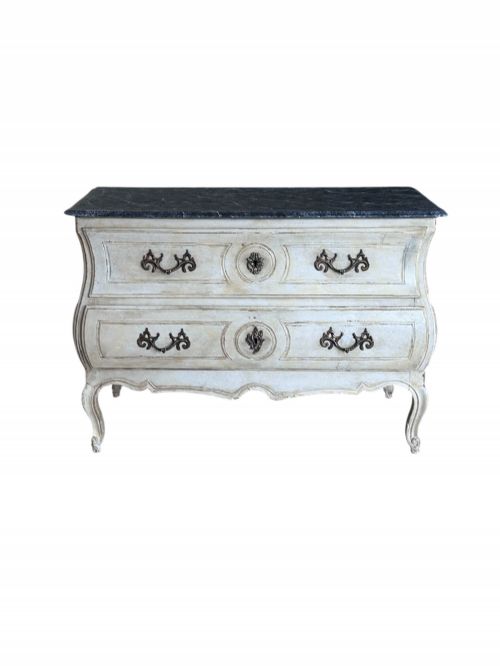
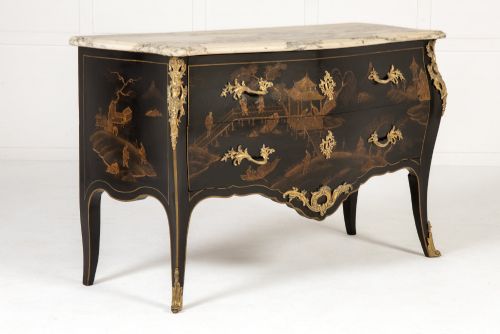


French Bombe Sideboard
A french bombe sideboard brings curving, swelling contours and generous proportions to a room.
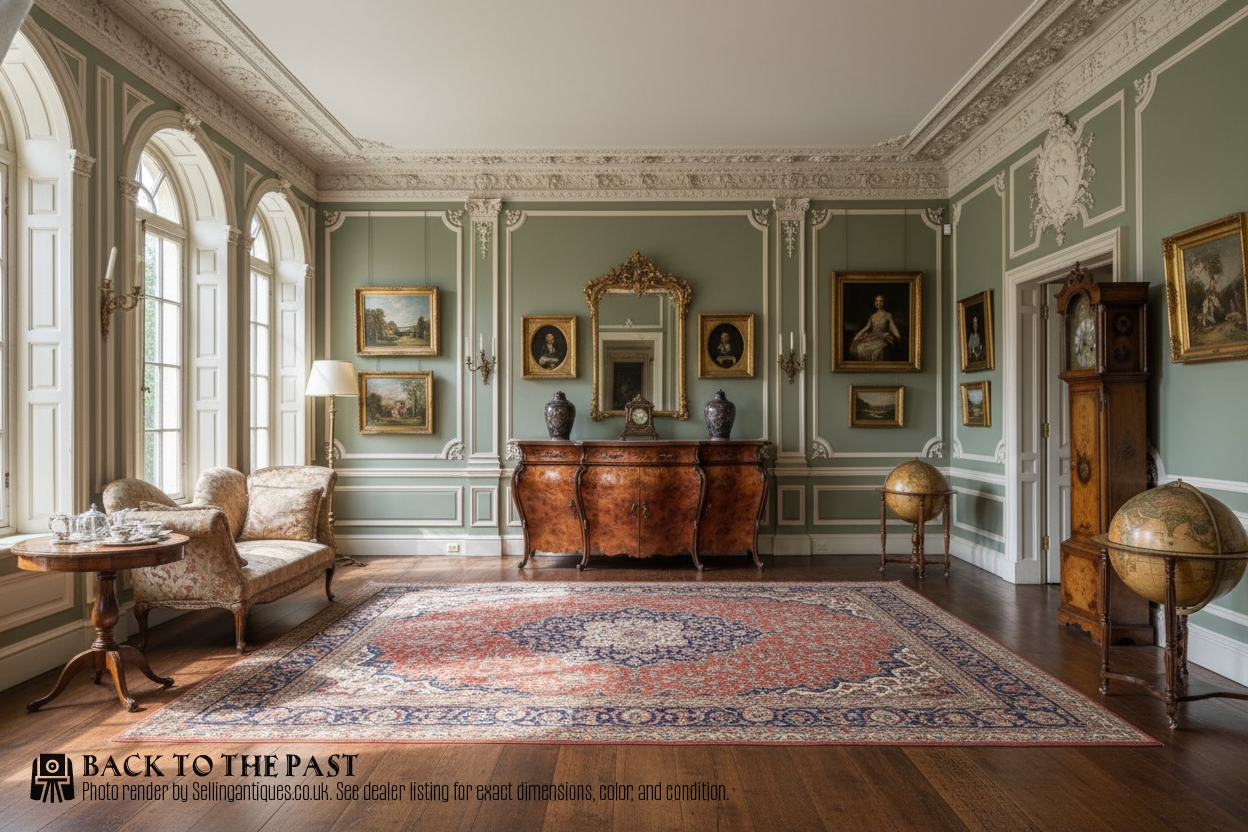
French Bombe Sideboard
A french bombe sideboard search brings up robust storage pieces defined by their convex swelling fronts and sides, rooted in historic cabinet-making traditions. Buyers encounter grand commodes and sideboards spanning the eighteenth century through to later revivals around nineteen hundred.
The selections on this page range from eighteenth-century provincial painted commodes and kingwood veneered chests to later nineteenth-century Louis XV revival pieces. Cabinet makers shaped these forms with serpentine outlines and substantial marble tops.
Originating primarily from French workshops, these items serve as commanding focal points in a dining room or hallway. The inventory displays various interpretations of the style, incorporating marquetry, japanned lacquer, and gilt bronze mounts.
How they were made
Workshops built these carcases using solid timbers such as walnut and mahogany, upon which cabinet makers applied decorative veneers like kingwood. The characteristic bulging profile required skilled shaping of both the internal framing and the external wood layers.
Mounts cast in bronze and ormolu were chased and applied to protect and ornament the corners, feet, and drawer pulls. Heavy marble slabs, shaped to match the undulating contours of the commodes, finished the upper surfaces.
Some commodes hide their curves so well they make walls look positively embarrassed by comparison.
What varies in quality
The sophistication of the timber veneers and the precision of the marquetry patterns set finer examples apart from simpler pieces. Master workshops employed intricate cuts of kingwood and walnut that follow the difficult curves without buckling.
The execution of the ormolu and bronze mounts dictates the level of refinement, with crisper chasing showing superior foundry work. Heavier, precisely fitted marble tops also indicate higher ambition in the original commission.
GERMAIN LANDRIN
The French Bombe Sideboard Glossary
- Bombé
- A swelling, outward-curving contour characteristic of furniture fronts and sides. This bulging profile required expert woodworking to achieve the curved silhouette.
- Ormolu
- Gilt bronze mounts applied to furniture for decoration and protection. The technique involves treating bronze with a gold amalgam.
- Kingwood
- A dense, richly grained timber utilised for veneers in cabinet-making. It appears frequently in eighteenth-century French pieces.
- Marquetry
- The art of applying pieces of veneer to a structure to form decorative patterns. Craftsmen utilised various woods to create pictorial or geometric designs.
- Japanned
- A style of European decorative finishing that emulates East Asian lacquerware. This technique employs dark varnishes and painted details.
French Bombe Sideboard: Frequently Asked Questions
Where should I place a French bombe sideboard?
These substantial pieces anchor a dining room, hallway, or spacious drawing room where their curved profiles can be viewed without obstruction. Their deep proportions require adequate floor space to allow the swelling silhouette to stand clear.
Because many feature heavy marble tops and prominent ormolu mounts, positioning them away from heavy household traffic prevents accidental knocks. They function well against flat walls where the three-dimensional movement of the front creates contrast.
How do I clean marble tops safely?
Wipe the marble surface regularly with a soft, damp cloth using plain warm water to remove dust. Avoid acidic cleaners, vinegar, or citrus products that etch the polished stone.
Dry the surface thoroughly with a clean lint-free cloth after washing. For stubborn marks, consult a specialist stone restorer rather than applying abrasive household chemicals.
How do I care for the wood veneer?
Keep wooden surfaces away from direct sunlight and strong heat sources to prevent the veneers from drying out or splitting. Dust gently with a dry microfiber cloth rather than using silicone sprays.
Apply a traditional beeswax polish sparingly when the wood appears dry, buffing it gently to maintain a soft sheen. Avoid excessive moisture during cleaning to protect the underlying glue and marquetry joints.
How do I date a piece?
Examine the construction methods visible inside the drawers and along the backboards, looking for hand-cut joints and tool marks. Eighteenth-century examples often display older timber shrinkage and specific hand-planed surfaces.
Compare the style of the ormolu mounts and veneer patterns against known historical periods like the Regency or Louis XV eras. Later revivals around nineteen hundred often utilised machine-assisted techniques and distinct hardware styles.