

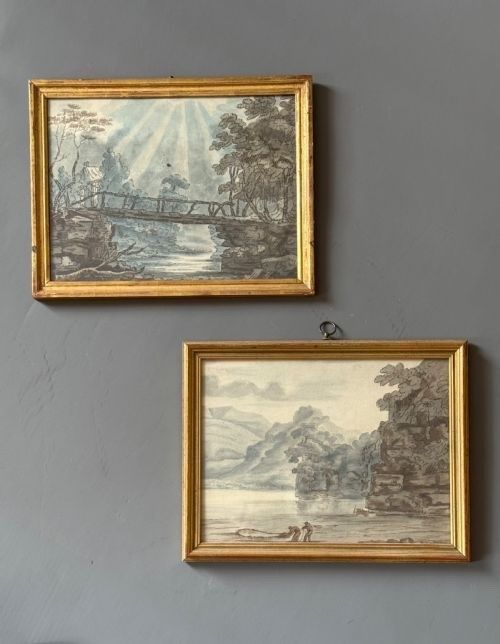
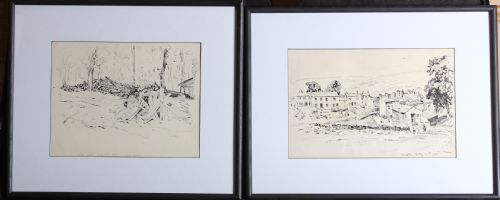
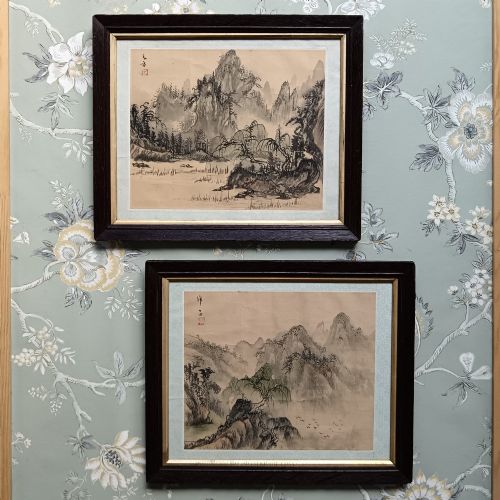
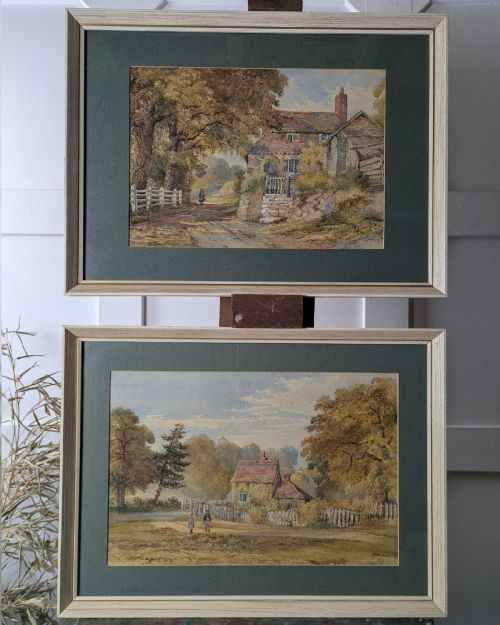


Framed Watercolour Landscape Pair
A framed watercolour landscape pair delivers balanced harmony to a wall through matching views painted side by side.
Framed Watercolour Landscape Pair
A framed watercolour landscape pair brings together two related painted views designed to hang side by side on a wall. When someone searches for a framed watercolour landscape pair, they encounter original works executed on paper, often depicting rural vistas, coastal scenes, or moorland views.
The selections on this page span from the mid-nineteenth century through the Edwardian era and into the mid-twentieth century. These works frequently arrive in wood, gilt wood, or ebonised frames protected beneath glass.
Materials and Technique
Artists painted these watercolours, gouache, and ink works directly onto paper sheets using water-soluble pigments. Many pieces employ sepia or full colour to capture light and shadow across landscapes and marine views.
Makers housed these original paintings within wood, gilded wood, or ebonised frames, frequently securing them behind glass to protect the delicate pigment and paper from atmospheric moisture and dust.
Framed Watercolour Landscape Pair Retail Price Guide 2026
Typical asking prices for framed watercolour landscape pair among the pieces listed under this phrase on Sellingantiques today, from the lower quarter to the upper quarter. They describe what is for sale here now, not the wider market.
Listings feature watercolours spanning the Victorian and Edwardian periods, executed on paper within period wooden and gilt frames.
Distinctions in Quality
The distinction between standard works and finer examples lies in the confidence of the brushwork and the precision of the topographical detail. Superior watercolours demonstrate a deft handling of light and atmospheric depth, whereas lesser examples remain flat and formulaic.
The preservation of the paper and the retention of original framing materials significantly influence the integrity of a pair. Intact period frames and clean, unbleached paper support the lasting character of the artwork.
Robert A. Nottingham·Fred Lawson·Th. Thibault·F.J. Snell·Alfred George Morgan·Ernest Uden·George Whyatt·Robert Buchan Nisbet·Sidney James Beer·Nora Cundell·Jan van Couver·James H Hulse·Thomas Bush Hardy·AJ Thornton·Arthur Claude Strachan·Alfred Rimmer·WD Scull·JS Cooper·T Fairfax
The Framed Watercolour Landscape Pair Glossary
- Watercolour
- A painting method in which the paints are made of pigments suspended in a water-based solution. The technique relies on translucent washes of colour applied to paper.
- Gouache
- An opaque water-based paint method that includes a binding agent and added white pigment. It creates heavier, more solid areas of colour than traditional watercolour.
- Gilt Wood
- Wood that has been treated with a thin layer of gold leaf or metallic gilding. It provides a reflective, decorative border to period artwork frames.
- Ebonised
- Wood that has been stained or finished to resemble ebony. This dark treatment offers a strong, contrasting border common in nineteenth-century framing.
- Diptych
- A painting created in two matching panels designed to be displayed together. These pairs share a unified subject matter or visual theme.
Framed Watercolour Landscape Pair: Frequently Asked Questions
How should I hang a pair?
Hang the two watercolours at eye level with a consistent gap between them to maintain visual balance on the wall. Aligning the centre points ensures the matching pair reads as a cohesive unit.
Keep the frames away from direct sunlight to prevent the watercolour pigments and paper from fading over time.
Are these works original?
The pieces listed here comprise original hand-painted works on paper rather than mass-produced prints or reproductions. Each painting bears the distinct brush marks and pigment variations of the artist.
Signatures or monograms appear on numerous examples, offering direct attribution to the original hand.
Why are they framed together?
Artists painted these scenes as matching companions to be displayed side by side as a unified decorative statement. The shared palette and subject matter create a balanced focal point in a room.
Keeping the original frames maintains the historical context in which the pair was created and presented.
How do I care for watercolour?
Protect the paper and pigments by displaying the paintings away from humid environments and direct heat sources. Glass covers the face of each work to shield the delicate medium from dust and handling.
Consult a professional paper conservator if the frame requires adjustment or if the paper shows signs of environmental distress.