
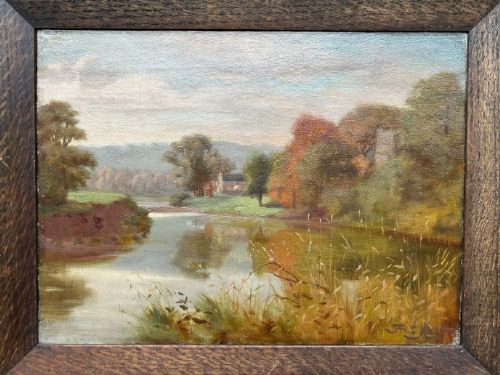
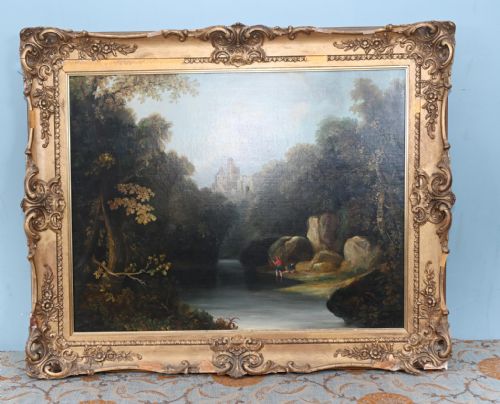


Framed Riverbank Oil Painting
A framed riverbank oil painting captures water, light, and rural life, offering a quiet window into past landscapes that suits any room.
Framed Riverbank Oil Painting
A framed riverbank oil painting depicts pastoral waterways, often featuring anglers, cattle, boats, or quiet stretches of water under changing skies. These works span the nineteenth century through the mid-twentieth century, capturing shifts from Victorian naturalism to impressionist and post-impressionist approaches.
You will encounter works from English country schools and French traditions alike, rendered on canvas and housed in period frames of gilt wood and gesso. The subjects range from anonymous views of lakes and rivers to named scenes by regional artists.
Many examples record specific locations such as Cumberland, the Teme, or the Kennett, while others present generalized pastoral settings populated by figures resting by the water or animals grazing on the bank.
Evaluating Quality
Quality rests in the artist's handling of light upon water and the naturalistic integration of figures or animals into the surrounding landscape. Stronger pieces demonstrate confident brushwork, depth of atmosphere, and a balanced composition that draws the eye along the river's course.
The integrity of the original canvas, stability of the paint layer, and the matching period frame contribute significantly to the enduring value and visual impact of the work.
Listings feature oil paintings on canvas spanning the nineteenth century through the 1960s, framed in gilt wood and gesso.
Frederick Marriott·Archibald Kay·Frank Hyde·William Manners·Phyllis Morgans·Harry Pennell·Constant Ludovic Artz·Henry Cheadle·T.B. Garvie·Robert John Hammond·Augustus William Ennes·Sonia Mervyn·Thomas E Francis·George Neil
The Framed Riverbank Oil Painting Glossary
- Impasto
- Paint applied thickly to a canvas, standing out in relief from the surface and catching the light. This technique adds tactile depth to water and foliage.
- Gesso
- A plaster-like mixture applied to wooden frame mouldings as a base for gilding or painting. It provides a smooth surface for detailed ornamentation.
- Gilt Wood
- Timber coated with gold leaf or metallic powder. It frames many nineteenth-century and vintage paintings to enhance their luminosity.
- Canvas
- Heavy woven fabric stretched taut across a wooden stretcher. It serves as the primary support for oil paint across the periods represented.
- Genre Painting
- Art depicting scenes from ordinary life, such as figures fishing or resting by a river. These works document social activities of the period.
Framed Riverbank Oil Painting: Frequently Asked Questions
How do I hang a heavy framed oil painting?
Ensure your wall fixings are secured directly into wall studs or use appropriate heavy-duty cavity anchors. Heavy gilt wood frames require robust picture wire and sturdy brass D-rings mounted securely to the wooden stretcher.
Position the centre of the painting at eye level for optimal viewing. Keep the work away from direct sunlight and strong heat sources to protect the canvas and oil pigments.
How can I tell the period of the painting?
Examine the style of brushwork, clothing of any figures depicted, and the construction of the wooden stretcher frame behind the canvas. Nineteenth-century works often feature tighter academic detail or naturalist composition, while mid-century pieces show looser impressionist brushwork.
Frame styles also offer strong clues, as Victorian gesso frames differ noticeably in profile from later twentieth-century mouldings.
What is the difference between an English and French river scene?
English river scenes from the nineteenth century tend to focus on narrative elements, local topography, and precise naturalism. French works from the period often lean towards Barbizon or impressionist atmospheric effects.
Both traditions utilise oil on canvas, but the treatment of light and shadow reflects the distinct regional schools of the artists.