



Framed Oriental Portrait
A framed oriental portrait captures the distinct likeness of Eastern subjects through traditional brushwork, woodblock printing and delicate pith painting.
Framed Oriental Portrait
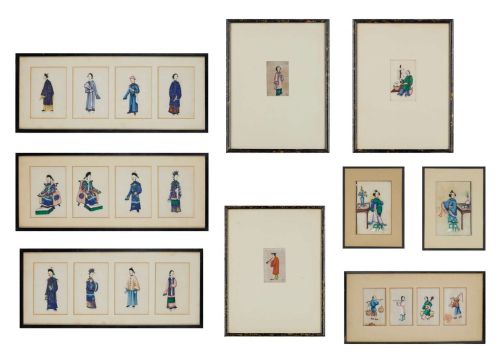
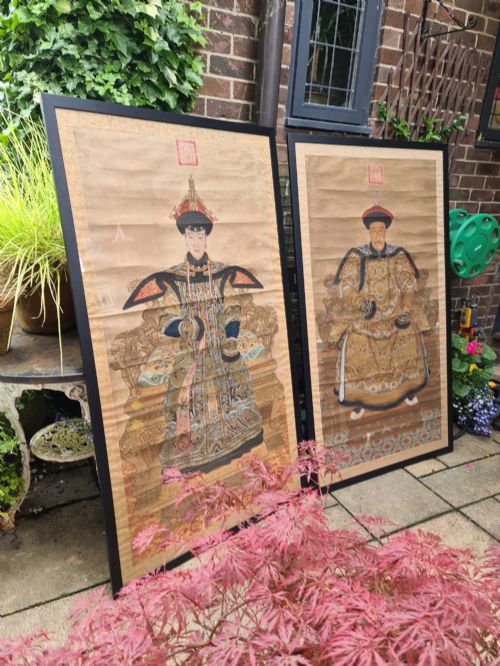
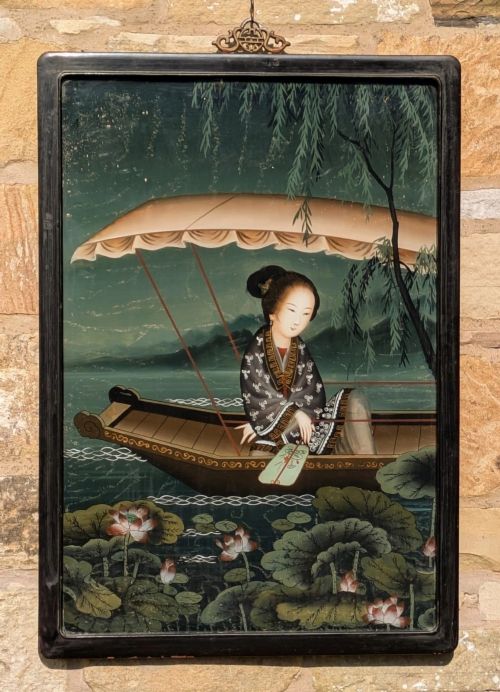
A framed oriental portrait presents figures from Chinese, Japanese, Indian and Middle Eastern traditions captured in various historic mediums. When searching for a framed oriental portrait, buyers encounter works ranging from large ancestral scrolls and reverse glass paintings to delicate woodblock prints and miniature gouaches.
The selection on this page draws heavily from nineteenth-century pieces alongside early twentieth-century examples. Common formats include pairs of ancestral portraits, figural pith paintings and Japanese ukiyo-e woodblock prints housed behind glass in period wood or rosewood frames.
Geographic origins span Qing dynasty China, Japan, India under Mughal influence and British depictions of Arab gentlemen. These portraits serve as both historical documents and striking decorative works suited for studies, hallways and drawing rooms.
How they were made
Artists utilised traditional surfaces such as delicate pith paper, woven silk, canvas and standard paper, applying pigments through gouache, watercolour, oil and ink. Chinese pith paintings rely on the spongy interior of the pith plant, absorbing vibrant pigments to yield luminous depictions of figures.
Japanese woodblock prints required precise carving of multiple blocks for distinct colour layers, often finished with silk brocade mounts. Reverse glass paintings involved applying oil or gouache directly to the rear of a glass panel so the image reads clearly from the front.
Frames play a crucial structural role, frequently utilising native timbers like rosewood or simple moulded wood to protect fragile paper and silk surfaces. Glazing shields these organic materials from atmospheric moisture and handling.
Framed Oriental Portrait Retail Price Guide 2026
Typical asking prices for framed oriental portrait among the pieces listed under this phrase on Sellingantiques today, from the lower quarter to the upper quarter. They describe what is for sale here now, not the wider market.
Several Victorian cats peer out from these frames, proving that feline companionship was just as captivating in nineteenth-century Japan as it is today.
What varies in quality
Material integrity significantly influences overall quality. Intact silk mounts, vibrant retained pigments on pith paper and original period frames command greater interest than heavily faded surfaces, water-stained paper or later replacement framing.
Frederick Goodall RA·Kitagawa Utamaro·Takabatake Kasho·Kunisada·Takashi Nakayama
The Framed Oriental Portrait Glossary
- Pith painting
- A delicate artwork created on the spongy internal cellular tissue of the Tetrapanax papyrifer plant. This medium requires a gentle touch as the material is inherently fragile.
- Reverse glass painting
- An image applied directly to the back of a glass panel, viewed from the unpainted front surface. This technique produces a glossy finish that protects the pigments from dust.
- Ukiyo-e
- A genre of Japanese art flourishing from the seventeenth through nineteenth centuries, depicting scenes of everyday life and notable figures. These works are typically produced as woodblock prints.
- Ancestor scroll
- A formal hanging portrait commissioned to honour family forebears in Chinese tradition. These pieces often display sitters in formal robes with meticulous attention to rank insignia.
- Gouache
- An opaque water-based pigment containing a binding agent, yielding a flat matte finish. Indian miniatures frequently employ this medium for rich colour saturation.
Framed Oriental Portrait: Frequently Asked Questions
How should I hang a framed oriental portrait?
Hang these works away from direct sunlight to prevent the fading of delicate watercolours, inks and dyed silks. Maintaining a stable indoor humidity protects organic supports like pith paper and woodblock prints from warping.
Ensure the wall fixings match the weight of the frame, particularly for large reverse glass paintings or heavy ancestral scrolls housed in rosewood.
What is the difference between pith paintings and rice paper?
Nineteenth-century pith paintings are frequently misidentified as rice paper due to the porous texture of the plant material used. Pith is actually sliced from the pith plant stem, yielding a velvety, slightly cushioned surface that absorbs gouache with exceptional brilliance.
Rice paper is made from various plant fibres pressed into a flat sheet, whereas pith retains a distinct cellular structure visible under close inspection.
Are these portraits in their original frames?
Many nineteenth and early twentieth-century pieces retain their period wooden or rosewood frames, sometimes accompanied by silk brocade mounts. Original frames often display minor signs of age that complement the historic nature of the artwork.
When replacement framing occurs, it is typically undertaken to ensure the continued preservation and structural security of fragile paper or glass elements.
How do I identify Japanese woodblock prints?
Japanese woodblock prints from the Edo and Meiji periods feature crisp outlines and distinct blocks of colour transferred from carved timber matrices. They often incorporate traditional calligraphy stamps, signatures and specialised border mounts.
Examining the paper through a loupe can reveal the subtle impression left by the printing block into the fibres.