




Framed Miniature Watercolour Pair
These framed miniature watercolour pair selections offer intimate portraits executed with delicate precision across the Georgian and 19th Century periods.
Framed Miniature Watercolour Pair
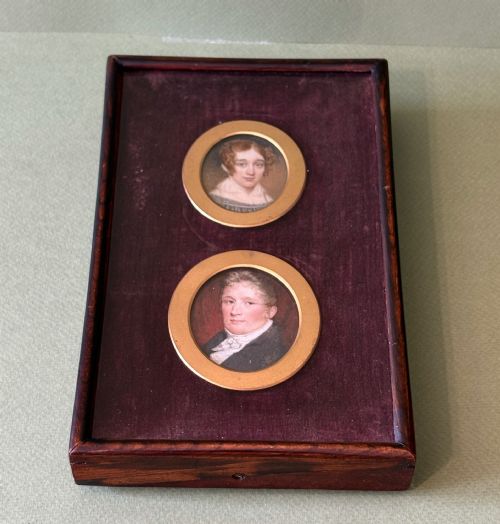
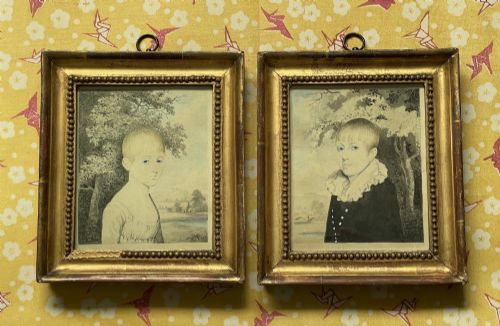
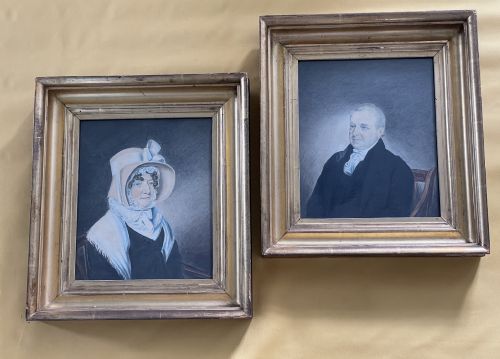
A framed miniature watercolour pair brings together companion portraits or studies executed on paper, designed to hang alongside one another as matched sets. These works span the Georgian, Regency, William IV, and Victorian periods, capturing subjects ranging from children and husbands and wives to character studies and American Folk Art. You are most likely to encounter oval portrait miniatures and companion oval watercolours framed in wood, giltwood, or rosewood.
The subjects depicted often include named sitters with annotations to the rear detailing their history, as well as works attributed to established portraitists. These pairs provide a direct window into historical portraiture on an intimate scale, preserved within their original protective glass and timber frames.
How they were made
Artists painted these delicate works directly onto paper using fine watercolours, capturing intricate details of costume and expression with minuscule brushstrokes. The resulting miniature paintings require steady hands and precise control over pigment and water due to their restricted scale.
To protect the delicate paper surface, these pieces are housed beneath glass and set within timber frames fashioned from rosewood, wood, or giltwood, often enhanced with brass or gold leaf accents. Many retain their original backing and annotations, showing the traditional methods used to seal and preserve portrait miniatures.
Framed Miniature Watercolour Pair Retail Price Guide 2026
Typical asking prices for framed miniature watercolour pair among the pieces listed under this phrase on Sellingantiques today, from the lower quarter to the upper quarter. They describe what is for sale here now, not the wider market.
Some subjects danced their way through history, leaving behind a mother and child caught mid-movement in watercolour.
What varies in quality
The refinement of the brushwork and the psychological depth of the portraiture distinguish the finest examples from simpler folk art renderings. Master hand execution in watercolour achieves subtle flesh tones and textural rendering of fabrics that less accomplished hands miss.
The preservation of the original framing materials, including giltwood, rosewood, and glass, impacts the integrity of the piece. Pairs that retain contemporary annotations, signatures, and matching frames offer greater historical completeness.
George Hargreaves·Thomas Woolnoth·Henry Edridge
The Framed Miniature Watercolour Pair Glossary
- Miniature portrait
- A small-scale painting, typically executed in watercolour on paper or vellum, focusing on an individual likeness. These works demand extreme precision from the artist.
- Companion pair
- Two matching artworks created by the same hand or studio to be displayed together. They frequently depict husbands and wives or family members.
- Giltwood
- Wood that has been coated with a thin layer of gold leaf or gilt gesso. This finish provides a bright, reflective border around the watercolour.
- Rosewood
- A dense, heavily figured timber often utilised for nineteenth-century picture frames. Its dark grain contrasts sharply with the gilt inner mounts.
- Oval
- A curved, rounded geometric shape frequently chosen for miniature portrait frames during the Georgian and Regency eras. This format softens the composition.
Framed Miniature Watercolour Pair: Frequently Asked Questions
How should I hang a framed miniature watercolour pair?
Display these companion pieces at eye level in a room with controlled lighting away from direct sunlight. Direct exposure to strong light can fade the delicate watercolours on paper over time.
Keep them away from damp environments like kitchens or bathrooms to protect the paper, timber frames, and glass sealing from moisture damage.
Why were companion pairs painted?
Companion pairs were traditionally commissioned to commemorate marriages, family relationships, or notable individuals. Having two portraits ensured that husbands and wives or family members remained visibly linked on the wall.
Artists produced these matched sets to be framed identically, creating a balanced decorative and sentimental display within the home.
How do I identify a Georgian miniature from a Victorian one?
Georgian miniatures often feature softer, more romantic pastel palettes and distinct costume details like powdered hair or high-waisted Regency dress. The framing materials and handwritten notes on the reverse also help establish the correct era.
Victorian examples frequently display darker wood frames, more rigid photographic influences in pose, and detailed biographical annotations written on the back of the backing board.
Are these watercolours painted on ivory or paper?
The listings on this page specifically utilise paper as the support medium for these watercolour paintings and portrait miniatures. Paper provides a stable absorbent surface for the delicate washes of pigment.
Examining the surface closely under magnification reveals the characteristic texture of the paper beneath the transparent watercolour layers.