



Framed Horse Watercolour
A framed horse watercolour brings the movement and character of equestrian subjects into a room through delicate washes on paper.
Framed Horse Watercolour
A framed horse watercolour gathers together equestrian scenes, hunting depictions, and rural working animals rendered on paper. The selection leans heavily toward British sporting art, Victorian pastoral scenes, and Edwardian watercolours.
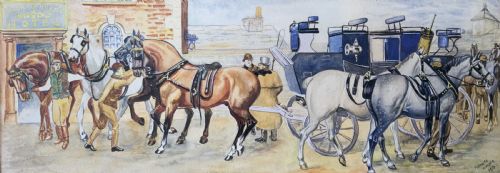
Buyers will encounter single character studies of horses, coaching scenes, and racing paintings spanning from the nineteenth century into the mid-twentieth century. Works range from detailed rural landscapes featuring plough teams to lively hunting sequences and racing sketches.
The framing typically matches the age of the paper, protecting delicate pigments behind glass within timber mouldings. These pieces capture horses at rest in stables, working in fields, and moving at speed across countryside courses.
Materials and execution
Artists relied on watercolour pigment and gouache applied to paper, occasionally combining ink line work to define the muscle and form of the horses. The transparent quality of the paint allows the white of the paper to provide natural highlights.
Support materials include traditional paper sheets housed under glass within wooden frames, which safeguard the water-soluble pigments from moisture and handling. Many examples incorporate period oak or moulded timber frames that complete the presentation.
The listings span from the early eighteenth century through the nineteenth century and into the mid-twentieth century.
Distinctions in execution
The distinction between works rests on the artist's command of anatomy, movement, and light within the medium of watercolour. Masterful brushwork captures the tension of a racing horse or the heavy build of a work animal with economy and precision.
Preservation of the paper and the vibrancy of the watercolour pigment dictate the visual strength of the piece over time. Strong tonal contrast and minimal fading distinguish finer examples from more muted, secondary studies.
Albert Ludovici Jnr·John Rattenbury Skeaping·James William Booth·Basil Nightingale·John Augustus Atkinson·Helena Maguire·George Hamilton Constantine·Rowland Henry Hill·Thomas Mackay·Adrian Jones·Will Anderson·Basil Bradley·John Sanderson Wells·David Woodlock·Charles H Poingdestre·Snaffles·William Manners·Charles Johnson Payne·Johan Noah Bemmel·Frank Dadd·Fred Lawson
The Framed Horse Watercolour Glossary
- Gouache
- An opaque watercolour paint that provides heavier coverage and solid highlights. It is frequently combined with transparent watercolour to add depth to equestrian subjects.
- Sporting Art
- A genre dedicated to depictions of equestrian sports, hunting, racing, and animals in the field. This tradition forms a core element of the works presented here.
- Genre Watercolour
- A painting style that depicts scenes from everyday life, often including figures, horses, and rural workers. These pieces record social history alongside artistic skill.
- Equestrian
- Pertaining to horses and horseback riding. The term describes the primary subject matter found across these nineteenth and twentieth-century sheets.
Framed Horse Watercolour: Frequently Asked Questions
How should I hang a framed horse watercolour?
Keep watercolours away from direct sunlight to prevent the pigments from fading across the paper surface over time. Hang them on interior walls where humidity and temperature remain stable.
Ensure the protective glass is clean and that the wooden frame is securely hung from appropriate picture hooks to support the weight safely.
What periods do these watercolours represent?
The pieces span from the early eighteenth century through the nineteenth century and into the mid-twentieth century. Victorian and Edwardian examples are particularly common in this selection.
Earlier works include eighteenth-century equestrian drawings, while later pieces extend into mid-century gouache and watercolour paintings.
Are these watercolours original works?
The listings feature original hand-painted watercolours, drawings, and sketches rather than modern reproductions or prints. Each piece is an individual creation by the named artist.
Signatures, framing styles, and paper characteristics help confirm the authenticity and period of each specific artwork.
What subjects feature in these horse watercolours?
Subjects range from hunting scenes and horse racing events to quiet rural moments involving plough teams and cart horses. Artists captured both working animals and sporting horses in varied countryside settings.
Some works focus on specific historical events or urban street scenes featuring cabs and cavalry horses.