
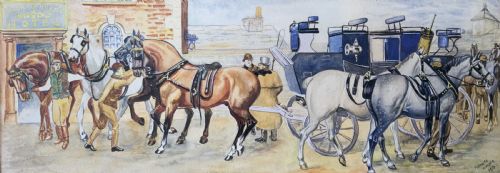


Brown Equestrian Watercolour
These brown equestrian watercolour paintings bring working horses, hunting fields, and racing scenes to life through historic pigment on paper.
Brown Equestrian Watercolour
A brown equestrian watercolour captures horses, coaches, plough teams, and sporting scenes across periods spanning the Georgian era through to the mid-twentieth century. Buyers encounter works rendered in traditional watercolour pigments, ink, and gouache, often framed in oak under glass.
The selections on this page range from nineteenth-century Victorian sporting art and British Impressionism to mid-century modern racing depictions. Common subjects include coaching scenes, greyhounds, working farm horses, and mounted hunt parties.
Works originate from British and French hands, showing both detailed narrative compositions and swift plein-air studies on paper. These paintings serve as historical records of equestrian life and working animals from past centuries.
Materials and methods
Artists painted these works using watercolour pigments and gouache applied directly to paper, sometimes supplemented with ink lines to define forms and figures. Pigments were layered to create depth in the horse coats, landscapes, and skies.
Many of these works survive within period wood and oak frames, protected behind glass to preserve the delicate paper supports. The combination of water-soluble pigments on paper demanded precise brushwork and control from the artist.
Listings feature periods from the Georgian era through Victorian and Edwardian times up to mid-century modern.
Evaluating quality and execution
Quality rests in the draughtsmanship of the horse anatomy, the vitality of movement in subjects like racing or hunting, and the preservation of the paper and pigment. Signed works by documented artists command greater attention than unsigned studies.
The handling of light and atmosphere separates competent illustrations from masterly compositions, particularly in complex multi-figure scenes such as horse fairs or cavalry clashes.
Herman S Melville·John Rattenbury Skeaping·John Augustus Atkinson·Helena Maguire·Adrian Jones·Charles Clifford Turner·Tom Carr·Snaffles·George Cattermole·Charles James Adams
The Brown Equestrian Watercolour Glossary
- Watercolour
- A painting method in which the paints are made of pigments suspended in a water-based solution. It is traditionally applied to paper supports.
- Gouache
- An opaque water-based paint that includes a white pigment filler, giving a heavier, more solid coverage than transparent watercolour. It is frequently combined with watercolour in equestrian works.
- Sporting Art
- Genre of art depicting blood sports, racing, coaching, and animals. It forms a major category within these equestrian paintings.
- Victorian Genre Art
- Painting style depicting scenes from everyday life of the nineteenth century. These pieces often record working animals and rural labour.
Brown Equestrian Watercolour: Frequently Asked Questions
How should I frame and display a watercolour?
Keep watercolours away from direct sunlight to prevent the pigments from fading over time. Conservation framing with UV-protective glass helps preserve the paper.
Ensure the painting does not touch the glass directly by using a mount. This prevents moisture damage and preserves the paper surface.
What subjects appear most frequently in these paintings?
Common subjects include hunting scenes, horse racing, coaching inns, plough teams, and rural horse fairs. These reflect the central role of horses in transport and sport.
Many pieces also depict military cavalry actions and stable scenes, highlighting nineteenth-century working life.
How can I tell the age of a watercolour?
Dating relies on the artist signature, stylistic markers of periods like Georgian or Edwardian, and framing materials. Paper quality and framing techniques also offer clues.
Comparative study with dated works by the same maker helps narrow the period of creation.
Are these paintings signed by the artists?
Many examples feature artist signatures, monograms, or inscriptions detailing the scene. Unsigned works are also common among period studies.
Attribution for unsigned pieces often depends on style, provenance, and subject matter matching known hands.