
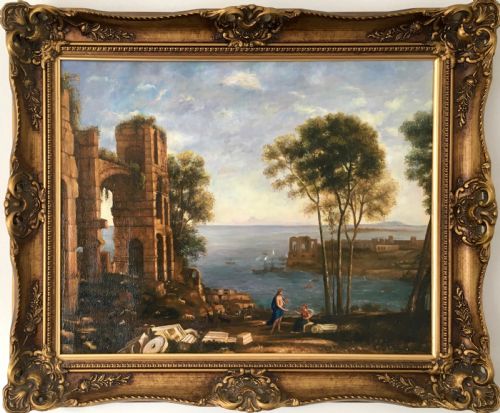
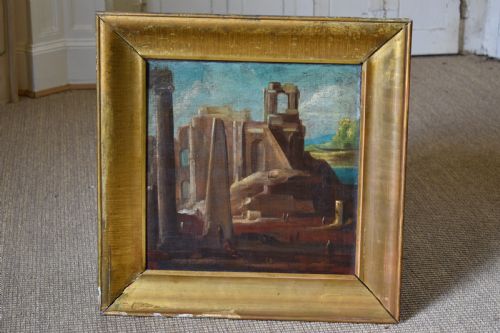
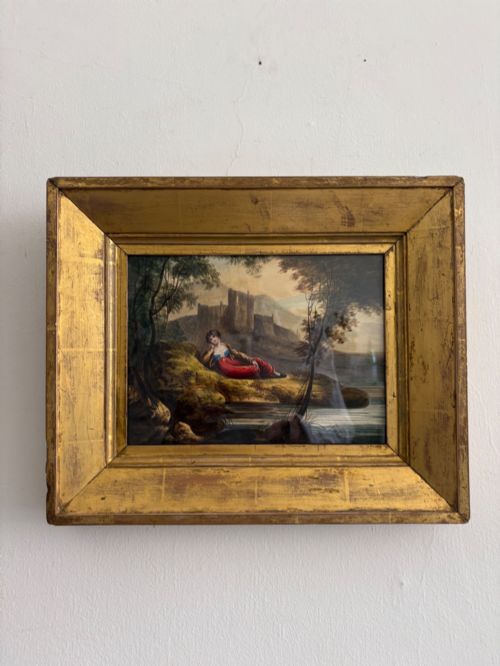
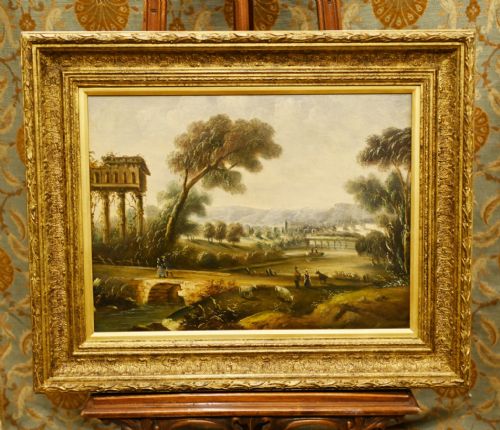


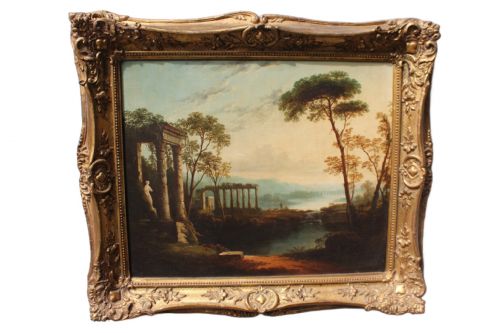


Framed Classical Ruins Artwork
Framed classical ruins artwork brings ancient architectural remnants and Mediterranean landscapes into British homes, capturing centuries of scholarly travel and romantic landscape vision.
Framed Classical Ruins Artwork
Framed classical ruins artwork captures the enduring European fascination with ancient Rome and Greece through painted landscapes, watercolours, and detailed architectural prints. Buyers seeking framed classical ruins artwork encounter pieces ranging from eighteenth-century Italian canvases to nineteenth-century Grand Tour watercolours and gouaches.
The subjects frequently record specific Italian landmarks, such as the Roman Campagna, the Forum, and the Colosseum, alongside imaginative capriccio compositions. Many examples arrive in period gilded wooden frames that complement the classical subject matter.
Nineteenth-century watercolours and gouaches from travel destinations dominate the selection, often depicting specific archaeological sites like Pompeii alongside pastoral Italianate scenery. Eighteenth-century oils and etchings also appear, connecting directly to the historical Grand Tour tradition.
Materials and techniques
Artists executed these works using oil on canvas, delicate watercolours, and opaque gouache upon paper, frequently framed behind glass within gilded wood. Etchings on paper provide another primary medium, capturing fine architectural linework for bound collections later framed for display.
Makers of the era housed these works in timber frames enhanced with gold leaf and gilt decoration to suit domestic display. The physical construction relies on traditional joining for wooden frames and high-rag content papers that survive from the eighteenth and nineteenth centuries.
Nineteenth-century tourists in Pompeii routinely hired local artists to paint watercolours of their excursion before the ink on their travel journals even dried.
Distinctions in quality
Quality separates unsigned student output or decorative souvenirs from accomplished works by named artists and skilled contemporary circles. Finer examples demonstrate superior command of perspective, atmospheric lighting, and accurate architectural detailing of ancient structures.
The preservation of the paper support, the vibrancy of watercolour and gouache pigments, and the originality of the accompanying period gilt frame influence the overall standard. Works carrying signatures or documented associations with known painters command higher regard among collectors.
Giovanni Paolo Panini·Claude Lorrain·Franz Knebel·Francesco Piranesi·Francesco Zuccarelli·Francesco Guardi·William Crouch
The Framed Classical Ruins Artwork Glossary
- Grand Tour
- The traditional journey through Europe, chiefly Italy, undertaken by wealthy young men in the seventeenth through nineteenth centuries to study classical art and architecture. Watercolours and paintings purchased during these travels form a core category of these artworks.
- Capriccio
- An architectural fantasy placing together ancient ruins, buildings, and other architectural elements in a fictitious compositional landscape. This style allowed artists to compose idealised Italianate scenes.
- Neoclassical
- The decorative and fine arts style inspired by the classical antiquity of Ancient Greece and Rome, prevalent from the mid-eighteenth through the early nineteenth century. Works in this style emphasise symmetry, classical motifs, and architectural dignity.
- Gouache
- An opaque water-based paint that dries to a matte finish, frequently utilised in nineteenth-century Italian landscape and architectural painting. It allows for rich colour saturation and strong tonal contrast on paper.
- Italianate
- A style of painting and landscape design that incorporates elements of Italian architecture and topography, such as rolling hills, ruined columns, and classical temples.
Framed Classical Ruins Artwork: Frequently Asked Questions
What is a Grand Tour watercolour?
A Grand Tour watercolour is a landscape or architectural painting acquired by travellers visiting classical sites in Italy during the eighteenth and nineteenth centuries.
These works served as visual records of ancient ruins like the Colosseum or Pompeii before the advent of modern photography.
How do I date an 18th-century ruin painting?
Dating relies on examining the canvas or paper substrate, the preparation of the wooden stretcher or frame, and the painting technique.
Eighteenth-century works often employ organic oil pigments on panel or lined canvas, paired with hand-carved gilded wooden frames characteristic of the period.
Where should I hang classical ruin art?
These artworks suit traditional studies, libraries, and living rooms where their warm gilt frames and historical subjects complement classic interior schemes.
Keep them away from direct sunlight to protect vulnerable watercolours and gouaches painted on paper from fading.
What is the difference between a capriccio and a real view?
A real view depicts actual archaeological sites and landscapes topographically, whereas a capriccio combines real and imaginary ruins into a single invented composition.
Artists used capriccios to create harmonious romantic landscapes rather than precise historical records.