




Framed Beach Scene Artwork
These framed beach scene artwork pieces capture coastal life through oil and watercolour, offering a direct window into nineteenth and twentieth century shores.
Framed Beach Scene Artwork
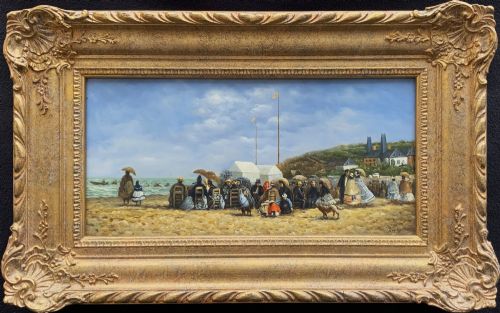
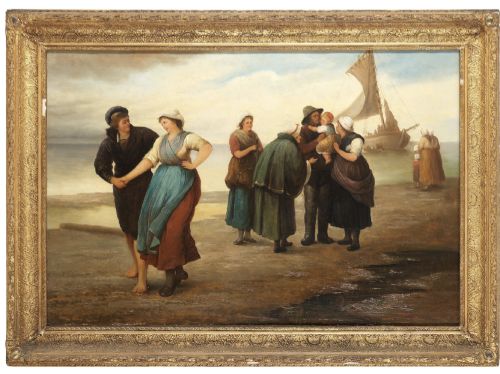
A framed beach scene artwork brings together coastal views, harbour mouths and figures upon the shore, captured primarily in oil and watercolour. These paintings document marine life from fishing boats on British sands to French seaside gatherings and Dutch fisherwomen.
The pieces on this page span from Victorian marine landscapes to later Post-Impressionist interpretations. Collectors encounter works executed on canvas, paper and panel, each retaining its original character through period framing.
British Impressionism, the Newlyn school and continental European traditions all contribute to the range of available shoreline depictions. Works focus variously on bustling port activity, quiet tidal flats and figures resting beside beached vessels.
Materials and execution
Artists relied upon oil paint applied to canvas or wood panels, alongside delicate watercolours laid down on paper. These mediums allowed painters to render changing coastal light, sea spray and damp sand with appropriate fluidity or texture.
Framing forms an integral part of the physical object, utilising moulded wood, gold leaf gilding and hand-enamelled polychrome finishes. Ebonised and giltwood surrounds protect the paper or canvas while completing the visual presentation of the artwork.
Several Victorian artists evidently spent long hours watching children and fisher folk muddy their boots on the tide-swept sands.
Distinctions in quality
Superior works demonstrate a confident handling of light and atmospheric depth, where brushwork or watercolour washes accurately convey the movement of water and the weight of coastal clouds. Lesser examples rely on rigid perspective and formulaic placement of figures.
The harmony between the painting and its frame contributes significantly to overall quality. Original giltwood or hand-finished surrounds that complement the palette of the canvas elevate the piece far above later replacement framing.
James Orrock·William Banks Fortescue·George Hamilton Constantine·James Webb·Sir William Russell Flint·Frederick William Hattersley·Ernest F Hill·Jeffrey Pratt·William Shayer·Owen Bowen·Robert Macaulay Stevenson·Madeline Hughes·William Greaves·William Edward Webb·George Smith·GM de L'Aubiniere·Daniel Sherrin·Yves Brayer·Markey Robinson·Charles McAuley·Thomas Bush Hardy·Henri Cadiou
The Framed Beach Scene Artwork Glossary
- Watercolour
- A paint consisting of pigment suspended in a water-soluble binder, traditionally applied to paper to achieve translucent washes of colour.
- Giltwood
- Wood carved and coated with a thin layer of gold leaf, commonly utilised for decorative picture frames during the Victorian era and earlier.
- Post-Impressionism
- An artistic movement following Impressionism that extended its use of vivid colours while emphasising geometric forms and expressive qualities.
- Marine landscape
- A genre of art focusing primarily on the sea, ships, harbours and coastal shores rather than inland topography.
- Ebonised
- Wood treated with a chemical stain or finish to simulate the dark, dense appearance of ebony.
Framed Beach Scene Artwork: Frequently Asked Questions
What periods do these beach scenes come from?
The selection spans from the Victorian era and late nineteenth century through to mid twentieth century movements. Works reflect changing artistic approaches across several decades.
Dates range from early nineteenth century studies up to works created in the 1960s, showing evolving interpretations of coastal subjects.
How should I care for watercolour beach scenes?
Watercolour paintings require protection from direct sunlight to prevent the pigments from fading over time. Glazing helps shield the delicate paper surface from atmospheric moisture.
Keeping them away from damp environments ensures the paper and any underlying board remain stable and free from discolouration.
Are original frames important for these artworks?
Original frames provide historical context and often complement the aesthetic of the period in which the artist worked. Giltwood and ebonised surrounds matched to the painting enhance its overall integrity.
Replacing a period frame can alter the intended presentation, making pieces retaining their original surrounds particularly desirable.
What distinguishes marine paintings from standard landscapes?
Marine paintings focus centrally on the sea, tidal shores, maritime vessels and coastal weather conditions rather than terrestrial scenery. They capture the specific atmosphere of coastal communities and maritime activity.
Artists working in this genre frequently studied tidal movements and harbour life to achieve accurate depictions of shorelines.