
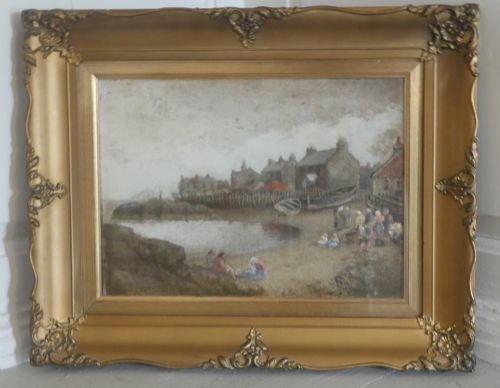


Vintage Seaside Oil Artwork
These vintage seaside oil artwork pieces capture coastal scenes through oil paint on canvas or board from the nineteenth and twentieth centuries.
Vintage Seaside Oil Artwork
When you search for vintage seaside oil artwork, you encounter coastal scenes rendered in oil paint across various periods, including the Victorian era, the nineteenth century, and mid-twentieth century movements. The most common version met on this page is a painted view of a British or French beach, harbour, or cliff rendered in an impressionist or realist manner.
These works range from topographical records of pleasure piers and fishing villages to atmospheric impressions of figures on the shore. They span multiple decades of artistic output, showing how painters approached the shifting light and expansive spaces of the coast from the eighteen-hundreds through to the nineteen-sixties.
How they were made
Artists painted these coastal views using oil paint applied to either stretched canvas or wooden board. Many works utilised heavy impasto or fluid brushstrokes to convey the movement of water and the texture of sandy shores.
Framing often involved gilt wood mouldings that complemented the palette of the composition. The physical support - whether woven canvas or rigid board - dictated how the artist built up layers of pigment to capture the light of the seaside.
The selection includes oil paintings on canvas and board from the Victorian era up to the nineteen-sixties.
What varies in quality
The strength of a composition rests on the artist's handling of coastal light and atmospheric perspective. Superior examples demonstrate a confident control of brushwork that captures the specific mood of a tide or shoreline without excessive detail.
The clarity of provenance and the strength of the signature also distinguish works. Paintings that securely link a named painter to a specific coastal location carry greater art historical interest.
Clifford Hanney·Edward Mills·Norman Lloyd·William J B Jenkins·William Raymond Dommersen·Alfred Henry Vickers·Jack R Mould·John Sanderson Wells·Robert Macaulay Stevenson·William Greaves·James Watson·Alfred Egerton Cooper·Harry John Pearson
The Vintage Seaside Oil Artwork Glossary
- Impressionism
- A style of painting that focuses on light and its changing qualities rather than precise details. Artists working in this manner often used rapid, visible brushstrokes.
- Board
- A rigid wooden or fibrous panel used as a support for oil painting instead of stretched canvas. It offers a firm surface that artists frequently utilised for plein air studies.
- Fauvism
- A modernist style characterised by strong, non-naturalistic colours and bold brushwork. Paintings in this manner prioritise painterly qualities and expressive colour over realistic representation.
- Topographical
- Representing specific real-world locations with a degree of geographic accuracy. Such works often serve as historical records of coastal towns and piers.
- Gilt wood
- Wood that has been treated with a thin layer of gold leaf or metallic gilt finish. It is commonly found on the traditional frames housing these oil paintings.
Vintage Seaside Oil Artwork: Frequently Asked Questions
What periods do these paintings cover?
The works span from the Victorian period through the nineteenth and twentieth centuries, reaching into the nineteen-sixties.
They reflect shifts in painting styles across multiple decades of coastal representation.
Are these works painted on canvas?
Painters used both stretched canvas and wooden board as supports for their oil pigments.
The choice of material often depended on whether the artist worked in a studio or outdoors by the shore.
Which coastal locations are shown?
Represented sites include various British seaside spots such as Whitby, Polperro, and Robin Hoods Bay, alongside French and Italian views.
Topographical details help identify specific piers, cliffs, and harbours from the past.
How should I frame an oil painting?
Many of these works retain their original gilt wood frames, which complement the tones of the oil paint.
Choosing a frame that suits the period of the artwork helps preserve its historical character.